
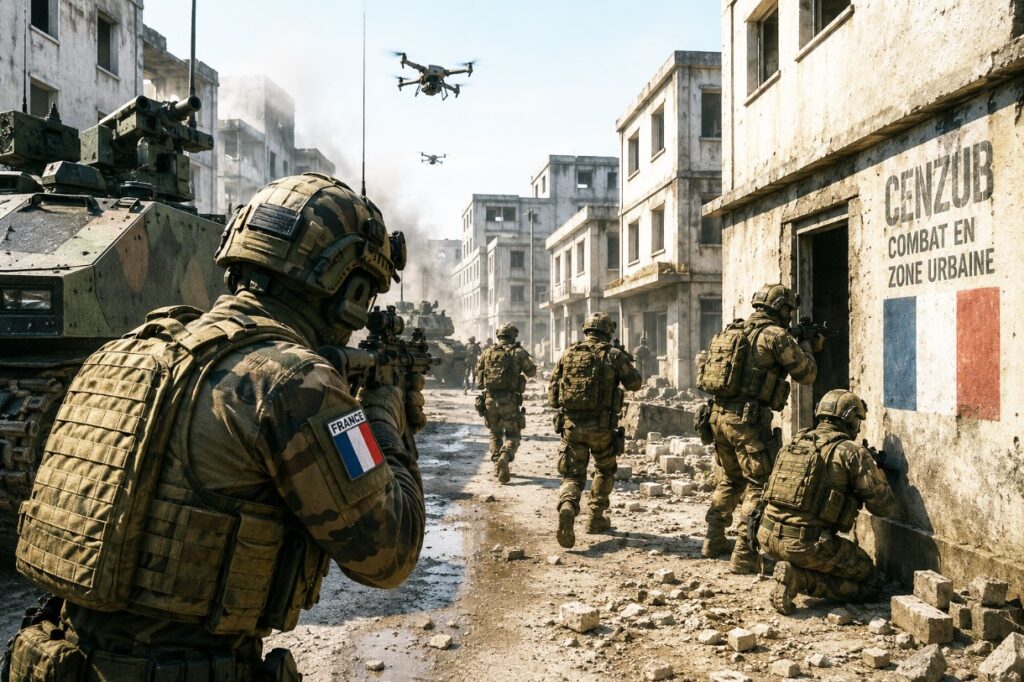
Just days before the celebrations for France’s National Day on July 14, the French Army is placing a focus on an area of training that long received little public attention: combat in urban terrain. While soldiers, vehicles and aircraft demonstrate military strength on the Champs-Élysées, the land forces are preparing under realistic conditions for a scenario that military planners now consider particularly likely: fighting in densely populated cities against a technologically equal opponent.
As part of the large-scale ORION 2026 exercise, numerous units of the French Armed Forces are undertaking a demanding training program designed to reflect the requirements of modern high-intensity conflicts.
Cities Are Becoming the Battlefield of Modern Wars
The experiences of recent years have fundamentally changed military planning. Whether in Mariupol, Bakhmut or Gaza, current conflicts show that cities are increasingly becoming the focal point of military confrontations. Urban environments offer tactical advantages and disadvantages to attackers and defenders alike. Multi-story buildings, industrial facilities, tunnels, sewers and densely built residential districts hinder reconnaissance as much as troop mobility.
For modern armies, this means a profound shift in operational doctrine. Urban warfare has always been among the most demanding military disciplines. Visibility is limited, threats can emerge from any direction, while the danger to civilians remains especially high. Every decision must be made within seconds and can have far-reaching consequences.
Training Under Realistic Conditions
To train for these complex requirements, France has specially designed training centers in which entire neighborhoods have been recreated. There, soldiers move through streets, apartment buildings, schools, administrative buildings and industrial facilities that simulate operational conditions as realistically as possible.
The exercise scenarios go far beyond conventional infantry engagements. In addition to urban combat, units must deal with drone reconnaissance, electronic warfare, improvised explosive traps and surprise attacks from underground infrastructure. At the same time, they must protect civilians and comply with the strict rules of engagement of modern armed forces.
It is not only infantry troops that train. Armored units, engineers, artillery, reconnaissance units and command staffs also practice coordinated interaction. The aim is to achieve the closest possible integration of all branches of service under the conditions of high-intensity combat.
ORION 2026 as a Strategic Stress Test
Urban warfare training is part of the large-scale ORION 2026 exercise, the most extensive French Armed Forces exercise in several decades. More than 12,000 service members, around 1,800 military vehicles, several dozen helicopters and hundreds of drones are taking part in the various phases of the exercise. Several European partner states are participating alongside the French Armed Forces.
The scenario simulates a high-intensity conflict between states with comparable military capabilities. Unlike the overseas operations of the past twenty years, which were often conducted against irregular opponents, the focus this time is on national and collective defense. Air forces, the navy, cyber forces, space components and land forces are brought together within a joint operational framework.
The exercise serves not only tactical training but also the testing of new command structures and decision-making processes under time pressure. Artificial intelligence, modern communication systems and digital operational pictures are intended to increase the speed of military decisions while improving interoperability with NATO partners.
Lessons From the War in Ukraine
Few conflicts have influenced military planning in Europe as profoundly as Russia’s war of aggression against Ukraine. The fighting over cities such as Mariupol, Sievierodonetsk and Bakhmut has demonstrated the importance of urban combat in a modern large-scale war.
Particularly striking is the massive use of unmanned systems. Small reconnaissance drones provide real-time information on enemy movements, while armed drones carry out attacks on vehicles or positions. At the same time, electronic warfare has become a decisive factor. Communication networks are disrupted, GPS signals manipulated and drones countered electronically.
These developments are being incorporated directly into French training. Soldiers are no longer training exclusively for conventional urban warfare, but for operating on a digitally networked battlefield where sensors, drones and information superiority have become as important as firepower and mobility.
CENZUB as a European Center of Excellence
The Centre d’entraînement aux actions en zone urbaine (CENZUB) in Sissonne plays a key role in this effort. The training center is considered one of Europe’s most advanced facilities for urban combat and trains several thousand French and allied soldiers each year.
The training city built there includes numerous buildings of different sizes and uses. It enables the realistic simulation of complex combat situations, from residential blocks to industrial facilities. Training takes place under conditions that are as authentic as possible and is regularly adapted to new findings from current conflicts.
The French Armed Forces now regard the center as an indispensable component of their preparation for possible future operations within Europe’s security architecture.
France’s military orientation underscores a fundamental shift in security policy priorities. After decades of asymmetric operations against terrorist organizations, the focus is increasingly on the ability to wage a conventional high-intensity war against an equal opponent. The urban environment plays a central role in this. Behind the National Day celebrations, it becomes clear how consistently the French Armed Forces are preparing for the forms of conflict that could shape Europe’s future security environment.
Author: P. Tiko