
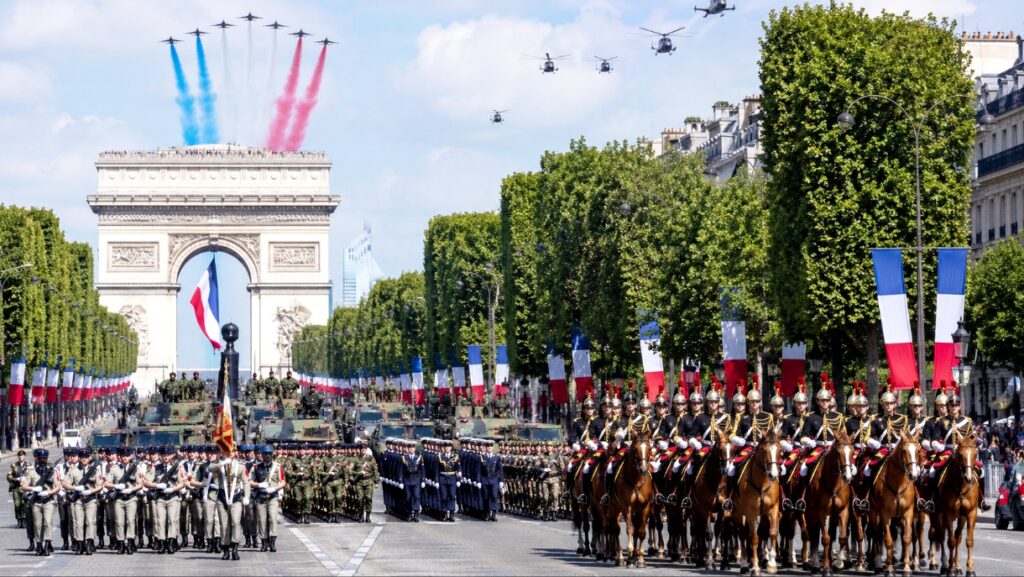
When the military parade marches down the Champs-Élysées on 14 July, France is not merely celebrating its national holiday. The ceremony is at the same time a demonstration of the state’s capacity to act, military operational readiness and republican tradition. This year, in light of the war in Ukraine, persistent crises in the Middle East and an increasingly tense international security situation, the event takes on an additional political dimension. With around 6,800 participants, more than 300 military vehicles and over 100 aircraft, the parade remains one of Europe’s largest military ceremonies.
One of Europe’s largest military parades
This year’s parade brings together a total of 6,800 women and men, 315 military vehicles, 200 horses of the Republican Guard, of which 193 are ridden, as well as more than 100 aircraft and helicopters. France thus once again underscores the importance of 14 July as a national symbol and showcase for its armed forces.
The core of the parade consists of units from the Army, the Air and Space Force and the Navy. They are joined by formations from the National Gendarmerie, the National Police, the Paris Fire Brigade and Civil Protection. In total, around 5,600 military personnel march on foot down the Champs-Élysées, representing the various capabilities of France’s security and defence bodies.
Modern equipment as a visible sign of transformation
Alongside the marching units, the technological modernization of the armed forces is a central focus. A total of 315 vehicles take part in the parade. These include the new Griffon multirole armored vehicles, Jaguar reconnaissance and combat vehicles, modern logistics vehicles, as well as engineering equipment and special vehicles.
The systems on display exemplify the French Army’s broad modernization program. For several years, Paris has been investing significantly in new capabilities to respond both to the requirements of high-intensity conflicts and to hybrid threats and international missions abroad. The parade therefore serves not only a representative function, but also offers an image of the technological development of the French armed forces.
Tradition and Republican self-image
For decades, one of the best-known elements of the parade has been the Republican Guard. With its 193 mounted guards, it combines military ceremony with an equestrian tradition spanning several centuries. Its performance is regularly one of the highlights of the event and symbolizes the continuity of state institutions.
It is precisely this contrast between historical tradition and modern military technology that gives the parade its distinctive character. France sees the ceremony not only as a demonstration of military capability, but also as an expression of republican identity and the continuity of the state.
The Air Force opens the celebrations
The opening of the celebrations is traditionally entrusted to a flyover by the air force. More than 90 aircraft take part, including Rafale and Mirage 2000 fighter jets, A400M transport aircraft, and aerial refueling tankers. The formation is completed by around 30 helicopters with various operational profiles.
As every year, the conclusion of the air parade is entrusted to the Patrouille de France, whose aerobatic team paints the French national colors—blue, white, and red—across the skies of Paris. This moment is among the most famous images of the French national holiday.
Military parade in a changed geopolitical landscape
This year’s edition takes place in a profoundly changed security environment. Russia’s war of aggression against Ukraine, tensions in the Middle East, and increased European efforts toward a more autonomous defense capability shape the strategic situation. France therefore places greater emphasis on the operational readiness of its armed forces and their ability to operate simultaneously across different theaters.
At the same time, several foreign military delegations are once again taking part in the parade. Their presence highlights France’s close cooperation with its international partners and demonstrates the importance of military cooperation in Europe and beyond.
The military parade on 14 July is therefore far more than a national festive ceremony. It combines history, symbolism and current security policy in an event that has an impact both within and outside the country. While paying tribute to the women and men in uniform, it also conveys the image of a state that aligns its armed forces with the challenges of the 21st century: from conventional territorial defence to cyber defence, space security and the protection of its own national territory.
Author: P. Tiko