
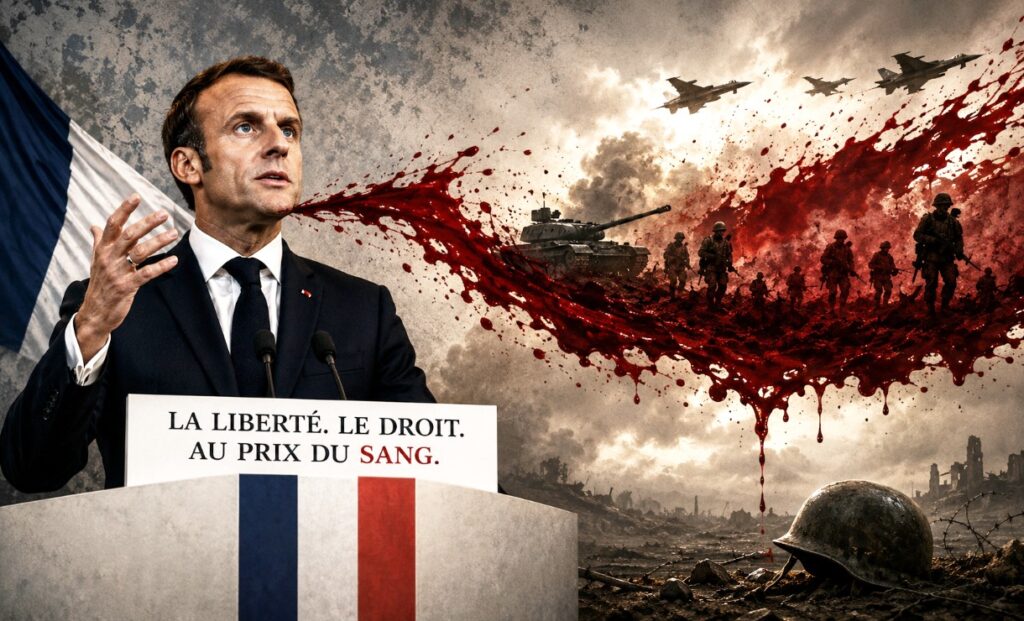
The Price of Blood—How the Language of War Rapidly Returns to Respectability
He was once seen as the opposite of Europe’s old-school power politicians. Emmanuel Macron—young, eloquent, educated, and European-minded. This president had originally wanted to build bridges rather than dig trenches. He wanted to lead France into the 21st century. And now he, too, speaks of the “price of blood.”
How quickly language changes. And politics changes with it.
Just a few years ago, words such as diplomacy, mutual understanding, and European cooperation still sounded like the foundations of the future. Today, people are once again talking about rearmament, a wartime economy, deterrence—and now more matter-of-factly about blood. As if it were merely a sober budget item. As if repeating the word often enough could strip it of its terrifying meaning.
The price of blood.
How easily this phrase can slip out in air-conditioned conference halls. People sit there in tailored suits discussing strategy, while others will later put on uniforms and bear the cost. After all, blood always belongs to someone else.
Of course, people immediately explain that all this has been misunderstood. It is only about deterrence, defensive preparedness, values, freedom, Europe. It sounds lofty, responsible, almost heroic.
Only one thing is not: peace.
The irony is that every demand for more weapons is justified by the claim that these weapons will secure peace. Every new armaments program allegedly serves only to ease tensions. Every multibillion budget is a peace project. And in the end, when people speak of the “price of blood,” it is, of course, also in the name of peace.
One cannot help but wonder: how many more speeches about peace will it take before no one notices anymore that this vocabulary has long since come from the history books of past wars?
Europe once wanted to become a continent that learned from history. Today, it seems people have mainly learned how to put old words into modern packaging. Rearmament is called “resilience,” military expansion is called “strategic autonomy,” and preparations for war are called “defending values.” Marketing can indeed work wonders.
And Emmanuel Macron? Of all people, this president who has repeatedly portrayed himself as an intellectual now uses language that is less reminiscent of 21st-century Europe than of times gone by. Perhaps that is the real shock. Not that a president wants to defend his country—that is his duty. What is truly alarming is that even those who once stood for dialogue now choose words that make a state of emergency seem normal.
Peace rarely dies with a loud bang. More often, it disappears one sentence at a time.
When politicians begin to speak of blood, citizens should not applaud. They should listen carefully. Because blood is not a rhetorical device. It has names, faces, families.
And those who call for its price should never forget: in the vast majority of cases, they are not the ones who pay it.
Andreas M. Brucker