
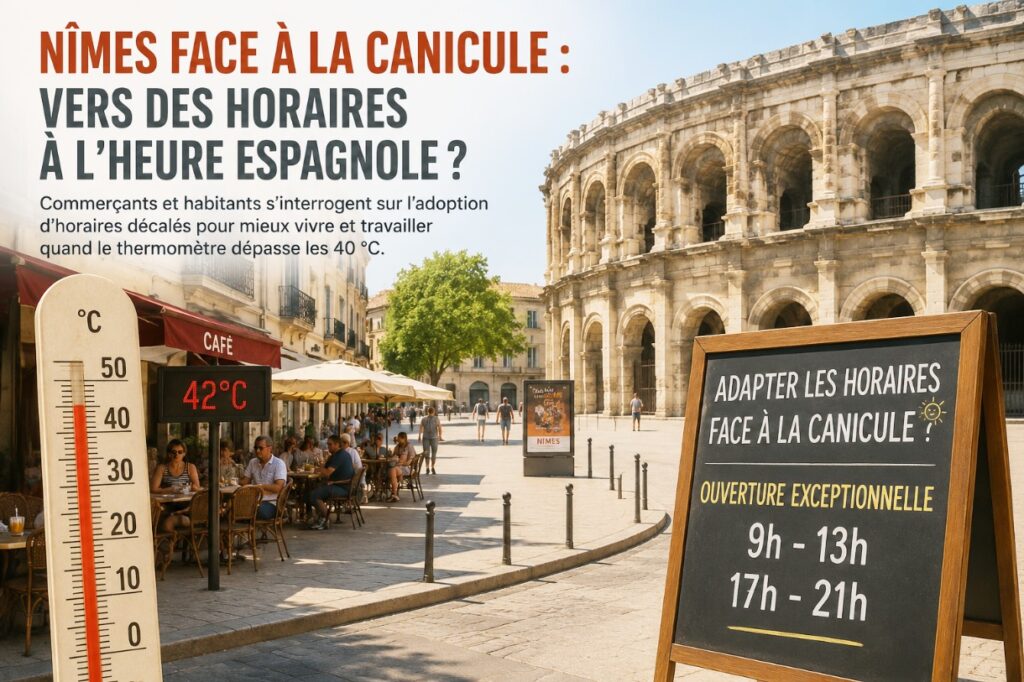
Summer in southern France is getting hotter and hotter. In cities such as Nîmes, thermometers regularly exceed 40 degrees Celsius during heatwaves. What was once considered an exception is gradually becoming the norm—with clear effects on the economy, everyday life and the working environment. In this context, an idea long regarded as a characteristic feature of Spain is receiving increasing attention: adapting the daily rhythm to the heat. Merchants in Nîmes are now calling for opening hours to be adjusted to climate conditions and to avoid the hottest hours of the day.
Commerce affected by the afternoon heat
The assessment of shop owners is very clear. From midday until around 5 p.m., streets in many central districts are almost deserted. During periods of extreme heat, customer numbers sometimes fall by 50 to 70%. Shops remain open, but the economic benefit is often negligible. At the same time, employees and customers are exposed to considerable strain due to high temperatures.
In this context, many retailers believe it would make more sense to shift opening hours to cooler times of the day. One model being discussed is opening in the morning from around 9 a.m. to 1 p.m., then reopening from 5 p.m. to 9 p.m. or even 10 p.m. The aim is to adapt shopping hours to people’s actual behavior.
Spain as a model
In many regions of Spain, this kind of daily rhythm has been part of social life for decades. During the hottest time at midday, many small shops close for several hours before reopening in the late afternoon, often remaining open into the evening.
This rhythm of life originally developed for climatic and cultural reasons. Today, it is also increasingly being considered from an economic perspective. Shopping, dining out, or leisure activities are often preferred when temperatures become pleasant again.
For Nîmes, this model is quite plausible. With its Mediterranean climate, long periods of sunshine and increasingly frequent heatwaves, the city has climatic conditions similar to those of many cities in neighbouring Spain. Public life is already tending to shift towards the evening hours. Night markets, busy pavement cafés and cultural events lasting until late at night show that people are gradually adapting to changing climatic conditions.
France’s structure makes change difficult
However, fully adopting the Spanish model is by no means simple. Organisationally, France operates according to a daily rhythm that is largely continuous. Schools, public authorities, public transport and many businesses operate on fixed schedules.
If only retailers change their opening hours, new problems may arise. Working people may have hardly any opportunity to shop if working hours and store opening hours no longer match.
In addition, there are operational challenges. While independent stores can arrange their opening hours relatively flexibly, large retail chains and shopping centres are bound by complex staffing plans, supply chains and regulations that apply across the entire company. Extending opening hours into the evening requires additional staff, changes to logistics and, in some cases, higher operating costs.
Adapting to climate change becomes a political task
The discussion has now gone far beyond the retail sector. In the face of increasingly frequent heatwaves, adapting working environments to climate change is becoming more important. Employers must pay greater attention to protecting employees from extreme temperatures and consider organisational measures. This also includes the possibility of adjusting working hours to avoid particularly harsh periods of the day.
Therefore, changing working hours and opening hours is shifting from a voluntary measure by individual companies to part of an overall climate adaptation strategy.
One possible look into the future
Climate researchers believe that future heatwaves in the Mediterranean region will occur more frequently, last longer, and reach higher temperatures. As a result, cities in southern France are facing the challenge of adapting infrastructure and daily life to these developments.
The debate in Nîmes could therefore be an example of a broader social development. What has long been regarded as a cultural characteristic of Spain may increasingly become an economic and public health necessity in some regions of France.
Ultimately, the question is not necessarily whether France should adopt a “Spanish lifestyle rhythm.” What may be decisive is the extent to which society, the economy, and public authorities are prepared to adapt existing time structures to a climate that is changing in the long term. Shop opening hours may only be the beginning of a much more comprehensive reorganization of daily life.
P.T.