
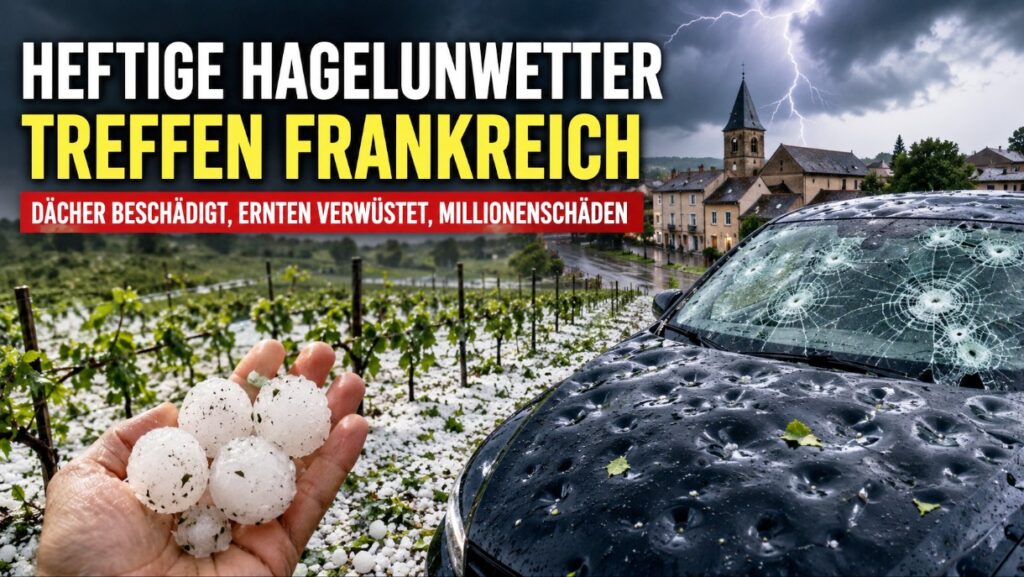
In the middle of summer, severe thunderstorms struck numerous departments in France, bringing unusually large hail in some areas. The storms often passed through the affected regions in just a few minutes, but left major damage behind. Roofs were damaged, cars were covered in deep dents, and farmland was devastated in a very short time.
According to initial observations, some of the hailstones reached the size of golf balls or even larger. For many residents, the severe weather came completely unexpectedly. The sun had been shining just moments before when the sky suddenly darkened. Strong gusts of wind began, followed shortly afterward by hail violently battering homes, vehicles, and fields.
For meteorologists, this pattern is well known. Hot air near the ground collides with moist air masses, creating ideal conditions for particularly powerful thunderstorm cells. Within minutes, so-called supercells can develop, potentially bringing heavy precipitation and large hail.
Many farmers were particularly hard hit. Vineyards, as well as orchards and vegetable fields, are considered extremely vulnerable to hail damage. A single thunderstorm cell is enough to destroy almost an entire year’s harvest. Many businesses are therefore now expecting significant financial losses and are increasingly concerned.
Such severe weather is also notable for the fact that its distribution varies greatly from region to region. In one municipality, intense hail may fall, while just a few kilometers away there is hardly any rain. It is precisely this localized nature that makes forecasting difficult and complicates preventive measures.
Summer thunderstorms have long been part of France’s climate, but experts have observed an increase in particularly intense weather events for many years. Rising temperatures provide the atmosphere with additional energy, encouraging the development of extreme thunderstorms. Although individual events cannot immediately be linked to climate change, the overall picture shows a clear trend toward more frequent and more intense extreme weather conditions.
On site, those affected describe striking scenes. Gardens were suddenly covered by a white layer of hail, and roads temporarily took on the appearance of midwinter. Windows and shutters also often failed to withstand the impact. Emergency crews were deployed to remove fallen trees, secure damaged buildings, and close off flooded areas.
This severe weather with hail once again showed how vulnerable cities, villages, and agricultural businesses are to extreme weather events. The importance of more precise warning systems, more resilient buildings, and protective measures suited to the situation is growing. For many people in the affected areas, the hope is that the next summer will be at least a little calmer.
C. Hatty 記