
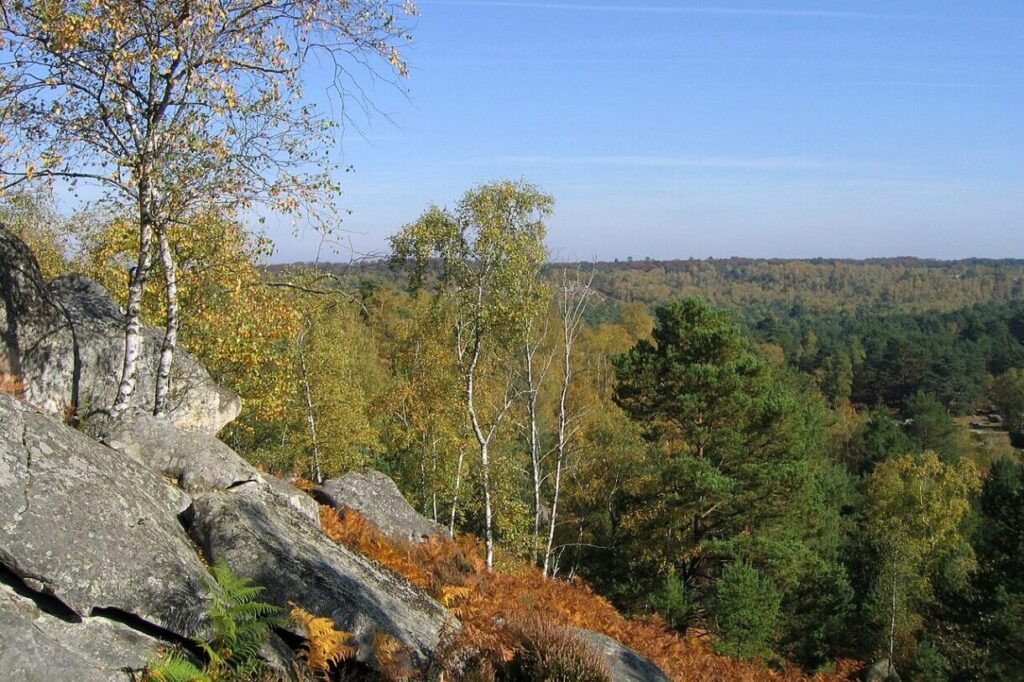
For centuries, the Forêt de Fontainebleau southeast of Paris has been one of Europe’s most important forest landscapes. Generations of artists, hikers and nature lovers have been captivated by this vast woodland with its striking sandstone rocks, ancient trees and extraordinary biodiversity. Now, this unique natural heritage is facing a historic turning point: a devastating forest fire in July 2026 left deep scars on a landscape regarded as a symbol of French natural and cultural history.
The state forest covers around 25,000 hectares in the Île-de-France region. Every year, up to 18 million people seek recreation among its pines, oaks and beeches. The spectacular rock formations attract boulderers from around the world, while dunes, bogs and wetlands offer valuable refuges to rare animal and plant species. This exceptional diversity makes Fontainebleau one of France’s most ecologically significant forest areas.
Yet within just a few hours, flames turned large parts of this idyllic landscape into a charred expanse. More than 2,000 hectares of forest fell victim to the fire. Hundreds of emergency personnel battled the flames with firefighting aircraft, helicopters and heavy equipment. Numerous local residents had to leave their homes as a precaution while the fire continued to tear through the dense forest. For many people in the region, it quickly became clear: this was no ordinary forest fire, but a catastrophe of historic proportions.
The difficult conditions posed major challenges for emergency crews. The loose sandy soil retained heat, underground embers repeatedly reignited, and strong winds drove the flames relentlessly onward. Several heatwaves and persistent drought had already placed the forest under severe strain. What was once considered an exception is increasingly becoming a harsh reality.
The cause of the fire is also occupying investigators. Because fires were reported at several locations almost simultaneously, investigators are examining not only technical causes but also the possibility of deliberate arson. Two young men became the focus of the investigation. It is now up to the courts to determine whether they are in fact responsible.
Fontainebleau’s significance extends far beyond the region. French kings used the forest as a hunting ground as early as the Middle Ages. In the 19th century, painters of the Barbizon School, followed later by the Impressionists, discovered its unique atmosphere. Their protest against extensive logging led in 1853 to the designation of the world’s first artistic nature reserves – a milestone in international conservation.
The fire also demonstrates how dramatically the risk of forest fires has changed. For a long time, major fires were considered a problem of the Mediterranean region. Now, forests in northern and central France are increasingly coming under pressure as well. Climate change, longer periods of drought and more frequent heatwaves are creating conditions that make even long-established forest areas vulnerable.
It will likely take decades for Fontainebleau’s complex ecosystem to recover. Old-growth stands, sensitive habitats and rare plants have been lost irretrievably. At the same time, reconstruction offers an opportunity to develop more resilient mixed forests and adapt fire protection measures to the new climate challenges.
The Forest of Fontainebleau now stands as a symbol of the vulnerability of even Europe’s most valuable natural landscapes. Its history stretches back many centuries – the coming decades will determine the form in which this unique natural heritage is passed on to future generations.
Author: C.H.