
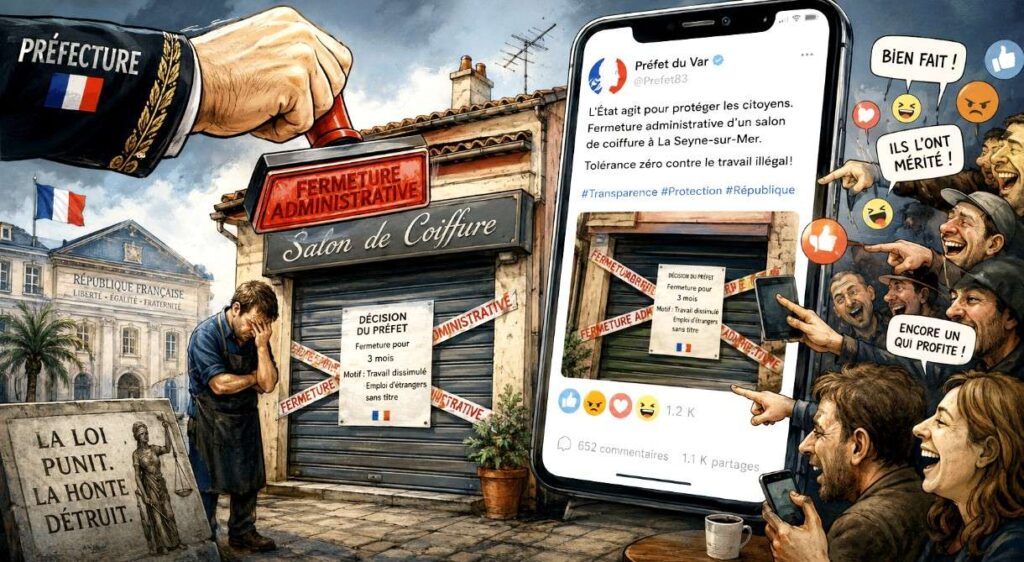
There are penalties that end after three months. And there are penalties that never end. France has now found a new way to elegantly combine both: first the official closure, then the public display on social media. The prefect posts. The state likes itself. And somewhere a small shop owner sits amid unpaid bills, shame, and the realization that today you are no longer just punished – you are exhibited.
The Var department sets an example of how the modern state apparently works. In the past, wanted posters were hung on village walls. Today they are uploaded to Instagram. There used to be the pillory in the marketplace. Today it is called the prefecture’s Facebook post. The technical progress lies in the fact that humiliation is now available in HD resolution and algorithmically amplified.
Of course: undeclared work is not a minor offense. Illegal employment neither. The state has the duty to enforce laws. Those who exploit workers, evade social contributions, or employ people without papers must not expect leniency. But that is no longer what this is about. It is about something else, something more dangerous: the state’s delight in public exposure.
Because the modern administrative state is just now discovering the psychological additional punishment. The administrative closure is no longer enough. The door of the shop must not only be locked – it must be photographed. With sealing tape. With an official notice. With an outraged emoji audience below.
“Ça va tuer les petits commerces” – that will kill the small businesses. This sentence contains more truth than all the press releases of the prefectures combined. Small businesses live from trust, from regular customers, from reputation. Whoever closes a small hair salon for three months takes away its income. Whoever posts the same closure on the internet on the digital gallows at the same time may take away its future.
Because the internet does not forget. The administrative penalty eventually ends. The Facebook post remains. Even years later it appears in search engines like an eternal prior conviction without a court verdict. The rule of law actually knows an important principle: the punishment must be limited. It must not become a lifelong social destruction. But social networks know no proportionality. They know reach.
It is remarkable how willingly democratic states now adopt methods they would indignantly criticize in other systems. In China, public shaming is called “social control.” In Europe, it is called “transparency.” The difference sometimes lies only in the choice of words by the press office.
The prefect as an influencer of criminal law – that is the real absurdity of this development. Authorities now speak the language of digital attention. They post closures like other people post holiday pictures. The state is discovering the mechanisms of social media: visibility creates impact. Outrage generates clicks. Deterrence generates political approval.
But deterrence has never been a free pass for humiliation. The rule of law lives precisely from not triumphing when it punishes. It carries out sentences soberly, controlled, without pleasure in humiliation. The state should not shout. It should act.
Instead, it now stages itself as a moral avenger. The audience may applaud. “Finally, someone is cracking down!” is what you read in the comment sections. The mob has never disappeared; it just has Wi-Fi today.
And of course, this new severity rarely hits the powerful. Large corporations pay their fines out of the petty cash of their legal departments. International tax avoidance rarely ends with an Instagram post by the authorities. The small hairdresser, the small snack bar, the small café, on the other hand, are ideal targets of state visibility politics: approachable, photographable, vulnerable.
The state discovers the symbolic fight against the small because the fight against the large would be complicated.
France in particular should know how sensitive the social balance between state and citizen is. The country thrives on its small shops, its cafés, its bakeries, its craft businesses. They are not just economic units; they are social places, daily life, neighborhood, republican life. Those who publicly brand them destroy more than just revenue.
Certainly: Some operators have violated laws. That must be named. But there is a difference between the rule-of-law information and public execution, which democracies must never forget. Otherwise, the state will eventually begin not only to exercise its power but to enjoy it.
And that is precisely where the real danger lies. Not in the individual closure of a hair salon in La Seyne-sur-Mer. But in the complacency with which authorities believe they may today not only sanction people but also expose them before an audience. The digital pillory has become convenient, politically popular, and morally cheap.
The question is not whether the state may punish. Of course it may. The question is rather whether it keeps measure in doing so. Whether it remembers that dignity is not a bonus for law-abiding behavior but a fundamental right – also for those who have made mistakes.
A democracy is not recognized by how harshly it treats the weak. But by whether it possesses the humility to forgo public humiliation even at the moment of sanction.