
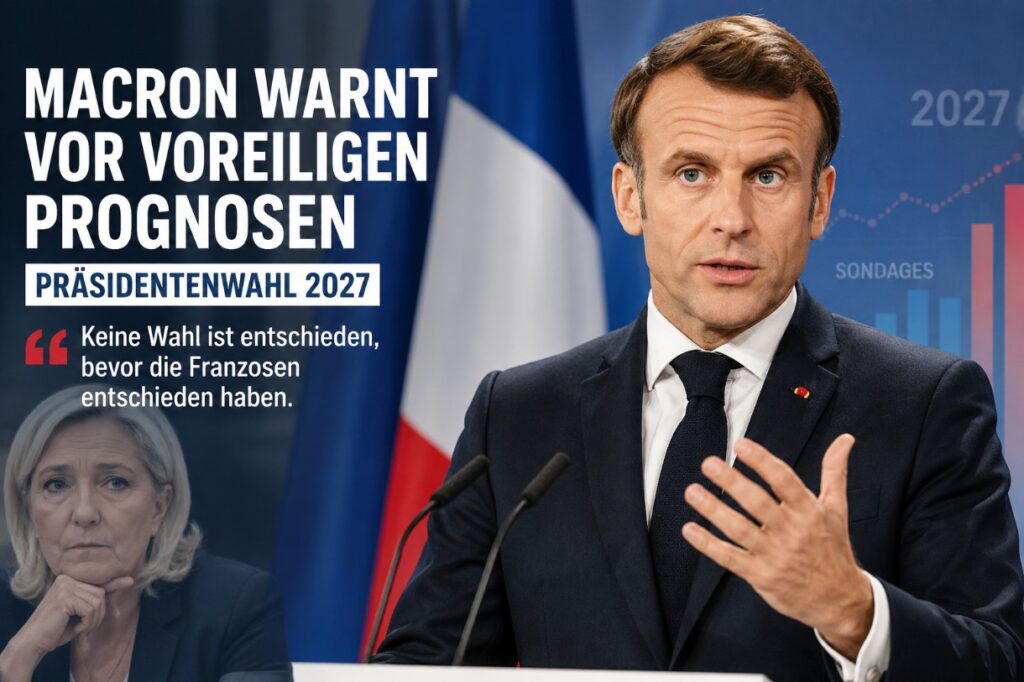
French President Emmanuel Macron has called for current polls on the 2027 presidential election to be viewed with the necessary composure. During a joint press conference with Chancellor Friedrich Merz in Bruehl near Cologne, he made clear that opinion polls may reflect public sentiment, but by no means determine the outcome of an election. His message was this: much remains in flux until election day.
Macron recalled his own political success story. In the summer of 2016, few observers seriously expected that the then economy minister would move into the Elysee Palace less than a year later. The presidential campaign developed a momentum that overturned many forecasts. This was precisely the example the president now cited. Political developments rarely follow a straight line; they often resemble a river with unexpected turns.
In Macron’s view, anyone already declaring a certain election winner for 2027 is overlooking the many factors that shape an election campaign. New candidates enter the scene, political alliances shift, economic developments suddenly take center stage, and international crises alter priorities. What seems likely today may look entirely different tomorrow.
In an appeal to citizens, Macron also spoke about trust in democracy. The French people should not constantly be confronted with bleak scenarios. Instead, they deserve to be trusted to make their decision independently and on the basis of political debates up to election day. This idea ran like a common thread through his remarks. Democracy depends on elections remaining open. Or, to put it another way: what would an election be worth if its outcome had already been decided years in advance?
The background to his remarks is obvious. Several recent opinion polls currently place Marine Le Pen clearly ahead of potential candidates for the 2027 presidential election. In various scenarios, she receives the highest approval ratings both in the first round and in possible runoffs. These figures have fueled political debate in France for weeks and attracted attention far beyond the country’s borders.
Macron sought to offer a different perspective on this development. Polls provide interesting snapshots, but they do not replace an electoral decision. Many months lie between a survey and the actual vote, during which political issues can gain or lose importance. Personalities can rise to the occasion or lose support. The political landscape is constantly in motion – and that is precisely what defines democratic elections.
Chancellor Friedrich Merz also commented on France’s political future during the press conference. Asked how Germany would deal with a possible election victory by Marine Le Pen, he responded diplomatically. Berlin would work with any government democratically elected by French citizens. Germany would extend its hand to France regardless of the election outcome and continue its close cooperation.
This statement underscores the special importance of the Franco-German partnership. For decades, both countries have been regarded as the engine of the European Union. Especially in view of economic challenges, international conflicts and security policy issues, close coordination between Paris and Berlin remains of central importance. That is unlikely to change much after the 2027 election.
For Emmanuel Macron, the debate also has a personal dimension. After two consecutive terms in office, the French constitution does not allow him to run again. Accordingly, political observers have long been focusing on his possible successor. Nevertheless, the president is urging patience. No official election campaign has yet begun, and there is still plenty of time before the decision is made. After all, who would have thought in the summer of 2016 that Emmanuel Macron would become France’s president just a few months later?
With his intervention, Macron is therefore sending a clear signal. He wants to prevent early polls from being understood as immutable truth. Instead, he is advocating trust in the democratic process and reminding people that political history is often written precisely when hardly anyone expects it.
An article by M. Legrand