
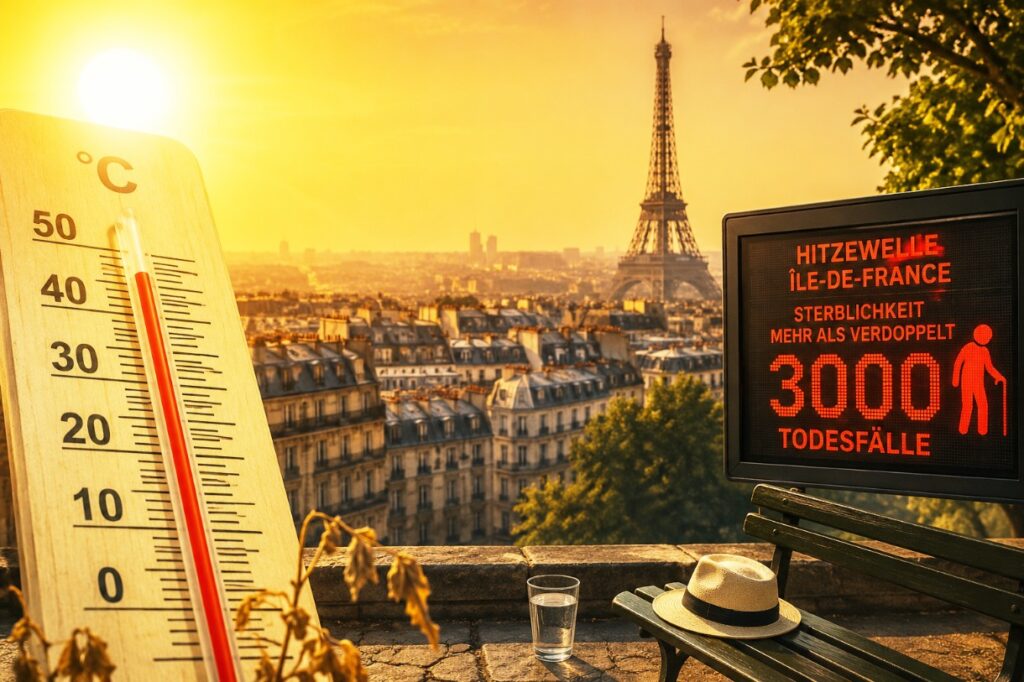
The exceptional heatwave at the end of June had significantly more severe consequences in the French capital region than initially assumed. New analyses by the French health authority show that nearly 3,000 people died in Île-de-France during the period of extreme heat. Mortality in the region was therefore more than twice as high as is usual at this time of year. Greater Paris in particular became the nationwide focal point of the heatwave.
The updated figures are based on a more comprehensive assessment of deaths and paint an even bleaker picture than the initial estimates in early July. Experts also assume that the final number of heat-related deaths is likely to be higher, as not all death certificates have yet been fully assessed.
That Île-de-France was particularly severely affected comes as only a limited surprise to experts. The metropolis of millions has suffered for years from the so-called urban heat island effect. Streets, buildings and sealed surfaces store enormous amounts of heat during the day and release it only slowly at night. As a result, temperatures barely cool even in the early morning hours and often remain above 25 degrees. This lack of nighttime recovery places enormous strain on the human body.
Older people in particular, as well as those with cardiovascular or respiratory conditions, reach their limits under such circumstances. Anyone who can barely sleep for days and cannot recover from the heat faces a significantly higher risk of health complications. People who live alone or depend on assistance are especially at risk.
There is also another problem affecting many Parisians: numerous apartments have no air conditioning. Older residents in particular often live in top-floor apartments or poorly insulated buildings, where heat builds up over several days. Indoor spaces effectively turn into heat chambers. Anyone forced to endure these conditions without sufficient cooling can quickly find themselves in a life-threatening situation.
Previous assessments had already found that around 85 percent of the additional deaths involved people over the age of 65. The current data confirm this trend and once again highlight how vulnerable this population group remains to extreme temperatures.
The number of deaths in private households rose particularly sharply. While hospitals and care facilities have significantly improved their protection plans following the experience of the hot summer of 2003, mortality in people’s own homes increased considerably. Nationwide, it rose by around 91 percent during the heatwave.
For public health professionals, this development is one of the greatest challenges. Many vulnerable people live alone and remain out of sight despite existing warning systems. Neighbors, relatives and social services therefore play an increasingly important role. Sometimes, a brief visit or a phone call is enough to arrange help in time. Who thinks that someone may be suffering silently from the heat behind a closed apartment door?
The health authority also points out that heat-related deaths often do not occur directly on the hottest days. Existing illnesses frequently worsen only after a delay, meaning that cardiovascular problems or respiratory diseases can lead to death several days later. For this reason, the true extent of excess mortality may not yet have been fully recorded.
The current figures inevitably evoke memories of the devastating hot summer of 2003, when around 15,000 people died in France as a result of extreme temperatures. At the time, the government drew far-reaching conclusions and introduced heat plans, warning systems and improved protective measures for care facilities. But are these tools still sufficient today?
Developments in the Paris region clearly show that the challenges are intensifying as climate change progresses. Heatwaves are occurring more frequently, lasting longer and reaching higher temperatures. At the same time, the number of older people who are particularly at risk is growing. The rising mortality in private households makes it clear that protecting these people must become an even greater priority in the future. Only a combination of preparedness, neighborhood support and targeted protective measures can effectively limit the consequences of future heatwaves.
An article by M. Legrand