
Sometimes it’s not cathedrals or castles that tell the story of a region, but places where people naturally meet.
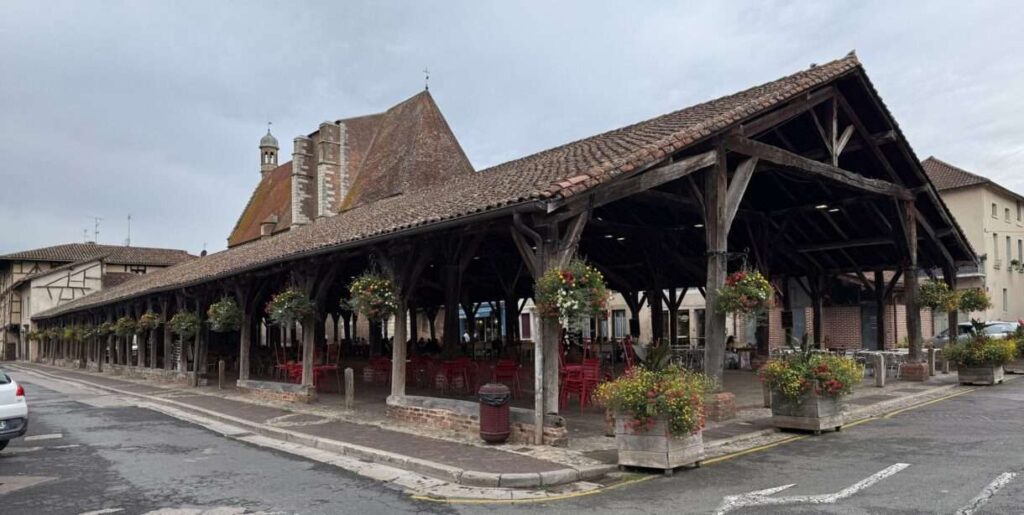
Châtillon-sur-Chalaronne – a small town in the Ain department – belongs exactly to this category. Cobblestones, half-timbered houses, waterways running through the old town. All charming, of course. But the real heartbeat is not hidden in postcard motifs, but under a huge oak wood roof.
There they stand: the Halles.
Since 1440.
And yes, you read that right – this market hall has experienced more stories than many a novel.
A fire destroyed it almost completely in 1670. But instead of reinventing it, they decided to rebuild it in its original form. An attitude that says a lot about the region: you don’t just preserve, you continue.
Today the hall measures about 80 meters in length and 20 meters in width. Big enough to leave an impression. Small enough not to be intimidating.
And this is exactly where the special begins.
Because the Halles are not a monument behind glass.
They are alive.
Sights Around the Halles
Those who stroll through Châtillon-sur-Chalaronne almost automatically end up on the Place de la Halle. The paths lead there like small streams into a quiet lake.
And suddenly you find yourself under this magnificent wooden structure.
The construction appears simple at first glance. But the longer you look, the more details you notice: the massive oak pillars, the rhythmic structure, the play of light and shadow.
This was not built for beauty.
This was built for generations.
A few steps further, you discover the surrounding alleys. Half-timbered houses lean slightly toward each other as if they were whispering. Small bridges span the waterways. And then – bam – another glance back at the halls, towering over everything without seeming dominant.
Have you ever experienced a building that is both present and unobtrusive at the same time?
That is exactly what happens here.
By the way, over the centuries the hall has not only been a market. It served as a storage room, a stable, even a place for religious gatherings.
Multifunctional, long before the word existed.
And somehow you can still sense that today.
Saturday Morning: When the Hall Comes to Life
Then comes the moment that changes everything.
Saturday.
Early.
The city seems quiet at first. A few footsteps echo over the pavement. A café is just opening.
And then – like a slow curtain – the hall awakens.
Stalls are set up. Crates are stacked. Voices mix together. It smells of fresh bread, cheese, herbs.
Suddenly everything is there.
About sixty producers arrange their goods – over 300 meters of stall space. And this is no exaggerated market staging for tourists. This is everyday life.
Real everyday life.
Here you can find poultry, game, fish from the ponds of the Dombes, cheese at all stages of ripeness, sausages, fresh vegetables, fruit depending on the season.
Strawberries in spring.
Cherries in summer.
Apples in autumn.
Walnuts in winter.
And yes – even live poultry.
A bit like a time travel, isn’t it?
But not a nostalgic one.
A functioning one.
Cultural Highlights: More Than Just Trade
What happens here goes far beyond buying and selling.
The market is a ritual.
A rhythm.
A meeting point.
People don’t just come to shop. They come to see each other. To talk. To exchange news.
A quick chat here.
A laugh there.
A “À samedi!” when saying goodbye.
It’s these little scenes that shape the place.
And then this special sensuality: the rustling of paper, the clinking of bottles, the soft clucking of chickens. Almost sounds like an orchestra conducting itself.
Sounds cheesy?
Maybe a little.
But honest.
In a time when much is digital, fast, and anonymous, this market almost feels like a counter-model.
Tangible.
Direct.
Human.
And exactly for that reason so strong.
Culinary Highlights: Tasting the Dombes
The halls are also a kind of culinary map.
Everything here tells a story about the region.
The Dombes – shaped by ponds, agriculture, and small businesses – delivers its products directly under this roof.
Fish plays a major role. No wonder, given the landscape. Freshly caught, sold directly.
Along with poultry – often from traditional farming.
Cheese that doesn’t look polished, but shows character.
And then these ready-to-eat dishes… honestly, it’s hard to just keep walking.
Ever tried to walk past a stall with freshly prepared specialties?
Good luck.
You stop.
Always.
And that is exactly part of the experience.
Here, it’s not about perfect presentation, but about quality, origin, and taste.
Without much fuss.
Architecture that works
One sentence would actually suffice.
But we’ll make more out of it anyway.
The halls are a masterpiece of functional architecture.
The oak construction not only supports the roof but also the history. Every beam seems to hold its own memory. And yet nothing feels heavy or oppressive.
On the contrary.
The space remains open, airy, inviting.
Why does it work so well?
Because the architecture was never an end in itself.
It serves.
And that is where its beauty lies.
No frills.
No show.
Simply substance.
A place between past and present
Many historic places feel frozen in time.
Nice to look at.
But quiet.
Almost too quiet.
The halls of Châtillon-sur-Chalaronne take a different path.
Here, history stays in motion.
The same function, the same use, over centuries.
That is rare.
And honestly, quite impressive.
Because how often does it succeed to not only preserve a building but also continue to use it meaningfully?
Here it works.
And without much fuss.
Summary Recommendations
If you travel through the Ain region, be sure to plan your visit on a Saturday.
Without a market, a piece of the soul is missing.
Come early.
Take your time.
Just stroll.
Try everything.
And above all: observe.
Because that’s exactly where the magic of this place lies.
Not in spectacular highlights, but in the little moments.
A conversation between two market stalls.
A smile at checkout.
A scent that suddenly awakens memories.
Sounds simple?
It is.
And precisely for this reason so valuable.
If you really want to understand France, you should not only visit the major sights.
But places like this.
Because here you see how closely culture, everyday life, and enjoyment are intertwined.
And honestly – when was the last time you experienced a place that feels both so old and so alive at the same time?
A travel report by V.O.Yager