
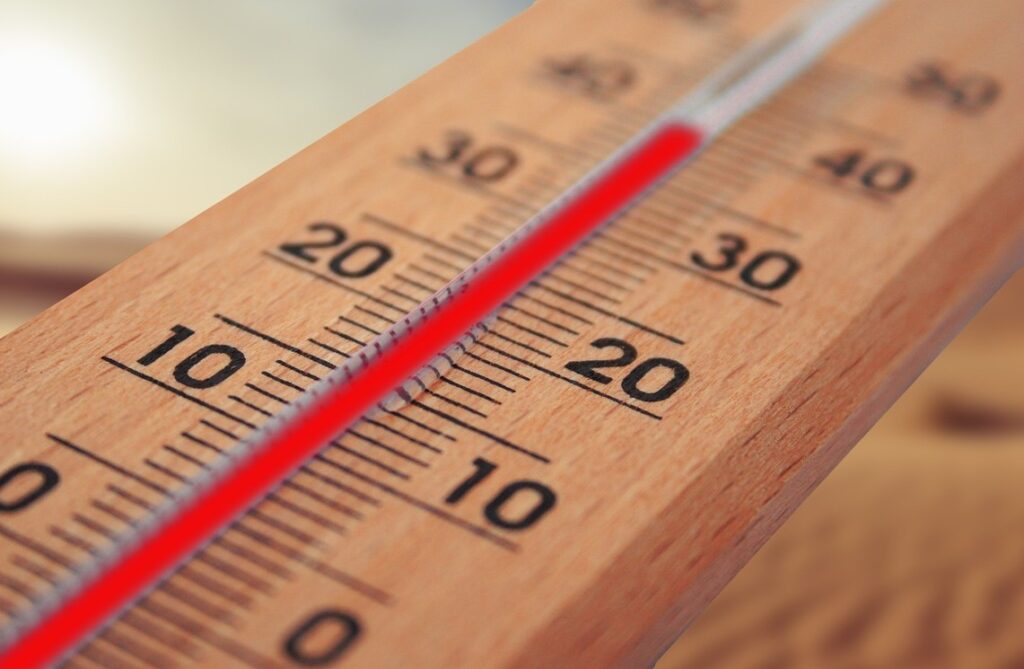
Summer no longer knocks on the door – it simply storms right in.
France is experiencing a heatwave at the end of May that even surprises experienced meteorologists. While many people are still thinking about spring jackets, changeable days, and cool mornings, temperatures in the western part of the country are already rising to levels usually only seen in midsummer. Regions along the Atlantic coast and in the west of the country are particularly affected. Since Tuesday, there has been an exceptional weather situation with temperatures far above the usual values for May.
In cities like Nantes, Bordeaux, or Lyon, the mercury rises to 34 to 35 degrees. Even in otherwise moderate regions, the weather map suddenly shows deep orange to red hues. Numerous departments have warnings due to extreme heat. And for now, there is hardly any thought of an end to this weather situation.
What stands out most is the timing.
Temperatures above 30 degrees in France are usually still considered an exception at the end of May. This time, however, experts are talking about a historic event. The air masses come from North Africa and are pushed into Western Europe by a stable high-pressure area. Meteorologists call this a so-called “heat cap.” It works like a lid over the atmosphere – the warm air accumulates, rain stays away, and temperatures rise day after day.
More than 350 weather stations have already reported new temperature records for May. This shows how exceptional the situation really is. Many elderly people remember hot summers like in 2003 or 2019, but such an early heatwave feels almost unreal even for France. “That is really intense,” one often hears now in street cafes or at train stations.
The health risks now come to the forefront.
Many people are familiar with heat in mid-summer – the body adapts to it. But at the end of May, this adaptation is often still completely lacking. Houses retain heat more strongly, schools and offices rarely have cooling, and many underestimate the strain. Especially elderly people, children, construction workers, or athletes quickly reach their limits.
Authorities therefore call to avoid physical exertion, drink enough water, and regularly check on vulnerable persons. Especially in cities, heat accumulates between concrete, asphalt, and densely built streets like in an oven.
Behind the current weather situation, however, lies more than just an exceptional spring.
Climate researchers have seen for years that heatwaves occur earlier, last longer, and become more intense. What used to be an extreme event is increasingly developing into the new reality. The classic summer heat shifts forward in the calendar – little by little, year after year.
Authorities therefore call to avoid physical exertion, drink enough water, and regularly check on vulnerable persons. Especially in cities, heat accumulates between concrete, asphalt, and densely built streets like in an oven.
Behind the current weather situation, however, lies more than just an exceptional spring.
Climate researchers have seen for years that heatwaves occur earlier, last longer, and become more intense. What used to be an extreme event is increasingly developing into the new reality. The classic summer heat shifts forward in the calendar – little by little, year after year.
France is thus getting a preview in May of a summer that will provoke many more discussions. About air conditioning, urban planning, water supply, and the question of whether Europe is prepared at all for these new temperatures.
Because one thing becomes very clear this week: the old image of a mild spring is under pressure.
By C. Hatty