
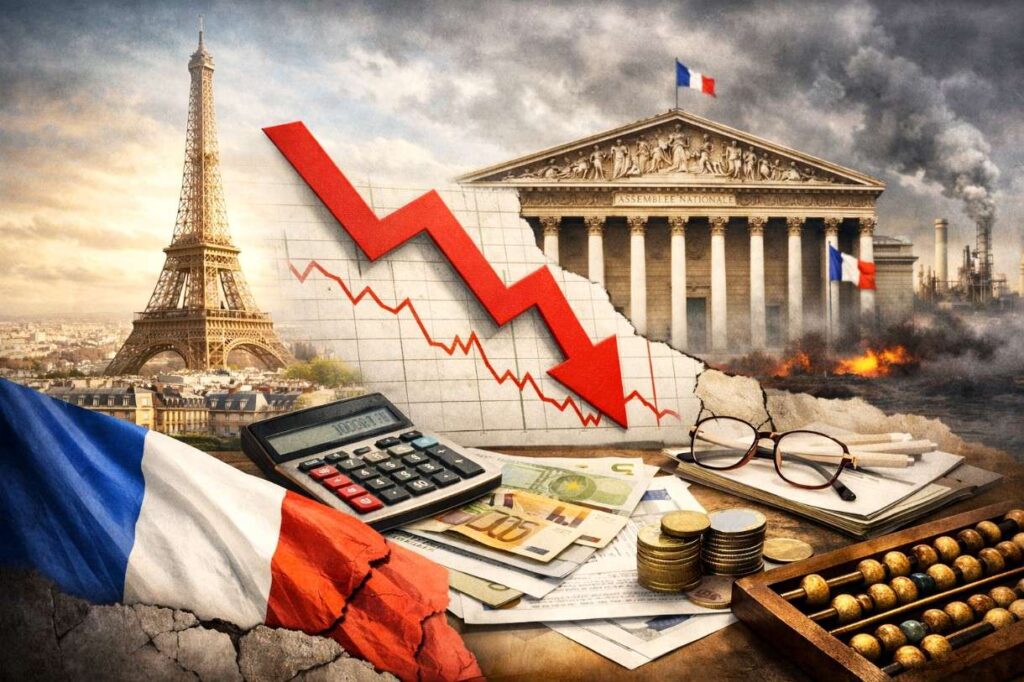
For years, France has lived with a contradiction that long seemed sustainable: a generous state, high public spending, and at the same time the claim to remain economically dynamic and geopolitically influential. But now signs are increasing that this model is reaching its limits. Although the International Monetary Fund does not warn of an immediate financial crisis, its latest analysis carries a much more serious message: France risks difficulties not due to a lack of resources, but because of a lack of reform capacity.
The numbers speak clearly. The budget deficit in 2025 stood at 5.1 percent of gross domestic product—far from the European stability criteria. Even more remarkable is the state quota of 57.5 percent. Among the major industrialized countries, France thus remains one of the states with the highest public spending overall. While the IMF acknowledges that Paris has initiated first consolidation steps, without a credible multi-year strategy, the goal of bringing the deficit back under the 3 percent mark by 2029 is hardly achievable.
This is explicitly not about a radical austerity policy of Anglo-Saxon design. The Fund does not call for abrupt austerity measures like those partly practiced in Europe after the euro crisis. The warning from Washington is more technocratic and at the same time political: France must set priorities and permanently control the dynamics of its spending.
A State That Promises More and More
The core of the French problem lies less on the revenue side than in the structure of the state itself. For decades, France has funded an exceptionally dense network of social security systems: pensions, unemployment insurance, healthcare, family benefits, and an extensive public service form the backbone of the republican social contract. This model is considered by many French citizens a civilizational achievement.
Yet this very consensus makes reforms so difficult. Every attempt to cut benefits or organize structures more efficiently triggers social and political conflicts. President Emmanuel Macron experienced this during the 2023 pension reform, when millions of French protested against the gradual increase of the retirement age. The reform was ultimately only enforced through constitutional special instruments—a symbol of how limited the political ability to secure majorities has become.
The IMF now suggests that piecemeal reforms are no longer sufficient. Paris must improve administrative efficiency, target social benefits more precisely, and define long-term expenditure pathways. Remarkably, the Fund explicitly warns against further tax increases. France already belongs to the OECD countries with the highest tax burdens. Additional levies could further weaken growth and investment.
The Return of Strategic Spending
At the same time, France faces new financial obligations that are hardly avoidable. The Russian war of aggression against Ukraine has changed the European security architecture. Paris is significantly increasing its defense spending and wants to expand its military capacity to act. President Macron sees France as a central power in Europe—a claim that would hardly be credible without higher military spending.
Added to this are the costs of demographic aging. Like many Western countries, France is experiencing a growing number of elderly citizens alongside a more slowly growing working-age population. This structurally burdens pension and healthcare systems.
Finally, there are investments for ecological transformation: infrastructure, energy transition, building renovations, and industrial decarbonization will require substantial public funds in the coming years. Especially France, which presents itself as a European leader in climate protection, can politically hardly afford a retreat from these programs.
The result is a paradoxical situation: the state is expected to save while delivering more. This is exactly where the IMF sees the central challenge.
The Real Problem Lies in Parliament
Economically, despite high debt, France is by no means a crisis state. The country has a diversified economy, significant industrial and technology companies, high private wealth, and still comparatively stable financing conditions in capital markets. Unlike Greece during the euro crisis, France is not facing an acute insolvency.
The real weakness is political. Since the early parliamentary elections in 2024, the government no longer has a stable majority. The National Assembly is more fragmented than rarely before. Left-wing parties reject social cuts, the Rassemblement National also opposes unpopular austerity measures, while the center-right camp itself is deeply divided.
The 2026 budget illustrates this dilemma exemplarily. While it contains savings, the volume of around nine billion euros falls considerably short of earlier announcements. The government had to reduce its ambitions because larger cuts would have been politically almost impossible to implement.
This creates a cycle of growing uncertainty: markets and European partners expect fiscal discipline, yet every concrete reform faces domestic resistance. France knows that consolidation is necessary—but cannot find a stable majority for its design.
Europe’s Founding Country Under Pressure
This development has considerable significance for the eurozone. France is not just any member state, but alongside Germany the main political pillar of the European Union. Should Paris come under fiscal pressure, this would have immediate consequences for the entire European architecture.
Therefore, the IMF’s choice of words is remarkably sober. The Fund avoids alarmism, yet between the lines it becomes clear what the issue is: trust. As long as investors are convinced that France remains capable of action in the medium term, a high debt ratio can be borne. However, if the state loses credibility, financing costs quickly rise and political leeway shrinks further.
The French debate thus recalls a fundamental problem of modern democracies. Many Western societies have grown accustomed to a state that guarantees security, prosperity, and stability. But financing these promises becomes increasingly difficult under conditions of low growth, aging populations, and geopolitical tensions.
France exemplifies this development. The country still has enormous economic and institutional strengths. But its political class seems caught between economic reason and social ungovernability. The IMF ultimately calls less for cuts than for reliability: a state that credibly shows it can set priorities—even against short-term political reflexes.
This is precisely today France’s greatest challenge.
Author: P. Tiko