
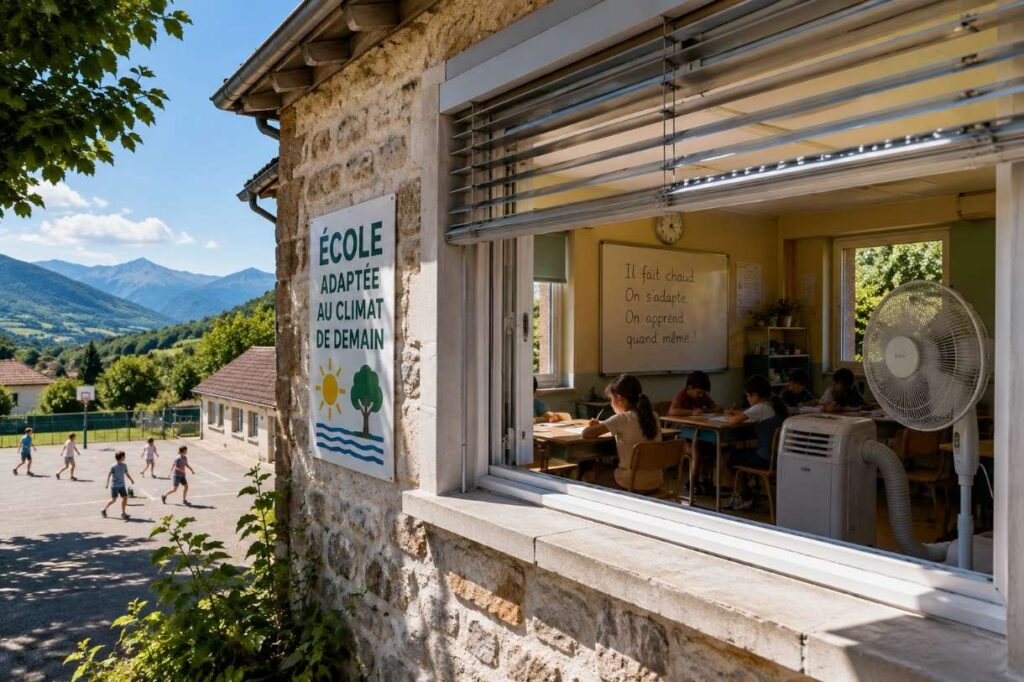
In the past, an open window was enough in the summer. Maybe a half-lowered shutter, the smell of chalk, warmed linoleum, and lunch bread alongside. Nowadays, more and more French schools have fans humming through the classrooms, mobile air conditioners running at full power against the heat, and teachers shifting lessons to cooler morning hours. What long sounded like a problem of southern big cities now even reaches small communities at the foot of the Pyrenees.
In Béarn, that green landscape between Le Mans and Reims, the new reality becomes particularly clear. There, municipalities suddenly invest in external blinds, sunshades, and relaxation spaces with air conditioning. No prestige projects, no futuristic school campuses — just the attempt to offer children somewhat bearable learning conditions.
Because heat in the classroom is no longer a marginal problem.
Anyone who has ever been in a poorly insulated school building from the 1970s knows the feeling: stuffy air, heavy heads, concentration as tough as chewing gum. Even at almost 30 degrees the attention quickly declines. Children become restless, teachers exhausted, the lesson turns into an exercise in patience. It sounds banal but hits the core quite precisely. Learning does not work like a diesel engine that you can start at any temperature.
Especially small municipalities come under pressure because of this. In France, municipalities are responsible for school buildings. Large cities finance million-dollar renovations, plant trees in schoolyards, or remove asphalt areas. Villages, on the other hand, often work with tight budgets and a lot of improvisational talent. Often, the municipal council decides between a new heating system or additional sun shading. Both at the same time? Difficult.
This is exactly where the political strength of this issue lies.
Climate change does not only show itself in spectacular forest fires or dried-up rivers. It creeps into daily life — in cafeterias, gyms, and classrooms. Places where the government suddenly has to function very practically. A school where children can hardly write at 36 degrees room temperature makes every climate discussion tangible.
Moreover: mobile air conditioners only solve the problem superficially. They consume energy, cause extra noise, and often just move the heat outside. A bit like someone scooping water from a leaking boat without sealing the hole. Sustainable measures are simpler architectural interventions: light facades, better insulation, natural ventilation, greened courtyards, trees as shade providers. Sounds inconspicuous — but has a big impact.
In many French municipalities, a change in mindset is now beginning. Schoolyards, once often gray asphalt expanses with a basketball hoop, are slowly transforming into small green areas. Some places are removing pavements, others are installing rainwater systems or planting sturdy plane trees. This takes time. And money. But the pressure to act is growing.
Because the heat does not just visit for a few days. Meteorologists expect longer and more intense heatwaves that can last for months. For schools, this means: adaptation becomes a permanent task. Not someday. Now.
Therefore, the small municipality in Béarn symbolizes much more than just local government matters. It shows a France that is gradually adapting bit by bit to a different climate. Quietly, pragmatically, and without much pathos. Perhaps the real change lies precisely in this: climate policy no longer takes place only at top meetings, but between the schoolyard, municipal budget, and classroom window.
And there, in the end, very concrete decisions will be made about how livable daily life remains in a warming Europe.
By C. Hatty