
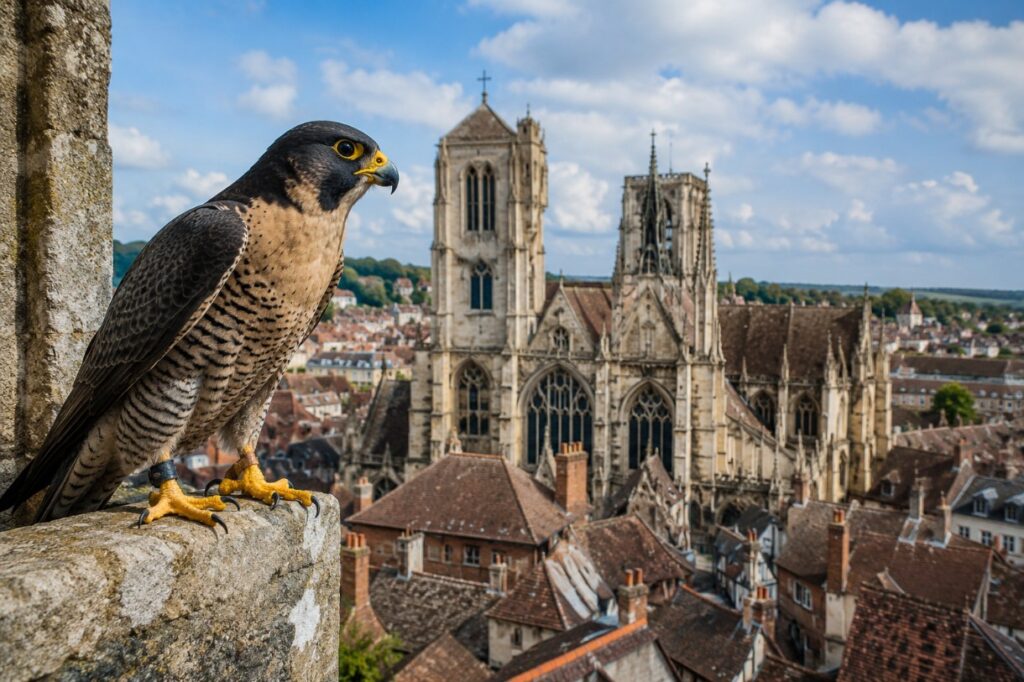
For a long time, city centers belonged to the pigeons. They sat on cornices, besieged train stations, fluttered over market squares, and made historic facades their personal residential complex. In many French cities, this was almost considered a natural law. But above Troyes, a different shadow now passes through the air: that of the peregrine falcon.
And it causes a disruption of the familiar order.
On the city’s cathedral, an official peregrine falcon pair now lives. High above, more than forty meters up, a nesting box was even installed. At first glance, this seems romantic – almost like a small return of wilderness among Gothic towers and old rooftop landscapes. But there is also hard urban policy behind it.
Because pigeons cost money. A lot of money.
Their droppings damage stone facades, pollute squares, and harm historic buildings. Municipalities invest huge amounts annually in cleaning and maintenance. Especially in cities with monumental architecture, the costs quickly add up. Then the idea suddenly sounds very logical: why not bring back the natural enemy?
The peregrine falcon is perfectly suited for this. It is considered one of the fastest hunters in the world and causes unrest among pigeons simply by its presence. Experts refer to the so-called “deterrent effect.” The birds constantly sense danger, change their flight routes, and gradually abandon certain areas. No large-scale trapping, no controversial sterilization programs – instead, nature handles the problem itself. Quite clever actually.
What remains especially remarkable is the story of this comeback. In the 1970s, the peregrine falcon was almost extinct in France. Pesticides and destroyed habitats had severely reduced the population. Today, the raptor is rediscovering the cities. And biologically, this works out well: tall church towers, modern skyscrapers, or industrial complexes resemble the cliff walls on which the birds formerly nested.
The city replaces the mountain.
Some residents now observe the falcons with almost childlike wonder. Ornithologists stand with binoculars in squares, families suddenly stop in front of the cathedral and look up. Such things also change the image of the city itself. Amid asphalt, traffic, and concrete, the feeling arises again that nature does not only exist in the countryside.
Perhaps therein lies the true fascination. The peregrine falcon is more than just an elegant pest controller. It symbolizes a new idea of urbanity – a city that no longer completely displaces animals but tries to live together with them.
And the pigeons?
They slowly realize that the sky above Troyes is no longer theirs alone.
Andreas M. B.