
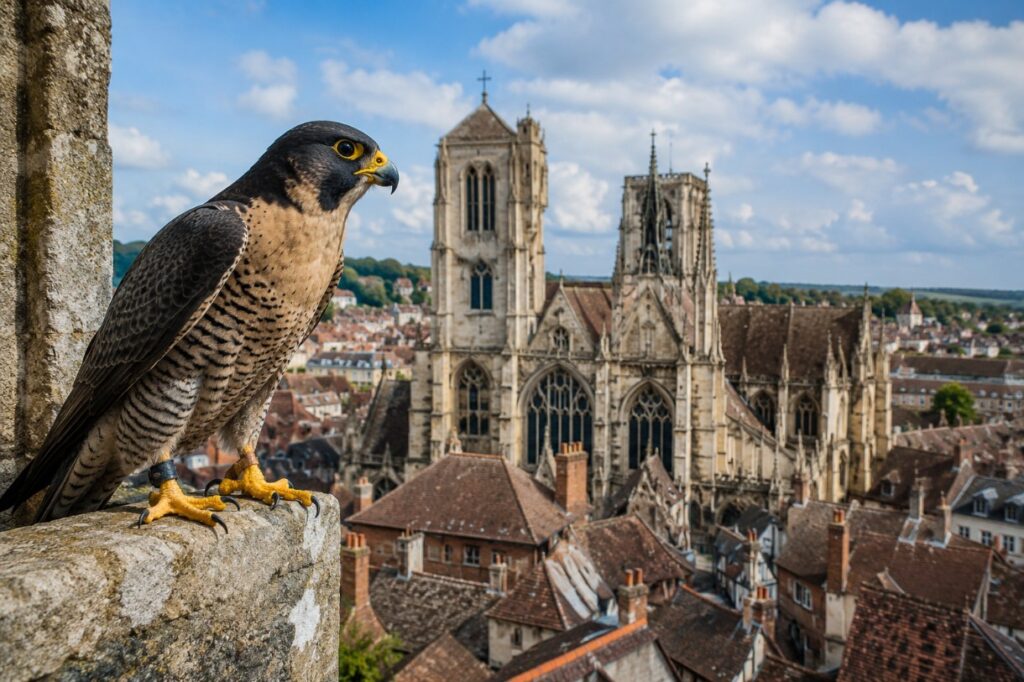
For a long time, the city center belonged to the pigeons. They perched on window sills, occupied the station, danced in the market square, and transformed historic facades into their homes. In many French cities, this was considered almost a natural law. But now, another shadow is crossing the sky over Troyes — the shadow of the peregrine falcon.
And this shadow is disturbing the usual order.
There is now officially a pair of peregrine falcons living in the city cathedral. A nest box has been installed over forty meters above ground. The first impression is romantic, as if wilderness has quietly returned among the Gothic towers and old rooftop views. However, behind this lies a solid urban policy.
Because pigeons cost money. A lot of money.
Pigeon droppings damage stone facades, pollute the squares, and harm historic buildings. The municipality spends enormous amounts every year on cleaning and maintenance. Especially in cities with protected cultural heritage areas, these costs quickly escalate. Therefore, the idea of bringing back a natural enemy seems quite sensible.
The peregrine falcon is perfect for this. Known as one of the fastest hunters in the world, its mere presence causes unease among pigeons. Experts call this the “deterrent effect.” Birds constantly sense danger and change their flight paths, gradually moving away from certain areas. There is no need for capture or problematic sterilization programs; instead, nature solves the problem on its own. Quite wise.
Especially remarkable is the history of this return. In the 1970s, peregrine falcons were nearly extinct in France. Their population had drastically declined due to pesticides and habitat destruction. Today, birds of prey are rediscovering urban areas. This makes biological sense. Tall church towers, contemporary high-rise buildings, and industrial facilities resemble the cliffs where they once nested.
The city is serving as a mountain.
Some residents now observe the peregrine falcons with nearly childlike enthusiasm. Ornithologists stand in the square with telescopes, families suddenly stop in front of the cathedral, looking up at the sky. These events also change the way the city itself is perceived. They create a renewed sense that nature exists not only in the countryside but also in the city, amidst asphalt, traffic, and concrete.
This aspect is probably the true charm. The peregrine falcon is more than just an elegant pest controller. It symbolizes a new urbanity and represents the city’s philosophy of coexistence with animals rather than their complete exclusion.
So, what about the pigeons?
They are slowly beginning to realize that the sky over Troyes is no longer theirs alone.
Andreas M. B.