
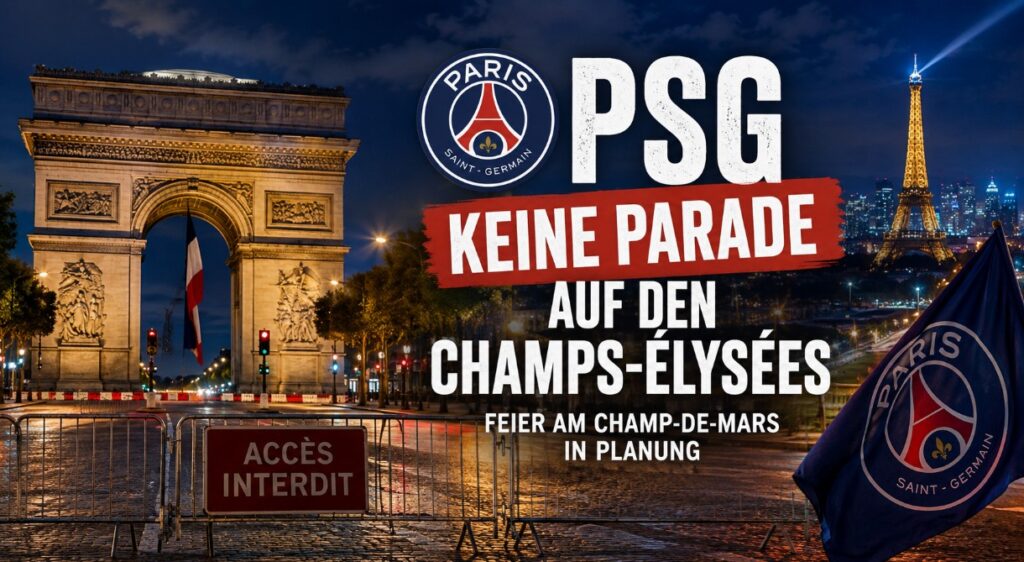
Paris loves its football nights. When Paris Saint-Germain Football Club reaches a European final, the city vibrates as if electrified. Cafés fill up late into the night, caravans of cars with horns drive along the boulevards, on every corner people discuss, curse, and wait. Before the UEFA Champions League final against Arsenal F.C., the gaze of the French capital once again turns toward a possible historic night. But something is clear before the opening whistle: this time there will be no triumphant parade along the Champs-Élysées.
The decision seems like a small political gesture amid the football fever.
While after the European victory in 2025 images of jubilant crowds around the world were still shared, now the city administration and the police prefecture are visibly holding back. The most famous avenue in France will not be deserted in the event of a PSG victory, but an official team parade is ruled out. Instead, the authorities are preparing extensive security measures. Already on Saturday afternoon parking bans will be applied around the Champs-Élysées, followed shortly after by street closures and traffic restrictions until early Sunday morning.
It sounds sober. Almost technocratic.
And that is where the message lies.
Paris wants to celebrate, but in an orderly manner.
The memory of past football nights is very present. Not all spontaneous celebrations ended peacefully; some developed dynamics that pushed the most experienced intervention teams to their limits. Broken bus stops, looted shops, burned trash bins: these scenes shape the political security perspective on large events in France. Football generates emotions, sometimes also chaos. Especially the Champs-Élysées are a nerve center: symbolic, crowded with tourists, and difficult to control.
That is why the officials seem to be considering an alternative celebration at the Champ de Mars, right at the foot of the Eiffel Tower. There it would be easier to regulate access and clearly delimit security zones. It somewhat resembles a festival venue rather than a spontaneous popular party. Some supporters probably will not look upon it favorably. Others simply say: this way is better.
Because the enthusiasm for PSG remains enormous.
For years the club has been trying to firmly establish itself among the European elite. National titles have almost become routine, but the Champions League holds an almost mythical character for Paris. Every final appearance carries the weight of a historic mission. Now against Arsenal, there is an opponent who also aims for European greatness: traditional, uncomfortable, and tactically dangerous.
In the bars around Belleville, Saint-Germain, or Montmartre, nothing else is being talked about. “If they win, the city goes crazy,” says the owner of a café near Place de la République, laughing. Then he gets serious. “But maybe this time Paris really needs a little more order.”
This is how the capital is currently moving between these two poles: passion and control, football ecstasy and security thinking.
The cancellation of a parade along the Champs-Élysées therefore represents much more than an organizational decision. It shows how today’s major sporting events carry a strong political and security charge. Even joy follows a protocol.
And yet, if PSG lifts the trophy again, Paris probably won’t sleep that night.