
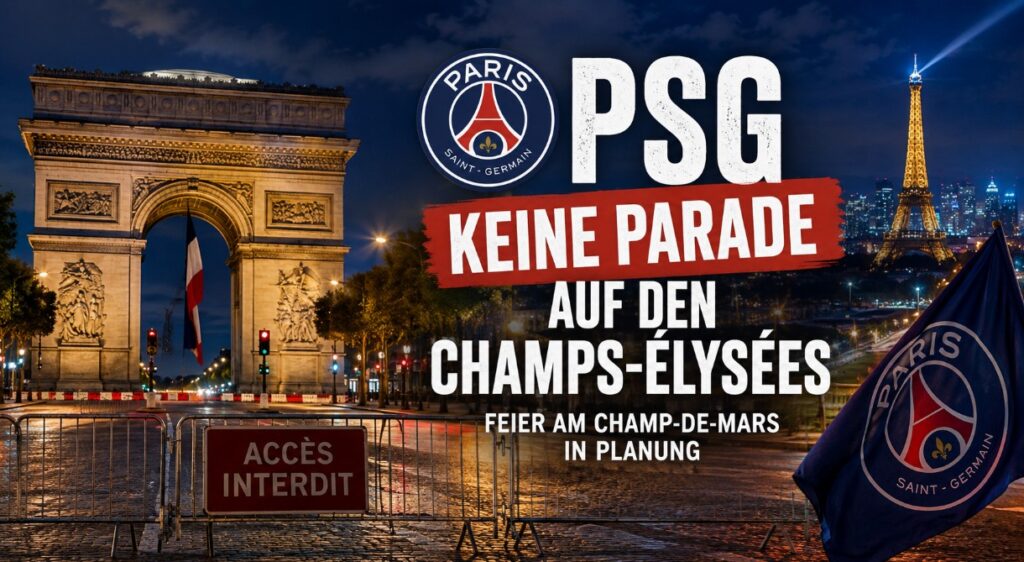
Paris loves soccer nights. When Paris Saint-Germain Football Club advances to a European final, the city trembles as if electrified. Cafes are packed until late at night, car convoys honk as they race down the main streets, debates spark on every corner, insults are exchanged, and expectations rise. Before facing Arsenal FC in the UEFA Champions League final, the eyes of the French capital are once again turned to the possibility of a historic night. But one thing is certain before kickoff. This time, there will be no victory parade on the Champs-Élysées.
This decision feels like a small political signal amid the soccer fever.
After the 2025 European title win, videos of jubilant people were broadcast worldwide, but this time, the city hall and the police department are clearly putting the brakes on. The most famous avenue in France will not be devoid of crowds during a PSG victory, but an official team parade is excluded. Instead, the authorities are preparing extensive security measures. On Saturday afternoon, parking will be prohibited around the Champs-Élysées, and soon road closures and traffic restrictions are expected to last until early Sunday morning.
This story sounds calm and almost technocratic.
But that is exactly where the message lies.
Paris wants to celebrate—but in an orderly manner.
Memories of past football nights are deeply engraved. Not all impromptu celebrations ended peacefully; some situations escalated to a point where even experienced security personnel felt overwhelmed. Damaged bus stops, looted shops, burning trash bins—such scenes shape the security policy perspective for large-scale events in France. Football stirs emotions, sometimes chaos as well. The Champs-Élysées, in particular, is like a nerve center: symbolic, overflowing with tourists, and difficult to control.
That is why those responsible seem to be considering celebration at the Champ de Mars at the foot of the Eiffel Tower instead. There, access can be more easily managed, and safety zones more clearly delineated. This might feel more like a festival venue than a spontaneous public fiesta. Some fans might be dissatisfied with this, but others may say, “Ah, that’s fine.”
Because the enthusiasm for PSG remains very strong.
The club has been striving for years to finally inscribe its name among Europe’s elite. Domestic titles have become almost routine, but the Champions League remains almost mythical in Paris. Each final appearance carries the weight of a historic mission. The match against Arsenal is traditional for a continental powerhouse, a formidable opponent with tactically dangerous challenges ahead.
In bars around Belleville, Saint-Germain, and Montmartre, there is hardly any other topic. “If they win, the city will completely erupt,” says the owner of a café near Place de la République with a laugh. Then he turns serious. “But perhaps this time, Paris needs a bit more order.”
It is precisely between these two extremes that the capital is swaying: enthusiasm and control, football ecstasy and concern for safety.
The decision to cancel the parade on the Champs-Élysées is more than just an administrative choice. It shows how much today’s large-scale sporting events are subject to political and security prerequisites. Even joy now follows protocols.
Nonetheless—if PSG lifts the trophy again, Paris will hardly sleep that night.