
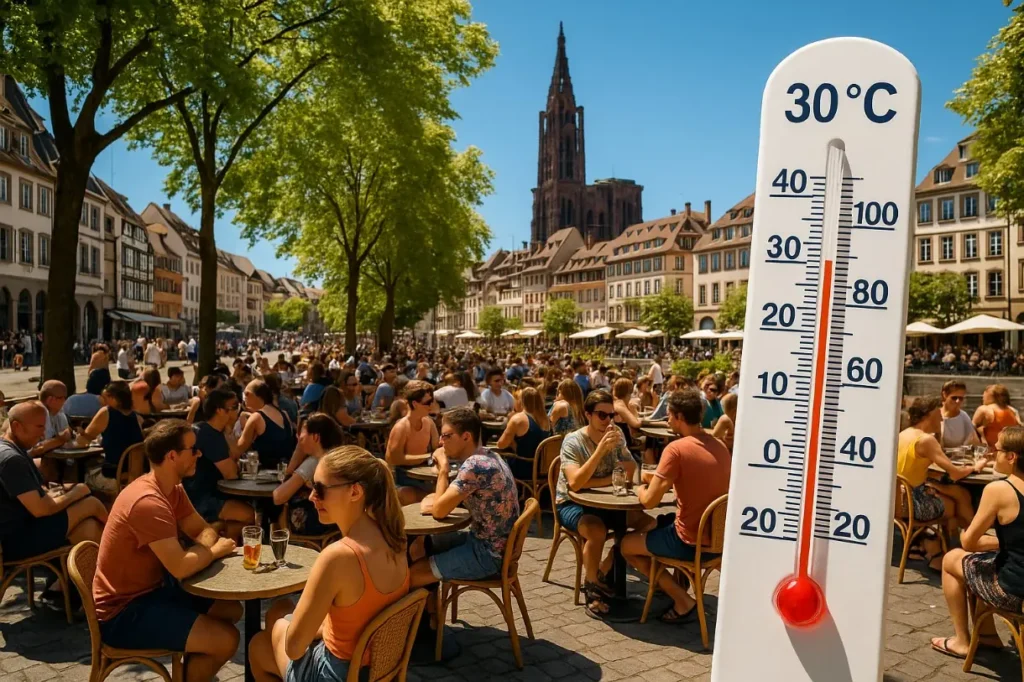
France is experiencing weather conditions at the end of May that are usually seen in high summer. Currently, a powerful phenomenon called a “heat wave dome” is covering a wide area of the country, with temperatures well exceeding 30 degrees in many regions. The most affected areas are particularly the western region, around Paris, the southwest, and parts of the Rhône Valley.
Meteorologists point out this abnormal situation. The heat wave dome acts like a giant lid in the sky. A stable high-pressure zone traps warm air flowing in from North Africa through Spain to France. The heat is literally accumulating over the country, and it hardly cools down at night — making these weather conditions very stressful for the human body.
In some areas, temperatures have reached 35 to 36 degrees. This is an extremely rare value for late May. Many French people already rely on fans, closed shutters, and water bottles, a staple in refrigerators. In street cafes in Bordeaux and Lyon, scenes can be seen where visitors desperately search for seats in the shade. Voices saying “It’s just like July” can be heard everywhere.
It is particularly noteworthy that since the introduction of France’s heatstroke warning system in 2004, this is the first time such a high alert level has been issued so early in the season. The Meteorological Agency Météo-France is now urging many departments to strengthen their vigilance. Specifically, this includes parts of the Brittany region, the Paris metropolitan area, and several areas along the Atlantic coast.
Health authorities are calling for caution. Especially at risk are the elderly, children, and people working outdoors. Even the yellow warning level indicates that health risks are realistic. Doctors recommend avoiding physical exertion during the hottest hours, staying well hydrated, and keeping living environments as cool as possible. While this may seem simple, these basic rules are often neglected in everyday life.
At the same time, discussions about climate change are flaring up again. Climatologists have been observing for years that early and intense heatwaves are increasing in Europe. What was once an exceptional phenomenon is gradually becoming a new reality. France, in particular, is one of the European countries that has repeatedly experienced extreme summers in recent years.
The memory of the devastating heatwave in 2003 is still deeply etched. At that time, thousands of people died due to the extreme temperatures. Since then, the government has become sensitive to early warning signs. Schools, hospitals, and care facilities are especially carefully monitored when high temperatures persist for several days.
So far, a nationwide heatwave crisis covering all of France has not been officially recognized. However, many French people already sense it. The summer of 2026 seems to have started very early and intensely.
Reported by C. Hatty