
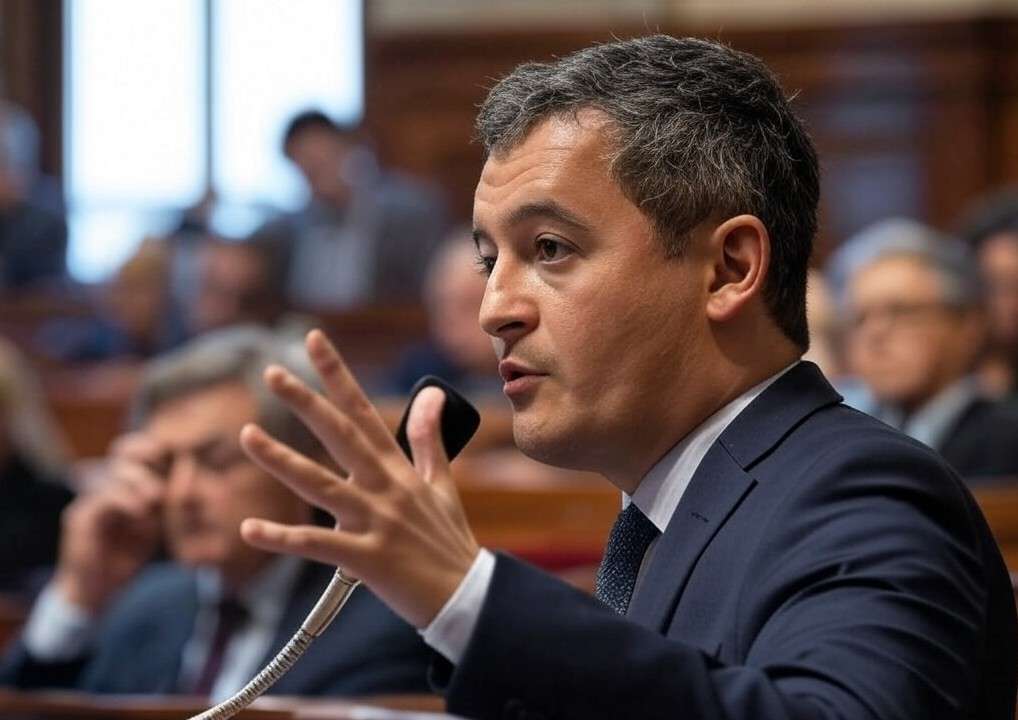
With his proposal for a “three-year moratorium on legal immigration,” French Justice Minister Gérald Darmanin has once again clearly shifted the country’s political debate to the right. This demand marks not only a rhetorical escalation in the French migration discourse, but also the beginning of a strategic reorganization of conservative forces ahead of the 2027 presidential election.
In an interview, Darmanin said that France was “at the limits of its capacity for integration and assimilation.” He is thus using terms that, for a long time, were primarily reserved for the ideological vocabulary of the French right and the National Rally. The fact that a prominent representative of the former liberal-centrist Macron camp now uses similar formulations shows how much the political center in France has shifted on migration issues.
Specifically, Darmanin proposes a temporary suspension of essential parts of legal immigration. Restrictions on family reunification, binding migration quotas with constitutional rank, as well as annual parliamentary debates on countries of origin and professional profiles of authorized migrants are being discussed. This initiative is less to be understood as a technocratic reform than as a political signal: the control of migration must become a central theme of public order for the election years to come.
The strategic positioning of a potential candidate
Officially, Gérald Darmanin has not yet announced his candidacy for the presidency. Yet many observers interpret his statements as part of a long-term political positioning. President Emmanuel Macron will constitutionally not be able to run again in 2027. In the power vacuum that is created, several figures from the government circle are trying to position themselves as successors.
Darmanin is deliberately occupying the space between a weakened Macronism and an increasingly dominant right. For years, a structural shift in political discourse has been observed in France: topics such as national identity, security issues and migration dominate the public debate more than classic socio-economic conflicts. The success of the National Rally under Marine Le Pen has accelerated this change.
One can particularly notice Darmanin’s own political biography. A few years ago he was still regarded as a pragmatic domestic politician with a conservative stamp but within the republican framework. As Minister of the Interior he largely contributed to the 2024 migration reform which on the one hand made expulsions easier while on the other provided possibilities for regularization for workers in sectors with shortages. Today that same politician actually talks about a temporary halt to a large part of legal immigration. This shows how much the political logic has changed: symbolic toughness now often matters more than administrative pragmatism.
Legal obstacles and European limits
The practical feasibility of such a moratorium, however, remains extremely uncertain. France is bound by numerous constitutional and European obligations. Family reunification as well as the right to asylum, in particular, are legally protected. Added to these are the European rules on the free movement of workers within the EU, which significantly limit unilateral national initiatives.
Darmanin himself acknowledges that a constitutional amendment would be necessary for his plans. But even that would not automatically make national law prevail over European law. France would have to reckon with the European Convention on Human Rights, EU directives as well as decisions of European courts. A complete halt to immigration would likely lead to legal conflicts that would last several years.
Added to this is an administrative problem often underestimated in political debates: “immigration” does not actually exist as a unified category. France distinguishes between labor migration, family reunification, student visas, asylum procedures, European mobility and humanitarian residence rights. Many of these areas are subject to distinct legal bases and international obligations. The concept of an overall “migration stop” therefore mainly functions as a political slogan.
The economic reality of France
The proposal becomes even harder to imagine when closely examining France’s economic reality. Many sectors are now structurally dependent on foreign labor. Particularly affected are gastronomy, construction, agriculture, care services and parts of the healthcare system.
Already today, many companies complain of a lack of personnel. France is aging demographically while certain professions are becoming increasingly unattractive to domestic workers. A complete moratorium on labor migration could therefore have significant economic consequences — ranging from higher wage costs to production shortages and an additional burden on public services.
French employers have so far been cautious, but they will likely have little interest in a total halt to labor migration. In the past, a tense balance of forces has often existed between critical rhetoric on migration and economic reality: while politicians call for tighter controls, the economy remains largely dependent on foreign workers.
This gap is not limited to France. Similar developments can be observed in other European countries. Even governments with restrictive migration policies are regularly forced to allow targeted labor migration to ensure economic stability.
The ideological shift of the political center
The real core of the debate therefore lies less in the concrete feasibility of the moratorium than in its symbolic impact. For years France has experienced a profound ideological shift in the public discourse on migration and national identity.
Terms such as “assimilation,” “saturation” or “limits of integration” are now widely accepted beyond the traditional right-wing camp. Center parties increasingly adopt narratives that were previously considered exclusively right-wing nationalist. This shift reflects a broader evolution in Europe, where migration is no longer discussed mainly as an economic or humanitarian issue, but as a cultural and identity challenge.
This dynamic is reinforced by social uncertainties: terrorism, social tensions in the suburbs, debates about secularism and integration problems have marked the political atmosphere in France for years. In this context, calls for limitation and control find growing resonance — even outside traditional right-wing electorates.
Darmanin is thus responding not only to pressure from the National Rally, but also to a shift in public opinion. The political center is trying to demonstrate firmness on migration in order to prevent a further loss of conservative voters.
It is already clear today that the 2027 presidential election has effectively begun. And as in previous French election campaigns, migration is likely to become one of the dominant themes again. Gérald Darmanin’s initiative shows less short-term pragmatic politics than the issues that will shape political discourse in the future.
Author: P. Tiko