
The dynamics are further strengthened by societal uncertainties: terrorism, social tensions in suburbs, debates about the separation of church and state, and integration problems have shaped the political atmosphere in France for years. In this context, demands for limitation and control are gaining more and more support — even beyond traditional right-wing voter groups.
Darmanin is thus responding not only to the pressure from the Rassemblement National but also to a changed public sentiment. The political center is trying to harden migration policy to prevent further loss of conservative voters.
The fact is already: the 2027 presidential election has effectively begun. And just like in previous French election campaigns, migration will once again be one of the dominant themes. Gérald Darmanin’s initiative shows less which politics are realistic in the short term, but more which themes will shape the political discourse in the future.
Author: P. Tiko
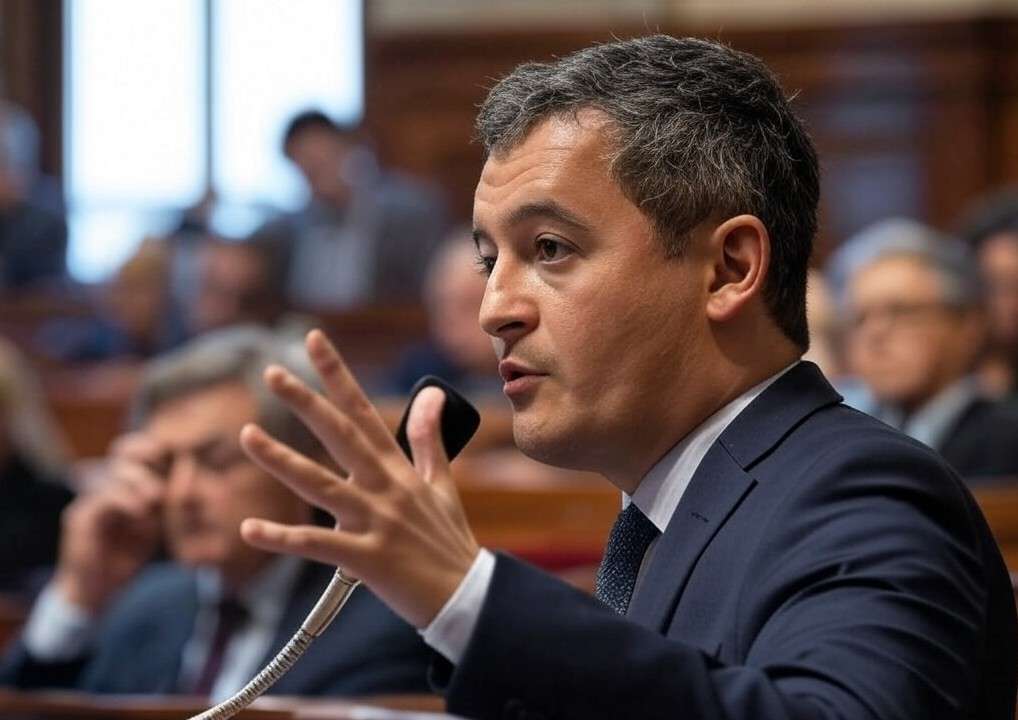
With his proposal for a “three-year moratorium on legal immigration,” the French Minister of Justice Gérald Darmanin has clearly shifted the political debate in the country further to the right. The demand not only marks a rhetorical escalation in the French migration discourse but also the beginning of a strategic repositioning of conservative forces ahead of the 2027 presidential elections.
In an interview, Darmanin stated that France has “reached the limits of its integration and assimilation capacity.” With this, he uses terms that for a long time were primarily part of the ideological vocabulary of the French right-wing and the Rassemblement National. That a prominent representative of the once liberal-centrist Macron camp now uses similar wording shows how much the political center in France has changed regarding migration.
Specifically, Darmanin proposes a temporary suspension of essential parts of legal immigration. There is talk of restrictions on family reunification, binding migration quotas with constitutional status, and annual parliamentary debates about countries of origin and professional profiles of admitted migrants. The step should be seen less as a technocratic reform and more as a political signal: control over migration must become the central regulatory theme in the coming election years.
The strategic positioning of a potential candidate
Officially, Gérald Darmanin has not yet announced a presidential candidacy. Nevertheless, many observers interpret his statements as part of a long-term political positioning. President Emmanuel Macron is legally not allowed to run again in 2027. In the resulting power vacuum, several figures from government circles are trying to profile themselves as successors.
Darmanin deliberately occupies the space between a weakened Macronism and an increasingly dominant right wing. For years, a structural shift in the political discourse has been visible in France: themes such as national identity, security issues, and migration strongly influence the public debate more than traditional socio-economic conflicts. The success of the Rassemblement National under Marine Le Pen has further accelerated this change.
The political biography of Darmanin himself is remarkable in this regard. A few years ago, he was seen as a pragmatic domestic politician with a conservative signature, but within the republican framework. As Minister of the Interior, he was closely involved in the 2024 immigration regulation, which on one hand facilitated expulsions but on the other hand provided regularization opportunities for workers in shortage regions. Now the same politician is effectively speaking of a temporary stop on large parts of legal migration. This shows how strongly the political logic has changed: symbolic hardness often counts more today than administrative pragmatism.
Legal obstacles and European boundaries
The practical feasibility of such a moratorium remains highly doubtful. France is bound by numerous constitutional and European obligations. In particular, family reunification and asylum law are legally protected. In addition, European regulations on the free movement of workers within the EU, which strongly limit unilateral national actions, apply.
Darmanin himself admits that a constitutional amendment would be necessary for his plans. But even that would not automatically override European law. France would have to take into account the European Convention on Human Rights, EU directives, and rulings of European courts. A comprehensive immigration freeze would therefore likely cause years of legal conflicts.
Furthermore, there is an administrative problem that is often underestimated in political debates: “immigration” does not actually exist as a clear-cut category. France distinguishes between labor migration, family reunification, student visas, asylum procedures, European mobility, and humanitarian residence rights. Many of these areas are subject to different legal frameworks and international obligations. The term of a general “migration stop” therefore functions mainly as a political slogan.
The economic reality of France
The proposal is viewed as even more complicated from the economic reality of France. Numerous sectors have now become structurally dependent on foreign labor. Especially affected would be the hospitality industry, construction sector, agriculture, care, and parts of healthcare.
Even today, many companies complain about a shortage of labor. France is becoming demographically older, while certain professions are becoming increasingly unattractive to domestic workers. A complete moratorium on labor migration could therefore have significant economic consequences — from rising labor costs to production problems and additional strain on public services.
The French employers’ organization has so far been cautious, but will likely have little interest in a full halt to labor migration. In the past, there has always been a tension between migration-critical rhetoric and economic reality: while politicians demanded stricter controls, the economy often remained dependent on foreign labor.
This gap is certainly not limited to France. Similar developments can also be seen in other European countries. Even governments with restrictive migration policies are regularly forced to allow targeted labor migration to ensure economic stability.
The ideological shift of the political center
The actual core of the debate therefore lies less in the concrete feasibility of the moratorium than in its symbolic impact. France has been experiencing a profound ideological shift in the public discourse on migration and national identity for years.
Concepts such as “assimilation,” “saturation,” or “integration limits” have meanwhile become widely accepted outside the traditional right-wing camp. Centrist parties increasingly adopt narratives that were previously considered exclusively right-nationalist. This change is an expression of a broader European development, where migration is no longer primarily discussed as an economic or humanitarian issue, but as a cultural and identity-political challenge.
The dynamics are further strengthened by societal uncertainties: terrorism, social tensions in suburbs, debates about the separation of church and state, and integration problems have shaped the political atmosphere in France for years. In this context, demands for limitation and control are gaining more and more support — even beyond traditional right-wing voter groups.
Darmanin is thus responding not only to the pressure from the Rassemblement National but also to a changed public sentiment. The political center is trying to harden migration policy to prevent further loss of conservative voters.
The dynamics are further strengthened by societal uncertainties: terrorism, social tensions in suburbs, debates about the separation of church and state, and integration problems have shaped the political atmosphere in France for years. In this context, demands for limitation and control are gaining more and more support — even beyond traditional right-wing voter groups.
Darmanin is thus responding not only to the pressure from the Rassemblement National but also to a changed public sentiment. The political center is trying to harden migration policy to prevent further loss of conservative voters.
The fact is already: the 2027 presidential election has effectively begun. And just like in previous French election campaigns, migration will once again be one of the dominant themes. Gérald Darmanin’s initiative shows less which politics are realistic in the short term, but more which themes will shape the political discourse in the future.
Author: P. Tiko