
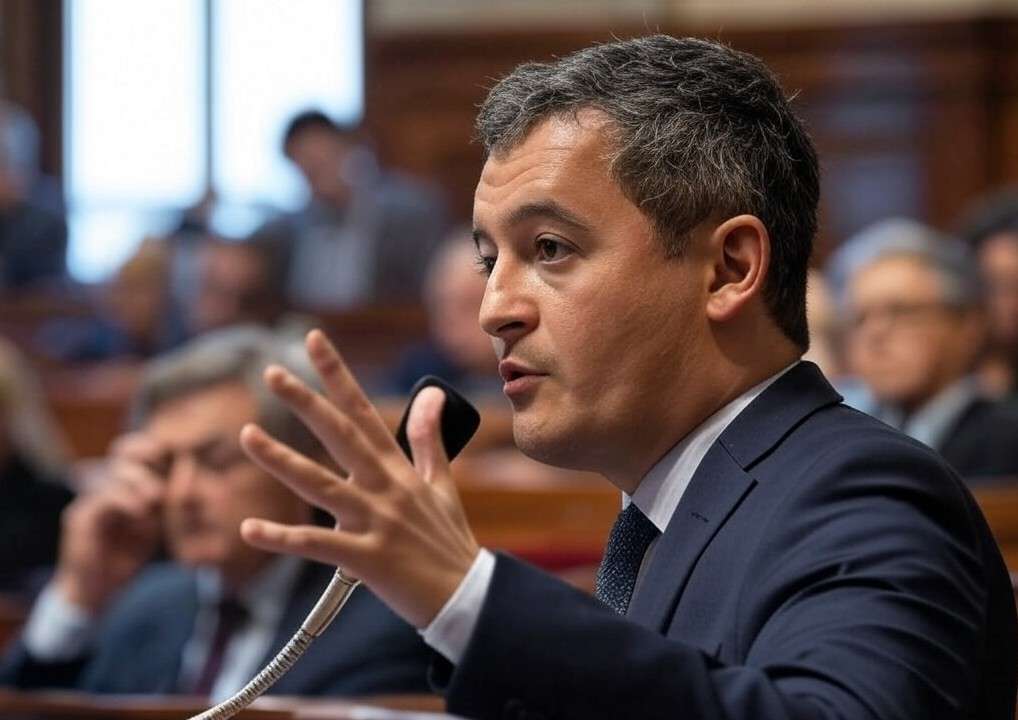
The proposal of a “three-year moratorium on legal immigration” has once again pushed the political debate in France clearly further to the right by the country’s Minister of Justice, Gérald Darmanin. This demand not only represents a rhetorical escalation in France’s immigration controversy but also signals the beginning of a strategic realignment of the conservative forces ahead of the 2027 presidential election.
In an interview, Darmanin stated that France has “reached the limits of its capacity for integration and assimilation.” This incorporates concepts that have so far been used mainly in ideological terms by the French right and the National Rally (Rassemblement National). The fact that prominent figures from Macron’s camp, formerly considered liberal centrists, have begun to use similar expressions indicates a significant shift in the political center of France regarding immigration issues.
Specifically, Darmanin proposes temporarily halting a significant portion of legal immigration. Restrictions on family reunification, immigration quotas as constitutional provisions, and annual parliamentary debates on the nationality of accepted immigrants and their occupational profiles are under consideration. This proposal is perceived more as a political message than a technical reform and aims to make immigration management a central theme in the upcoming election years.
Strategic Positioning of Potential Candidates
Officially, Gérald Darmanin has not yet announced his candidacy for the presidential election. Nevertheless, many observers interpret his statements as part of long-term political positioning. President Emmanuel Macron is not constitutionally allowed to be re-elected in 2027. In this power vacuum, several figures around the government are aiming to establish themselves as successors.
Darmanin intentionally occupies the space between the weakened Macronism and the rising right-wing forces. In France, political discourse has been structurally changing for several years. National identity, security issues, and immigration dominate public debate more strongly than traditional socio-economic conflicts. The success of the National Rally led by Marine Le Pen has further accelerated this change.
What is notable is Darmanin’s own political career. Until a few years ago, he was known as a pragmatic domestic official with conservative inclinations, but remained within the framework of the republic. As Minister of the Interior, he played an important role in the 2024 immigration reform, on the one hand facilitating deportations, while also including the possibility of regularizing residence permits for occupations facing labor shortages. However, now the same politician is effectively advocating for a suspension of the majority of legal immigration. This represents a major shift in political logic and shows that symbolic toughness is being prioritized over administrative pragmatism.
Legal Barriers and European Limits
However, the feasibility of such a moratorium remains highly questionable. France is bound by many constitutional and European obligations, especially family reunification and asylum requests, which are legally protected. In addition, European regulations on the free movement of workers within the EU significantly restrict unilateral actions.
Darmanin himself admits that a constitutional amendment is necessary for the plan. However, even if the constitution is amended, European law does not automatically become invalid. France must confront the European Convention on Human Rights, EU directives, and rulings of the European Court, and a comprehensive immigration suspension is likely to trigger many legal disputes.
There are also administrative issues, and it is often underestimated in political debates. The unified category of “immigrants” does not actually exist. France distinguishes between labor immigrants, family reunification, student visas, asylum applications, intra-European movement, and humanitarian residence rights. Since each of these has different legal foundations and international obligations, the concept of a “stop to immigration” mainly functions as a political slogan.
The Economic Reality of France
Looking more closely at the economic reality, this proposal becomes even more challenging. Many industries structurally depend on foreign labor. The restaurant industry, construction, agriculture, caregiving, and healthcare sectors would be particularly affected.
Many companies are already reporting labor shortages. France’s population is aging, while certain occupations are becoming less attractive to domestic workers. A complete stop to labor immigration could have significant economic impacts, including wage increases, production stagnation, and further strain on public services.
French employer organizations have so far taken a cautious stance and are seen as reluctant toward a complete stop to labor immigration. In the past, there has been tension between harsh rhetoric on immigrants and economic realities. While politicians call for stricter regulations, the economic sector continues to rely on foreign labor.
This gap is not limited to France alone. Similar trends can be seen in other European countries as well. Even governments with strict immigration policies are currently compelled to accept strategic labor immigration in order to ensure economic stability.
Ideological Shift in the Political Center
The essential point of the debate lies more in its symbolic impact than in the concrete feasibility of the moratorium. France has experienced a profound ideological shift in public discourse concerning immigration and national identity over several years.
Terms such as “assimilation,” “saturation,” and “limits of integration” are now widely accepted beyond the traditional right-wing. Centrist parties have begun adopting narratives once monopolized by right-wing nationalism. This shift reflects a broader trend across Europe where immigration is no longer primarily treated as an economic or humanitarian issue but as a cultural and identity issue.
Furthermore, social unrest such as terrorism, suburban social tensions, and debates over secularism and integration issues are accelerating this trend. Under these circumstances, demands for limitation and control are gaining support beyond the traditional right-wing base.
Darmanin’s response is not only to pressure from the National Rally but also to changed public sentiment. The political center is trying to take a tough stance on immigration policy to prevent further loss of conservative voters.
For now, the 2027 presidential election has effectively already begun. As has been the case in past French election campaigns, immigration issues will once again be one of the main points of contention. Gérald Darmanin’s proposal does not indicate which policies are realistic in the short term, but rather reveals the themes that will dominate political discourse going forward.
Author: P. Tiko