
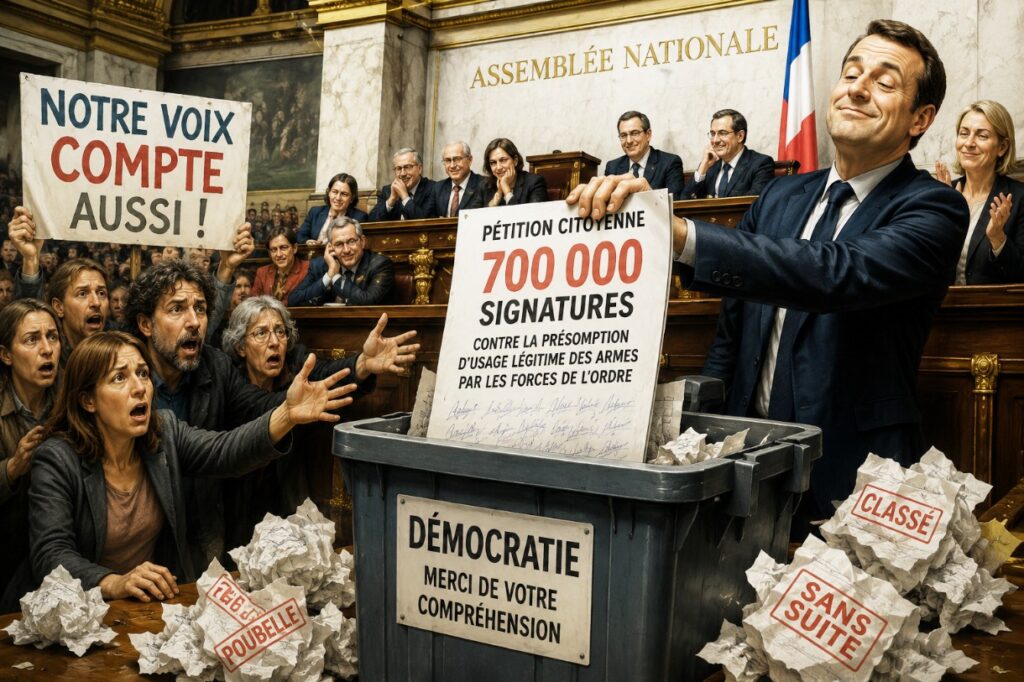
700,000 signatures. Seven hundred thousand.
In a democracy, one would think that such a number would at least bring about one thing: being heard. A debate. A public confrontation of arguments.
Yet what happened was something difficult to surpass in bureaucratic arrogance: The petition was reviewed, politely acknowledged – and then transferred to the political archive drawer. Thank you for your commitment. The exit is at the back.
One almost has to congratulate the French Parliament. In record time, it has succeeded in explaining to hundreds of thousands of citizens that their voices are welcome – provided they do not change anything.
Of course, everything was fully compliant with the law. No one ever claimed that 500,000, or even 700,000 signatures, oblige Parliament to hold a debate. The law merely says: look it over, nod, move on. Democracy by file.
So the real problem lies not in the legal decision, but in the political message.
That message is: Your participation only interests us as long as it does not disrupt our schedule.
Anyone who has spent months collecting signatures, mobilizing supporters and finally submitting one of the most successful petitions in recent French history can apparently expect only one thing: a rejection on official letterhead.
One cannot help but wonder why this platform exists at all. Perhaps as a kind of democratic gym. Citizens are allowed to get involved, flex their muscles, and then realize that the weights are made of rubber.
For years, politicians have complained about political apathy, declining voter turnout and fading trust in state institutions. At the same time, they impressively demonstrate how to produce precisely that distrust.
After all, what is a citizen supposed to think when not even 700,000 voices are worth a debate?
Perhaps the petition should have been submitted as a TikTok dance video. There, attention now seems to be worth more than on an official platform of Parliament.
Those defending this decision argue that the bill has been debated. That is true. But precisely for that reason, a debate on the petition would be a strong signal: We have decided—and nevertheless, we are listening to the citizens once again.
Democracy does not exist because parliaments constantly change their minds. But it exists because they are willing to face public criticism.
Instead, one gets the impression of a class of politicians willing to praise citizen participation in Sunday speeches, but who regard it as an annoying disruption in everyday parliamentary life.
Perhaps Parliament should have the courage to honestly rename the rules.
No longer “right to petition,” but “petition archive.”
At least that would be transparent.
And perhaps the most honest reform in a long time.
C. Hatty