
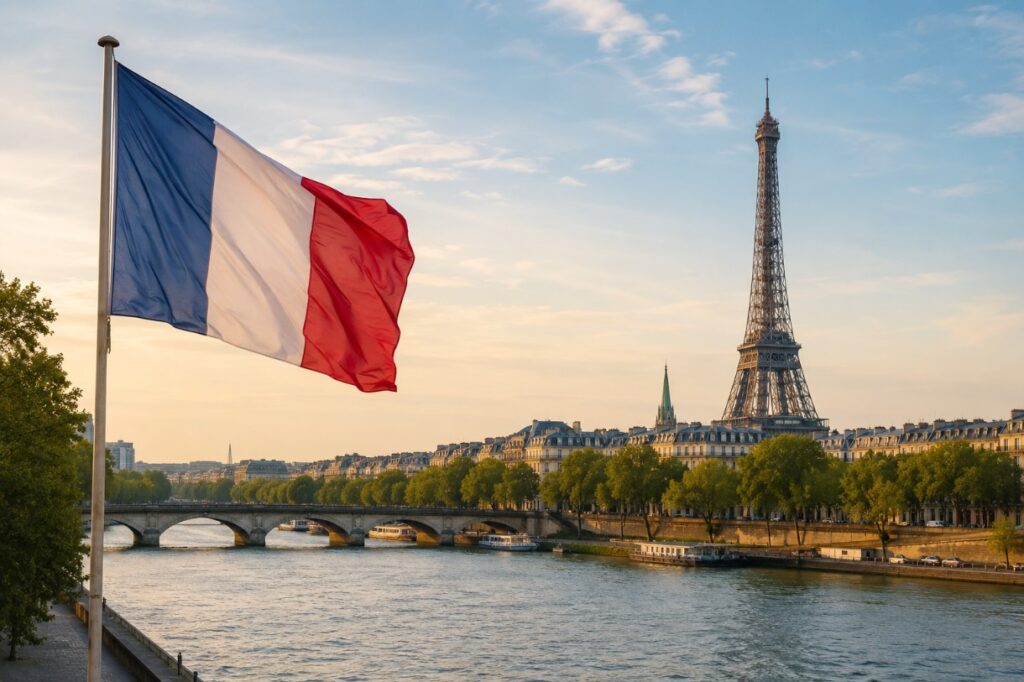
France is experiencing on this May 27, 2026, one of those days when political, social, and international tensions converge into a general panorama. The headlines initially seem disparate: heatwave, presidential elections, migration, crisis in the Middle East, and football. But together they tell the story of a country in transition – of a republic that, after years of ongoing crises, increasingly looks nervously at its own future.
The French public seems both exhausted and highly politicized. Many debates revolve around the same fundamental question: Is the state gradually losing the ability to guarantee order, prosperity, and security? This sentiment permeates much of the press today.
The long shadow of the 2027 presidential elections
Officially, the election campaign has not yet begun. But France is already in a pre-election phase. Since the parliamentary crises of recent years, there is no longer a stable political center. The former order of the Fifth Republic – once characterized by clear majorities and strong presidents – seems increasingly fragmented.
Currently, competition within the moderate bourgeois bloc is observed with particular intensity. Gabriel Attal continues to try to position himself as a dynamic figure of modernization. For his part, Édouard Philippe represents for many conservative voters the state’s political stability and administrative experience. Both know that the political vacuum after Emmanuel Macron could be large.
Meanwhile, Prime Minister Sébastien Lecornu is under increasing pressure. His government appears technocratically capable of acting, but politically fragile. That is why, in many editorials, a term that has historical weight in France reappears: “fin de règne” – the feeling of a political cycle coming to an end.
At the same time, the Rassemblement National maintains a strategic advantage. The party hardly has to govern at this moment, but can dominate the debates: migration, purchasing power, insecurity, and national identity. The political right benefits less from fervor and more from the erosion of trust in traditional institutions.
The situation also worsens on the left. Jean-Luc Mélenchon continues mobilizing a radical urban and young audience, but at the same time faces massive rejection in the political center. France today seems ideologically more polarized than ten years ago.
The heat wave as a political omen
Practically no topic currently dominates the French media more than the exceptionally early heatwave. Temperatures above 35 degrees at the end of May are considered alarming even for southern France.
But the coverage goes far beyond meteorological aspects. The heat is progressively becoming a political symbol. Many commentators describe France as a country that is not infrastructurally prepared for the new climate reality.
The major cities are especially affected. Paris, Lyon, or Marseille suffer from extreme soil sealing, lack of green areas, and overheated residential neighborhoods. Many schools still do not have adequate cooling systems. In numerous suburbs, the heatwave further exacerbates social inequalities: those who are well-off escape the burden through second homes or air-conditioned residences; those who are poor remain in the concrete.
The term “France suffocating” therefore describes not only the climate but also a social mood. France seems overwhelmed in many places — administratively, infrastructurally, and financially.
Additionally, there is the issue of water. Restrictions are already being discussed in several regions. Farmers warn of problems with the crops, while municipalities debate the safety of the supply during the summer. Climate change is no longer an abstract future issue in France but part of everyday politics.
Migration and security as a permanent crisis
Practically no political field today mobilizes French public opinion more than migration and security. The recent statements by Gérald Darmanin about a possible moratorium on certain parts of legal immigration have further fueled the debate.
Conservative media openly talk about a historic limit of burden. Left-wing commentators, on the other hand, warn of a rhetorical shift in which far-right narratives increasingly infiltrate the dominant political discourse.
Particularly striking is the connection of several topics: migration, drug-related crime, urban violence, and state authority are now frequently discussed together in France.
The situation in Marseille is emblematic. The violence of rival drug trafficking networks has occupied the police and judiciary for months. At the same time, the feeling of insecurity in public spaces is growing in many places, regardless of whether crime rates actually increase or not.
What is decisive is less the objective statistics than the political perception. France is today intensely debating state control: over the borders, neighborhoods, the monopoly of violence, and the judiciary’s ability to act.
For this reason, security will probably be the central theme of the next presidential election campaign.
France between Global Crises and European Powerlessness
There is also notable nervousness in Paris regarding foreign policy. The escalation in the Middle East and tensions around Iran are being closely followed in France, rightly so due to possible repercussions on energy prices and inflation.
There is a fear of a new wave of economic shock. France has been struggling for years with high public debt, low growth, and structural problems in public finances. A new energy crisis could further destabilize the social situation.
At the same time, international developments reveal a strategic dilemma for Europe. Many French commentators criticize that the European Union remains very dependent on the United States in foreign and security policy, while China expands its economic and geopolitical position.
This debate touches a core of the French raison d’état: the aspiration for strategic autonomy. But today France seems weakened in domestic politics and limited in its capacity to act abroad.
The contrast could not be greater: while international crises escalate, French domestic politics simultaneously deals with issues such as pensions, violent crime, and plans to face the heat wave.
PSG and the search for national symbolism
Even football currently takes on a political dimension in France. The upcoming Champions League final between Paris Saint-Germain and Arsenal FC is discussed beyond sports.
For many fans, a European victory would be the club’s definitive international legitimization. Others continue to see PSG as an artificial project without historical depth – financially gigantic, but culturally controversial.
The role of the state is notable. Authorities are preparing intensively for possible celebrations and riots. After the violent episodes of previous years, great caution prevails. Even major sporting events are now viewed in France from a security perspective.
This is symptomatic of the country’s general mood: even moments of collective joy are marked by social tension.
France appears on May 27, 2026, as a republic caught between the art of living and exhaustion. Cafés, festivals, travel, and football continue to generate that image of French lightness admired internationally. At the same time, the feeling of structural fragility is growing.
The major debates of the day – climate, migration, state authority, geopolitical insecurity, and political fragmentation – ultimately revolve around the same question: Can France still fulfill the promise of republican stability?
There is still no clear answer to this. But it is precisely this uncertainty that currently defines the country’s political atmosphere.