
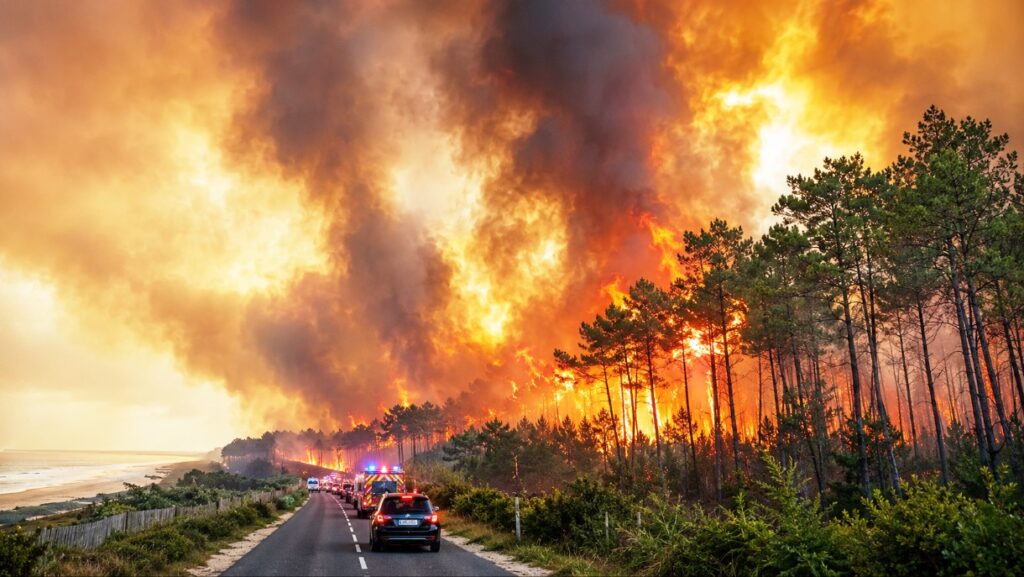
The plumes of smoke over the Gironde have long been more than a summer extreme event. They represent a structural vulnerability that has built up over decades and is now becoming plainly apparent under changing climatic conditions. The evacuation of tens of thousands of people around the Bassin d’Arcachon is not an isolated exceptional case, but the expression of a system reaching its limits.
It would be politically convenient to identify a single culprit – climate change, forestry or human negligence. But reality is more complex. The major fires in southwestern France arise from the interaction of several factors that reinforce one another. It is precisely this combination that makes them so difficult to control.
An Artificial Forest with Historical Roots
The Landes de Gascogne forest is considered one of Europe’s largest contiguous forest areas. Its appearance suggests natural origins, but in fact it is largely a human-made system. In the 19th century, the region was deliberately reforested to stabilize sandy soils, drain marshes and produce commercially usable timber.
The maritime pine was chosen – a tree species ideally adapted to barren, dry sites. It grew quickly, had commercial value and could be efficiently organized in large stands. This created a forestry landscape that was regarded as a success story for decades.
But this efficiency comes at a cost. The extensive uniformity of the stands means that combustible material stretches almost uninterruptedly over large distances. Different age structures, natural breaks or wetter zones are comparatively rare. What brings economic benefits under normal conditions becomes a weakness in an emergency.
The Logic of Fire: Continuity Rather Than Chance
Wildfires rarely begin spectacularly. A spark is enough – often triggered by human carelessness. What matters is not the ignition, but whether the fire can spread.
In southwestern France, such a spark encounters a landscape that offers ideal conditions. Needles, twigs and dry vegetation accumulate on the forest floor and quickly become highly flammable material in the heat. This layer acts like tinder. From there, flames can rise through shrubs and low-hanging branches into the tree crowns.
Once the fire reaches the crowns, its dynamics change fundamentally. It spreads faster, develops higher temperatures and becomes difficult for emergency crews to control. The uniform structure of the pine forests facilitates its spread: the fire finds hardly any natural barriers.
Soil That Accelerates Drought
The particular nature of the soils further amplifies the risk. The region is characterized by sandy, permeable substrates that retain hardly any water. After rainfall, the landscape appears moist for a short time, but the upper layers dry out quickly again.
This means that months-long droughts are not necessary to create dangerous conditions. Just a few weeks without significant rainfall are enough to bring vegetation into a highly flammable state.
Combined with rising temperatures and intense sunlight, this creates an environment in which even small ignition sources can trigger major fires.
Wind as a Fire Accelerator
There is another factor, often underestimated: wind. The region’s flat topography offers it little resistance. At the same time, the proximity of the Atlantic and local temperature differences create variable air currents.
Wind can not only fan a fire, but also make it unpredictable. Glowing particles are carried over great distances and ignite new fire outbreaks – often far ahead of the actual fire front. This creates multiple fire lines that reinforce one another.
For the fire service, this presents an enormous challenge. Strategies must be continually adapted, and areas believed to be secure can become dangerous again within a very short time.
Climate Change as a Multiplier
In this configuration, climate change does not act as an immediate cause but as an amplifier. More frequent heatwaves, longer dry periods and increasing evaporation cause forests to dry out more quickly and remain in a critical condition for longer.
At the same time, the temporal dimension of the threat is shifting. The wildfire season begins earlier in the year and ends later. Periods of extreme risk occur more frequently and last longer.
Consecutive dry years are particularly problematic. They weaken trees, increase the share of dead biomass and create additional fuel. The landscape enters a cycle of growing vulnerability.
Humans as the Trigger
Despite all the structural and climatic factors, people remain the trigger of a fire in most cases. Cigarettes, sparks from machinery, poorly controlled fires or everyday carelessness – the list of possible causes is long.
In the southwest, this risk is exacerbated by the close interweaving of forest and settlement. Around the Bassin d’Arcachon, holiday homes, campsites and transport routes directly border forest areas. During peak season, the number of people rises – and with it the likelihood of a fire.
At the same time, firefighting becomes more complex. It is no longer only about protecting the forest, but about protecting lives, infrastructure and property. Evacuations, traffic management and building protection tie up resources that are then lacking elsewhere.
Between Economy and Safety
Criticism of the pine monoculture is understandable, but it does not go far enough. The Landes forest is a key economic factor. A radical transformation would neither be feasible in the short term nor make economic sense.
At the same time, it is clear that the existing structure is becoming more vulnerable under changing climatic conditions. The challenge lies in reconciling economic interests with security needs.
One possible path lies in gradual diversification: more broadleaf tree islands, stands of varying ages, wider firebreaks and deliberate interruptions to forest continuity. Such measures can slow the spread of fires without calling the entire system into question.
Spatial Planning as an Underestimated Lever
At least as important is the question of development. Houses in the immediate vicinity of forests increase the risk – not only for their residents, but also for emergency crews.
Stricter building regulations, greater safety distances and consistent maintenance of vegetation around buildings could considerably reduce the danger. But such measures are politically sensitive. They interfere with property rights and often encounter local resistance.
Nevertheless, there is no avoiding the need to align spatial planning more closely with the actual risks. Uncontrolled expansion of settlements into vulnerable areas creates long-term problems that can scarcely be resolved in an emergency.
The fires in southwestern France are not a coincidence, but the result of a historical model that is reaching its limits under new conditions. Neither technological upgrades nor short-term emergency measures will fundamentally change this. What matters is whether the landscape itself can be made more resilient – through smarter forestry, more consistent spatial planning and a more realistic approach to risk. Otherwise, the next major fire will not remain the exception, but become part of a new normal.