
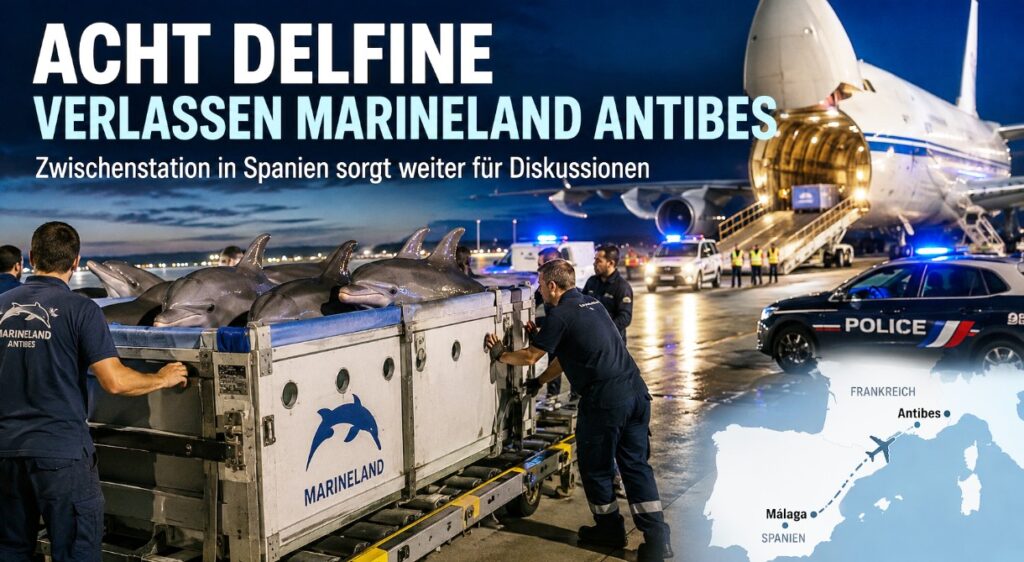
In the middle of the night, an extraordinary relocation began for eight dolphins from the former Marineland Antibes. In a meticulously planned transport operation, the marine mammals left the Cote d’Azur and set off for southern Spain. The transfer marks an important step in the dismantling of the amusement park, which has been closed since early 2025, but it is by no means ending the debate over the animals’ future.
Shortly after midnight, animal keepers and veterinarians carefully lifted the dolphins out of their pools. They were taken in specially designed transport containers to Nice Airport under police escort. A cargo aircraft was already waiting there and flew the animals to Malaga in the early morning hours. A few hours after landing, the dolphins reached their new pools at Selwo Marina.
According to those responsible, the journey went without incident. French and Spanish veterinarians accompanied the transport, along with experienced keepers who monitored the animals’ health throughout the journey. Over the coming weeks, Joe, Anya, Tux, Kai, Neo, Lua, Dam and Rocky will first undergo an acclimatization period. Medical checks and a careful adjustment to the new surroundings are intended to keep the stress of the move as low as possible.
Nevertheless, the stay in Malaga is not considered a final solution. Under the current plans, the eight dolphins are to return to France at a later date. ZooParc de Beauval plans to build a new center intended to combine research, scientific observation and dolphin conservation. However, it may still be some time before this facility can begin operating. Until then, Selwo Marina will serve as temporary accommodation.
This is precisely the point drawing criticism. Several animal welfare organizations argue that the animals have merely been moved from one dolphinarium to another. In their view, this does little to change the fundamental conditions in which they are kept. They also accuse the French authorities of failing to make sufficient provisions since the 2021 animal welfare law for suitable alternatives such as marine sanctuaries.
The organizations are therefore calling for greater transparency. They want independent information on the dolphins’ health and their housing in Spain. The operators’ statements so far are not sufficient for them. Especially after such a long transport, it must be possible to determine how the animals coped with the journey.
While eight dolphins have already arrived in Spain, four more animals are still living at the former Marineland in Antibes. A move is also planned for them, possibly to the Oceanografic of Valencia. However, no specific date has yet been set.
The situation of the two orcas, Wikie and Keijo, is even more complicated. They remain in the facilities of the closed park. Various proposals for their future are on the table, but no solution that can be implemented in the short term has yet been found. A possible transfer to Tenerife also remains controversial and continues to fuel political and animal welfare debates.
The removal of the eight dolphins has therefore created momentum, but it has not ended the conflict. Rather, the case vividly illustrates how difficult it is to move away from the decades-long keeping of marine mammals in dolphinariums when suitable alternatives first have to be created. Whether Malaga truly remains only a stopover on the path to a better long-term future will likely become clear only in the years ahead.
Author: C.H.