
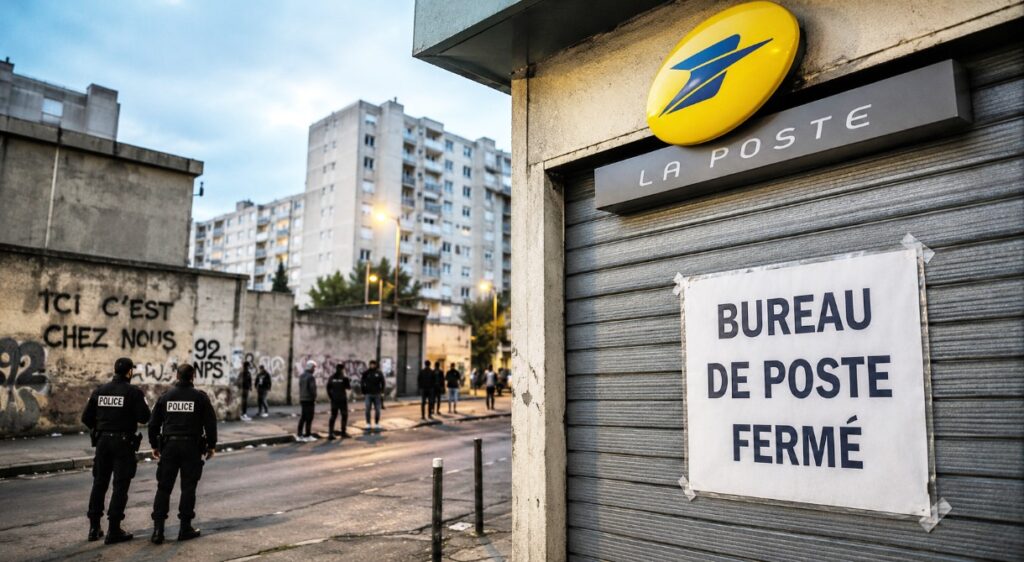
In Nîmes the anger of many residents is ignited around a building that at first glance seems insignificant: a closed post office. But behind the locked doors lies much more than the end of an administrative service. For many people in the neighborhood the closure marks a further retreat of the state — and at the same time the advance of those forces that now dominate everyday life: drug trafficking gangs, violence and intimidation.
Especially in socially weaker neighborhoods like Pissevin or Valdegour, a mix of fear, frustration and exhaustion has been brewing for years. Many residents openly say that their neighborhood is being handed piece by piece to the networks of drug trafficking. What once sounded like an exaggerated headline is now almost normal.
The post office was considered by many residents to be the last neutral place.
The elderly collected their pension documents there, families made transfers, people without secure internet access received help with forms or official correspondence. Above all, however, the building represented something bigger: a visible state presence. Order. Normality.
When a place like that disappears, it is not only a gap in services that remains. A void is created.
And it is precisely in these empty spaces that criminal networks insinuate themselves. Residents speak of dealers in building entrances, young people used as lookouts and nighttime gunshots that no longer wake anyone from sleep. Some parents accompany their children to school only via alternative routes. Shops close earlier. There is a silent, almost palpable tension in the streets.
“Once everyone here knew each other,” says a shopkeeper. “Today people prefer to look the other way.” A phrase that sticks with you.
The situation in Nîmes is exemplary of a phenomenon that no longer concerns only large cities like Marseille. Drug trafficking has spread to many medium-sized towns in France. Organized professionally, brutal and economically profitable. Investigators now speak of structures that operate almost like companies — with clear hierarchies, territorial control and enormous power of intimidation.
The state responds mainly with police operations, raids and temporary security measures. In Nîmes there have also been intensified checks and even curfews for minors in the most at-risk neighborhoods. But many residents say openly: it is not enough.
Because security is not created by patrols alone.
They are created in places where schools work, doctors stay, shops open and public institutions are visibly present. This is what is missing in many places. When libraries close, associations disappear and even post offices leave, neighborhoods lose their social fabric.
Then others take control.
Not officially. But you can feel it.
The closed post office in Nîmes has thus long been more than just a local news item. It symbolizes the question of how much withdrawal a state can afford before entire neighborhoods lose trust. And regaining that trust — is much harder than reopening a door.