
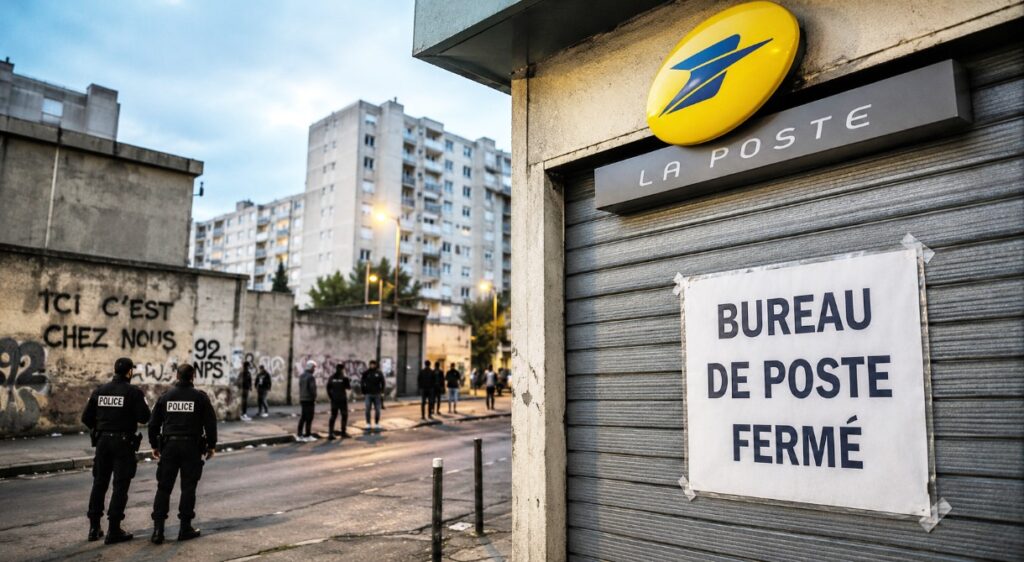
In Nîmes, the anger of many residents is focused on a seemingly ordinary building: a closed post office. But behind this locked door is more than just the end of an administrative service. For many people in the community, the closure means a further retreat of the state — and at the same time, the advance of forces that have long dominated daily life: drug gangs, violence, and intimidation.
Especially in socially weaker districts like Pissevin or Valdegour, fear, frustration, and exhaustion have intertwined over the years. Many residents openly state that their community is gradually being taken over by drug trafficking networks. What once sounded like exaggerated headlines has now almost become everyday reality.
This post office is seen by many residents as the last neutral place.
Elderly people collect pension documents there, families handle money transfers, and those without stable internet connections get help filling out forms or dealing with government paperwork. But most importantly, this building symbolizes a greater meaning: the visible presence of the state, order, and normalcy.
The disappearance of such a place leaves not only a gap in services. It creates a vacuum.
And it is precisely these gaps that become spaces for criminal networks to move in. Residents report that drug dealers lurk at building entrances, teenagers are used as lookouts, and nighttime gunshots no longer wake anyone. Some parents have to take detours to get their children to school, and shops close early. The streets are filled with a palpable silent tension.
“Everyone used to know each other here,” said a shopkeeper, “now people would rather look the other way.” This statement is striking.
Nîmes’ situation typically reflects a trend that is no longer limited to large cities like Marseille. Drug trafficking has spread to many medium-sized cities across France. It is highly organized, ruthless, and economically very profitable. Investigators now describe these structures as almost corporate entities—with a clear hierarchy, territorial control, and strong intimidation capabilities.
The state usually responds with police operations, raids, and short-term security measures. Nîmes has also increased patrols and even imposed curfews on minors in some high-pressure neighborhoods. But many residents admit: these measures are far from enough.
Because a sense of security is not built on police patrols alone.
Security arises from schools functioning effectively, doctors continuously available, shops open, and visible public services. Many places lack these very things. When libraries close, associations disappear, and even post offices cease to exist, the community’s social ties unravel as a result.
Then, other powers take over control.
Not official, but perceptible.
The closed post office in Nîmes is no longer just local news. It symbolizes a problem: how much more can the state withdraw before an entire community loses trust? And regaining this trust is much more difficult than simply reopening a door.