
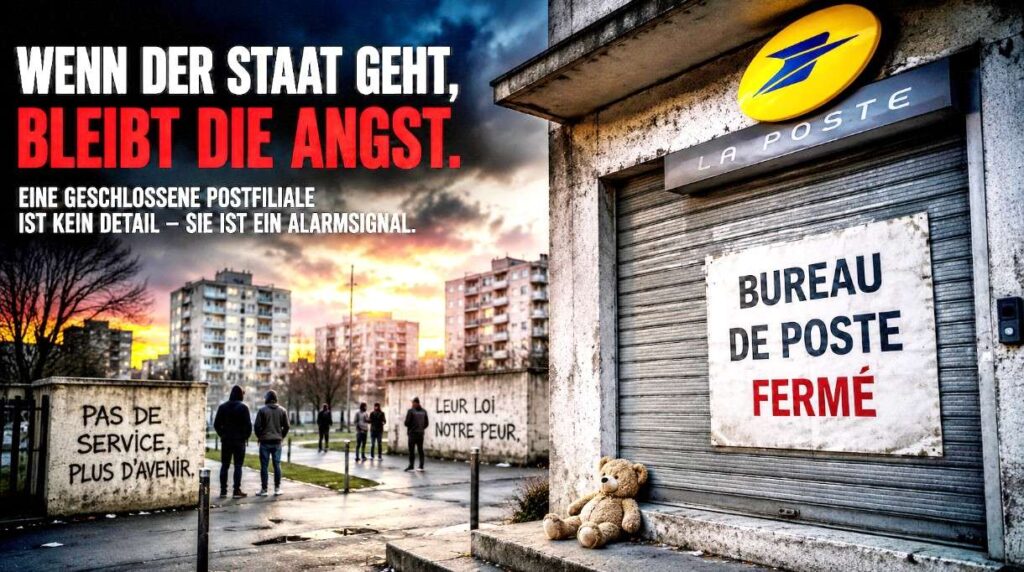
It always starts innocently. First the little corner shop closes. Then the pharmacy disappears. One day, the post office closes. Officially it’s called “economic adjustment,” “reorganization” or “offer optimization.” Words from air-conditioned meeting rooms, polished like a spokesperson on television.
But outside, in the streets of Nîmes, it sounds different.
There people only hear one thing: they don’t care about us.
And that is the real catastrophe.
Because a post office branch is not just a place for stamps and parcels. It is light, movement, everyday life, meeting. It is a piece of the state among grey blocks of housing. A visible sign that the republic has not completely withdrawn. When even a place like that disappears, there is no neutral ground left. Then others take control.
Traffickers do not need citizens’ service offices.
They only need emptiness.
In some neighborhoods of Nîmes the postmen no longer patrol, but young people on motorcycles who keep watch for the drug gangs. In the doorways there are not neighbors with shopping bags, but watch posts. Children quickly learn which streets are best avoided. And the adults? They have become accustomed to many things that should never be normal. That is what is frightening.
This gradual normalization is perhaps the worst defeat of all.
France has been debating drug-related crime for years as if it were only a security problem for the police and judiciary. More checks, more flashing blue lights, more militarized interventions. Of course, all that is necessary. But anyone who thinks they can reclaim a neighborhood with armored vehicles alone has clearly never understood how society works.
A neighborhood does not die from a single shot.
It dies slowly. Silently. Through administrative inaction.
Whenever the state disappears and only the criminals remain visible.
The tragic thing is that many residents of these neighborhoods have been fighting for years to be heard. They don’t want pity shows, nor visits from politicians with cameras and doleful faces. They simply want the same everyday life that other people have. To feel safe. To go shopping. To send their children to school without fear. To send letters without having to pass by armed youths. It’s truly crazy that one has to explain something like that in the year 2026.
But there is the bitter truth.
When the state withdraws, a neutral space does not emerge. That place is always occupied by someone. And in the worst case, by those who understand violence as a business model.
That’s why the closed post office branch in Nîmes is much more than a local news item. It is a symbol of a republic that in some places exists only in Sunday speeches.
And one day it will be no surprise if people lose confidence.
A commentary by M.A.B.