
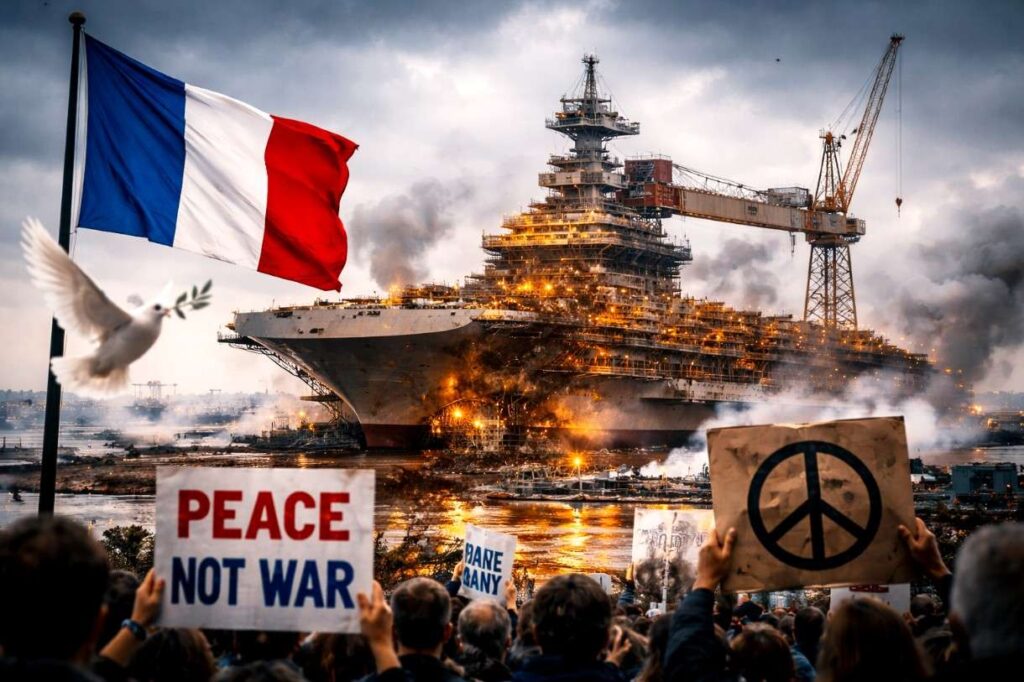
There are decisions that come silently – and yet carry a powerful message. The construction of the largest warship in Europe is one of them. France, the land of enlightenment, human rights, and the republican idea, is investing more than ten billion euros in a new aircraft carrier. A ship meant to project power. A ship that can wage an entire war. A ship that will bear the name “Free France.”
You have to let this name linger on your tongue for a moment. “Free France.” A term born from Europe’s darkest hour, from occupation, collaboration, resistance. A term that once was hope, a moral uprightness against violence and subjugation. And today? Today it becomes the name of an instrument of military power.
Is this still remembrance – or already reinterpretation?
France is not building a defensive bastion. It is building a symbol. Aircraft carriers are not shields. They are floating messages. They say: We can be anywhere. We can intervene anywhere. We are ready to enforce our interests with military force if necessary.
You can call this realpolitik. You can call it strategic autonomy. You can explain it with geopolitical shifts, with an uncertain America, with an aggressive Russia, with a self-confident China. All of that is true. And yet one question remains that cannot be dismissed:
Where is the will for peace in all of this?
After 1945, Europe gave itself a different promise. Power was never again to be considered solely militarily. Security was never again to arise from the threat of being stronger than the other. The European idea was – at least in its core – a rejection of this logic.
And now? Now it returns. Not loudly, not pathetically, but technically, rationally, budgeted. Ten billion here, new systems there, strategic capabilities – the vocabulary is cold. But the direction is clear.
France is leading the way. Perhaps because it does not want to rely on others in a world of uncertainties. Perhaps also because it has never fully abandoned the notion of being a global power. The aircraft carrier is the perfect instrument for this: visible, impressive, intimidating.
But precisely for that reason, it is also a political commitment.
A commitment to thinking security more militarily again. That deterrence becomes more important than trust. That power projection is once more considered a legitimate means.
One can understand that. But one should not simply accept it.
Because every aircraft carrier not only changes military balances. It also changes ways of thinking. Those who possess such capabilities will factor them into their politics. Those who finance them will have to justify them. And those who name them – “France libre” – give them a moral aura that they may not even deserve.
Freedom was once a concept of resistance against violence. Today it is a label for a system that applies violence if necessary.
That is more than a semantic shift. It is a political one.
The real tragedy lies in the fact that this development hardly provokes any opposition anymore. The threat scenarios are too plausible, the crises too present, the international order too fragile. Anyone who advocates disarmament today quickly appears naive. Anyone who calls for diplomacy sounds like they are from another time.
And yet that is exactly what is needed: a new debate about what security in the 21st century actually means.
Is it really only guaranteed militarily? Or does its strength precisely lie in developing alternatives to violence?
France is currently answering this question clearly. It relies on strength, presence, deterrence. That is consistent, perhaps even rational. But it is also a decision — not a necessity.
And decisions can be questioned.
An aircraft carrier costing ten billion euros is not just a piece of steel, technology, and engineering. It is a priority. It says something about what a country considers important. And what it does not.
Imagine the political power that could lie in a different signal. In a Europe that does not build the largest warship, but dares the boldest peace initiative. In a France that translates its historical experience not only into military strength but into diplomatic leadership.
That might be the real “Free France” of our time.
Instead, a ship is being built.
Big. Impressive. Powerful.
And disturbing.
A commentary by Andreas M. Brucker