
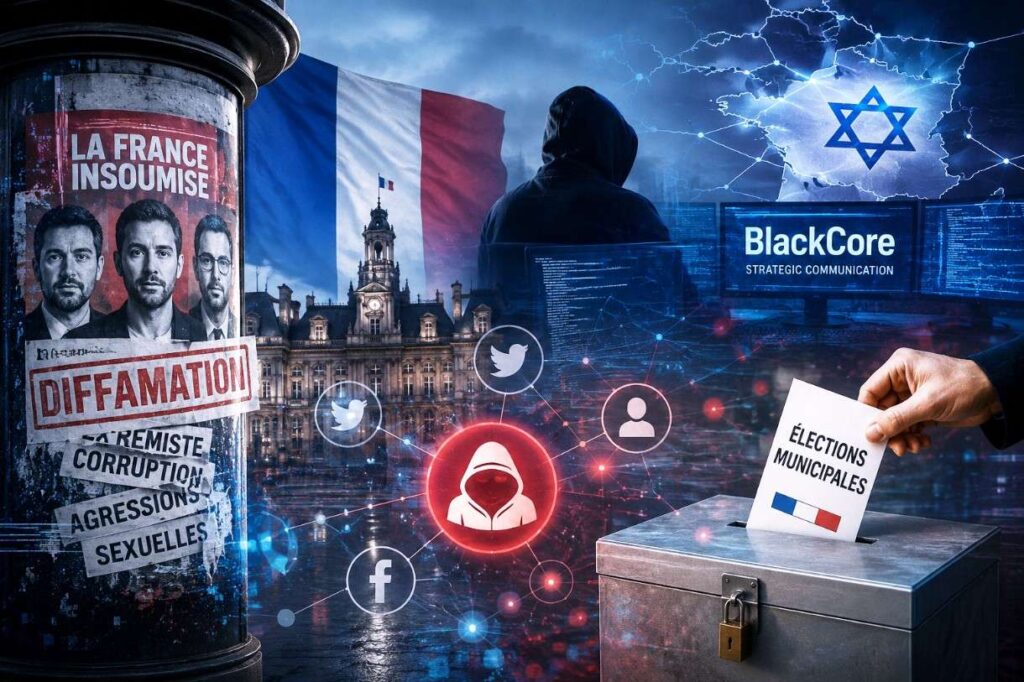
French judicial authorities are currently investigating a case attracting unusual attention in the political hub of Paris. There are suspicions of coordinated digital influence operations against candidates from the left-wing party La France Insoumise (LFI) in the recent local elections. At the center of this issue is an allegation of an organized disinformation campaign targeting several prominent politicians from the movement led by Jean-Luc Mélenchon. In particular, a key focus is whether there is a connection to entities linked with Israel behind these actions.
According to investigations so far, those affected include LFI members of parliament Sébastien Delogu, François Piquemal, and David Guiraud. During the election campaign, they were the target of large-scale defamation campaigns on social networks and dedicated websites. These spread accusations such as extremism, corruption, and sexual assault allegations. French media have also reported that fake “whistleblower” profiles and estimated AI-generated content were deliberately used to undermine the politicians’ credibility.
At the center of the investigation is a communications organization called “BlackCore.” Several French and international media outlets have recently reported linking this organization to digital influence operations. Evidence suggests that part of the activity may have been organized from Israel, but there is no official confirmation at this point. The French prosecution authorities have cautiously described it as an “operation that may serve the interests of a third country.”
The investigation is led by the national cybercrime unit, which is particularly examining whether there has been systematic interference in the democratic election process. This case occurred at a time of increasing concern about hybrid influence strategies from foreign countries. Until now, France had primarily focused on Russian disinformation campaigns, but it is now becoming clear that digital influence operations can no longer be exclusively linked to Moscow.
Politically, this issue is developing into domestic political conflicts. Jean-Luc Mélenchon accuses the government of deliberately downplaying the issue. He calls it a “national scandal” and argues that parts of the official report have been weakened or withheld to avoid diplomatic tensions. Opposition politicians in France are demanding full transparency regarding the scope of the suspected operations.
This issue simultaneously touches on an area that is geopolitically highly sensitive in the French debate. Since the beginning of the Gaza conflict, La France Insoumise has been regarded as one of the most clearly Israel-critical political forces in France. Therefore, this matter is broadly interpreted beyond just a problem of an online campaign. However, there is currently no publicly available concrete evidence of direct state involvement from Israel. French security authorities have also remained cautious in their statements.
Regardless of the results of the investigation, this issue highlights the vulnerability of modern democracy, especially in the digital age. Local elections have long been regarded as regional politics of limited international importance. However, social networks, artificial intelligence, and transnational communication structures are fundamentally changing this reality. Election campaigns now unfold not only in public spaces and televised debates but also on anonymous digital networks where the senders are difficult to identify.
Therefore, this incident could have profound implications for France. If suspicions of organized foreign influence operations are confirmed, debates regarding digital sovereignty, election security, and the protection of democratic institutions will intensify further.
Author: P. Tiko