
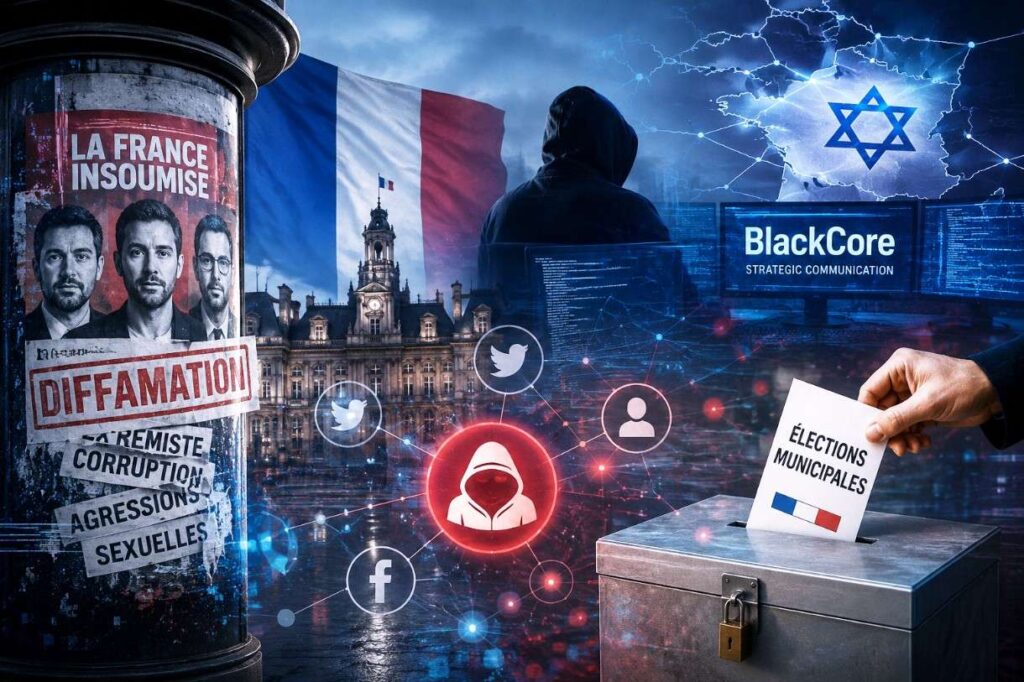
The French judicial authorities are currently investigating an incident that is causing a major stir in the political arena. It concerns allegations of organized digital influence targeting candidates from the left-wing party La France Insoumise (LFI) during the recent local elections. At the heart of the case are accusations of an organized misinformation campaign aimed at several prominent politicians of Jean-Luc Mélenchon’s movement. In particular, the question of whether actors possibly linked to Israel are behind these actions is a very sensitive matter.
According to current findings, politicians affected by this incident include LFI members of parliament Sébastien Delogu, François Pico, and David Girod. During the election campaign, they were the targets of extensive defamation campaigns on social networks and specially created websites. These sites alleged extremism, corruption, and sex crimes, and the French media reported that forged “whistleblower” profiles and content presumed to be generated by artificial intelligence were deliberately used to undermine the credibility of the politicians.
At the core of the investigation is a communication organization called “BlackCore.” Several French and international media have reported that this organization is connected to digital influence operations. There is also speculation that some activities may have been organized in Israel, but there is no official confirmation yet. The French prosecution cautiously mentions the “possibility of manipulation activities for the benefit of a third country.”
The investigation is handled by the national cybercrime department, focusing on whether there was systematic interference in the democratic election process. This case occurred at a time of increasing concerns about foreign hybrid influence strategies. In recent years, France has focused mainly on Russian disinformation campaigns, but it has become clear that digital influence operations are no longer exclusively associated with Moscow.
Politically, this case is escalating into domestic conflict. Jean-Luc Mélenchon has opposed the government, accusing it of deliberately downplaying the issue. He calls the case a “national scandal,” claiming that parts of the official report were softened or withheld to avoid diplomatic tensions. Opposition politicians in France are currently demanding complete transparency regarding all suspected manipulation attempts.
This incident is also related to a geopolitically very sensitive area within France. La France Insoumise is considered one of the political forces that most clearly criticize Israel in France following the outbreak of the Gaza war. For this reason, interpretations spreading beyond a simple online campaign issue are emerging regarding this case, but so far, no concrete evidence has been disclosed proving direct involvement by the Israeli government. Accordingly, French security authorities are also maintaining a cautious stance.
Regardless of the investigation results, this case starkly reveals the vulnerabilities of modern democracy in the digital age. Local elections have long been regarded as regional political arenas receiving limited international attention, but this reality is fundamentally changing due to social networks, artificial intelligence, and transnational communication structures. Today, election campaigns are actively conducted not only in public venues or TV debates but also on anonymous digital networks where identity verification is difficult.
For France, this incident could cause significant repercussions. If suspicions of organized foreign influence are confirmed as true, debates about digital sovereignty, election security, and the protection of democratic institutions are likely to intensify.
Author: P. Tiko