
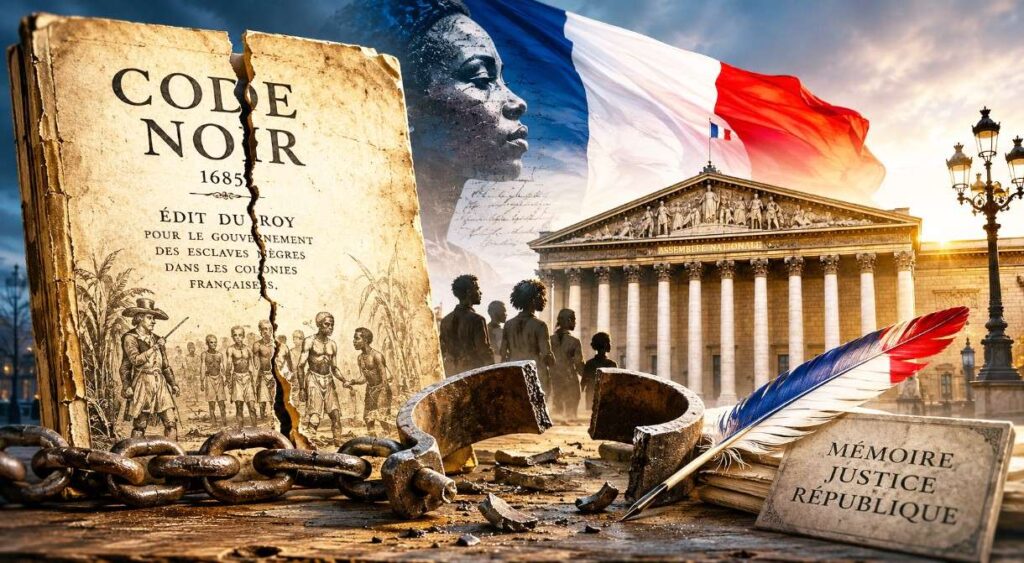
The French National Assembly is discussing a document that, despite having lost its legal force for nearly 200 years, remains much more alive in France’s collective memory than any other text related to its colonial past. The resolution on the symbolic “abolition” of the so-called Code noir may have no legal consequences. However, politically, it touches on very sensitive nerves of the French Republic. It is a question of how a nation deals with a dark chapter of its history without collapsing because of it.
The mere fact that the parliament is still discussing the 1685 decree in 2026 reflects well the current situation in France. It is no longer a question of legal technicalities or philosophy of law. It is a matter of memory, identity, and the authority to interpret national history.
The Code noir was one of the key instruments of the French colonial empire. Created during the reign of Louis XIV, this document legalized slavery in the French West Indies, imposing a legal order on an economic system based on deprivation of rights and violence. It defined people as movable property and regulated corporal punishment, religious coercion, and social control by the state. This document reflects an era when economic rationality and monarchic power were allied with systematic dehumanization.
It is not surprising that today France symbolically tries to distance itself from this document. Rather, it is noteworthy that France still finds this step difficult.
Legally, the Code Noir no longer exists. Its provisions lost their effect with the final abolition of slavery in 1848. Today, courts do not base their rulings on it, nor do administrative procedures use this document as justification. This document belongs to historical records only and does not have legal force. Therefore, demanding its “abolition” today is deliberately nothing more than a symbolic political act.
But this is exactly the true meaning of the debate. Modern democracy exists not only through institutions but also through moral self-description. When parliament adopts a resolution, it is not merely to set norms but to clarify a historical position. France has regularly done this through laws such as the Holocaust Memory Law, the recognition of the Armenian Genocide, and the 2001 Taubira Law, which defines the slave trade and slavery as crimes against humanity.
The current resolution is also part of this tradition. This resolution is more a signal sent by the Republic than the creation of a law: the French government acknowledges that slavery was not merely the historical fault of some individuals but was institutionally organized and legalized.
Meanwhile, this debate also reveals the limits of the increasingly ritualized politics of memory. France has been in a state of tension for years between the necessary historical reckoning and a kind of ongoing moral self-reflection. The shadow of colonialism is deeply cast over contemporary society, evident in social inequalities in overseas territories, identity conflicts in suburban areas (banlieues), and fierce debates over national symbols and the educational curriculum. However, the more history is politicized, the greater the risk of it being used as a political tool.
Critics of the resolution call this a phenomenon of symbolic emptiness. They see the “abolishment” of a document that became useless back in 1848 again as nothing more than a parliamentary show without substantial results. It is questionable whether the excessive proliferation of historical resolutions actually leads to the devaluation of political memory. If all historical responsibility is renegotiated symbolically in parliament, it can easily give the impression of a republic that can never move beyond the past.
Such skepticism is not entirely unfounded. Politics of memory often carries the risk of simplifying historical complexity into moral clarity. French colonialism was a system of oppression but at the same time part of the historical dynamics in which the modern republic was born. French history is neither solely the history of Enlightenment nor merely the history of oppression. Both coexist, and it is precisely this duality that makes its political management difficult.
On the other hand, the opposing view is also too simplistic. Dismissing symbolic gestures as ineffective underestimates the power of political symbols. A nation is formed not only through laws but also through shared narratives. For many people in Guadeloupe, Martinique, and Guiana, the Code noir is not an abstract historical document but a symbol of rights denied for centuries. Its social and cultural impact is still felt today. Even if the Republic’s clear condemnation of this document does not change the material reality, it has political significance.
Therefore, the real challenge lies not in the resolution itself but in what follows. Memory cannot replace social policies, educational reform, or serious discussions about structural inequality. A republic that relies solely on symbolic acts risks falling into moral self-satisfaction without substantial results.
The current debate surrounding the Code noir ultimately reveals deeper changes. France is renegotiating its self-understanding of its history. The universalist model, which for a long time considered an individual’s background irrelevant in the public sphere, is increasingly being challenged. Questions about colonial history, origin, and cultural memory are no longer marginalized.
Therefore, the real challenge lies not in the resolution itself but in what follows. Memory cannot replace social policies, educational reform, or serious discussions about structural inequality. A republic that relies solely on symbolic acts risks falling into moral self-satisfaction without substantial results.
The current debate surrounding the Code noir ultimately reveals deeper changes. France is renegotiating its self-understanding of its history. The universalist model, which for a long time considered an individual’s background irrelevant in the public sphere, is increasingly being challenged. Questions about colonial history, origin, and cultural memory are no longer marginalized.
It is wrong to understand this debate as an expression of national weakness. Democracy proves its stability by maintaining the ability to openly discuss its contradictions. The way the Code noir is handled shows that France is a nation that has learned to endure both historical greatness and historical guilt simultaneously. This is not a sign of self-destruction.
Whether the resolution is adopted or not will have no legal effect. However, politically, it indicates that France is taking another step in the long process of integrating the colonial legacy into the Republic’s narrative. This process will be neither fast nor free of contradictions. But perhaps such confusion is the price of a democratic culture of memory that does not ignore history but discusses it openly.