
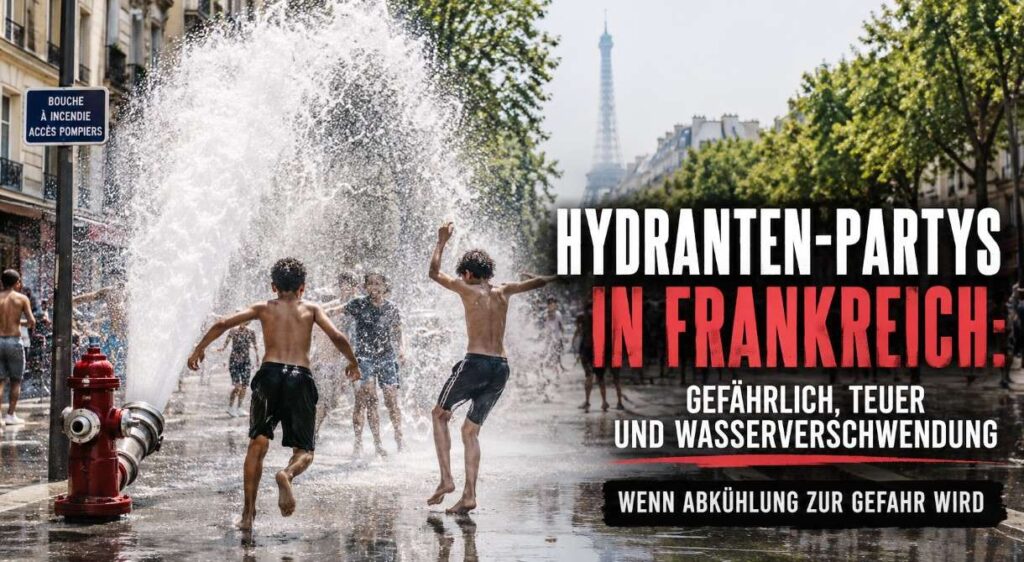
When the heat strikes France and the asphalt in the suburbs of Paris shines in the sun, some streets suddenly transform into improvised water parks. Children run screaming between water jets several meters high, young people record the scene with their mobiles, neighbors sit in camping chairs at the edge of the street. For a brief moment, everything seems like a summer party in the middle of the big city.
But behind these spectacular images lies a problem that increasingly makes the authorities nervous.
With every new heat wave, the so-called “Street Pooling” reappears in France. It consists of illegally opening fire hydrants — the famous “bouches à incendie” — to create sources of drinking water for cooling off. The most affected area is the densely populated Île-de-France around Paris. There, in many neighborhoods, public free swimming pools, green spaces or public places where people can relax when temperatures exceed 35 degrees are missing. That is why some people opt to turn on the tap directly.
What on TikTok or Instagram seems like innocent summer fun actually makes firefighters and water supply companies very nervous.
Because as soon as a hydrant is opened, the water pressure in the network can drop drastically. In the worst case, firefighters lack the necessary pressure for the fire trucks during a fire. Emergency teams have been reporting for years situations where open hydrants affect entire streets. This can have fatal consequences, especially in densely populated residential areas.
Added to this are floods, water-filled basements, and damaged underground garages. Water bursts out of the pipes with enormous force, overturning traffic signs, undermining sidewalks, and turning intersections into small lakes within minutes. Drivers lose control on wet streets, pedestrians fall, and electrical cables dangerously approach the streams of water. Sometimes, only an unfortunate coincidence is needed for firefighters to intervene not because of heat, but due to a serious accident.
What is particularly paradoxical is the enormous waste of water.
France has been facing droughts, declining groundwater levels, and increasingly frequent periods of no rainfall for years. Municipalities debate water restrictions, farmers fear for their crops, and in some regions, how to manage water scarcity is already being discussed. However, thousands of liters of drinking water vanish uncontrollably in public spaces within hours. A single open pipe can lose up to 80 cubic meters of water per hour — an amount that could supply many homes for several days.
Furthermore, many people underestimate the risk of injuries. The force of water coming out of a hydrant is enormous. In recent years, some jets have thrown children several meters into the air, and some suffered serious injuries. For this reason, firefighters no longer see it as youthful mischief, but as a serious public safety hazard.
France has begun to take stricter measures. Cities install special protective rings on hydrants, increase inspections, and threaten severe fines and prison sentences for damage to public property. However, these security systems cost municipalities millions — money that is lacking for other matters.
This debate reveals, above all, one thing: climate change not only changes temperatures but also urban life. When heat combines with social inequality, new conflicts arise. Children seek to cool off, families flee stifling homes, and public infrastructure reaches its limits. That is why open fire hydrants are much more than simple vandalism. They are also a symptom that many urban spaces are not prepared for extreme summers.
And that is where the real bombshell of these images lies.
Andreas M. Brucker