
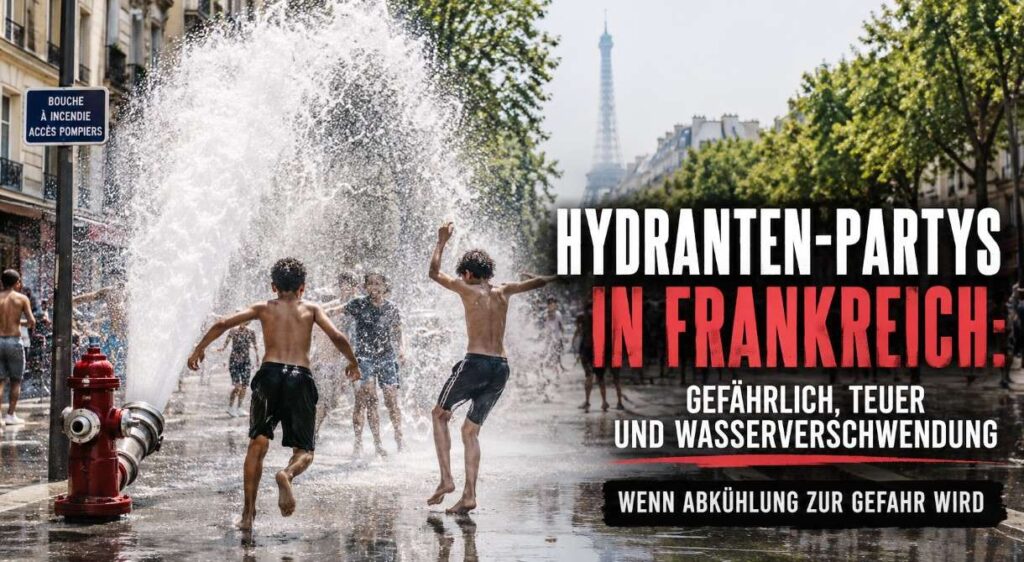
When a heatwave hits France and the asphalt in the suburbs of Paris shimmers, a certain street suddenly turns into an impromptu water park. Children run around shouting through meters-high fountains, young people capture the scene on their smartphones, and neighbors sit in camping chairs by the roadside. For a moment, it feels as if a summer festival is taking place right in the middle of the big city.
However, behind this spectacular sight lies a problem that authorities are becoming increasingly sensitive about.
Every time a heatwave strikes, a phenomenon known as “street pooling” reappears in France. This involves fire hydrants—famous “bouches à incendie”—being illegally opened to create fountains of drinking water for cooling. The impact is especially severe in the densely populated areas around Paris, known as Île-de-France. There, many districts lack free pools, green spaces, or public places where people can rest during temperatures above 35 degrees, so some people take matters into their own hands and reach for the fire hydrant valves.
What looks like harmless summer fun on TikTok and Instagram causes concern for fire departments and water utilities.
When a fire hydrant is opened, the water pressure in the water supply network can drop significantly. In the worst case, there may be insufficient pressure for the fire trucks needed during a fire, hindering firefighting efforts. Fire departments have reported situations where an open fire hydrant affects an entire street over many years. This can be especially deadly in densely populated residential areas.
Furthermore, damage such as flooding, inundated basements, and damaged underground parking garages also occurs. Water gushes out from the pipes with great force, knocking over road signs, breaking sidewalks, and turning intersections into small lakes within minutes. Drivers lose control of their vehicles on wet roads, pedestrians fall, and power lines get dangerously close to the water fountains. If mere coincidences line up, the fire department may be dispatched not for heat stroke but for serious accidents.
What is particularly ironic is this enormous waste of water.
France has been struggling for years with droughts, falling groundwater levels, and increasingly frequent dry spells. Municipalities discuss water usage restrictions, farmers face anxiety about their harvests, and in some regions, responses to water shortages are a hot topic of debate. Meanwhile, thousands of liters of drinking water are lost uncontrollably on the streets within a few hours. One open fire hydrant can lose up to 80 cubic meters of water per hour, which is enough to supply many households for several days.
Many people also underestimate the risk of injury. The water pressure from fire hydrants is extremely strong, and in recent years there have been several cases where water fountains have blown children several meters away, causing serious injuries. Fire departments no longer see this as “youthful mischief” but as a serious threat to public safety.
France is currently responding with stricter measures. Cities are installing special protective rings on fire hydrants, increasing surveillance, and warning of heavy fines and prison sentences for damage to public property. However, these safety devices cost municipalities millions of euros, leading to budget shortages in other areas.
What this discussion shows is that climate change not only alters temperatures but also changes urban life itself. New conflicts arise where heatwaves and social inequality intersect. Children seek coolness, families try to escape stuffy homes, and public infrastructure faces its limits. Open fire hydrants are more than just vandalism; they are a symptom of many urban spaces being barely prepared for extreme summers.
And therein lies the real bombshell of these photos.
Andreas M. Brucker