
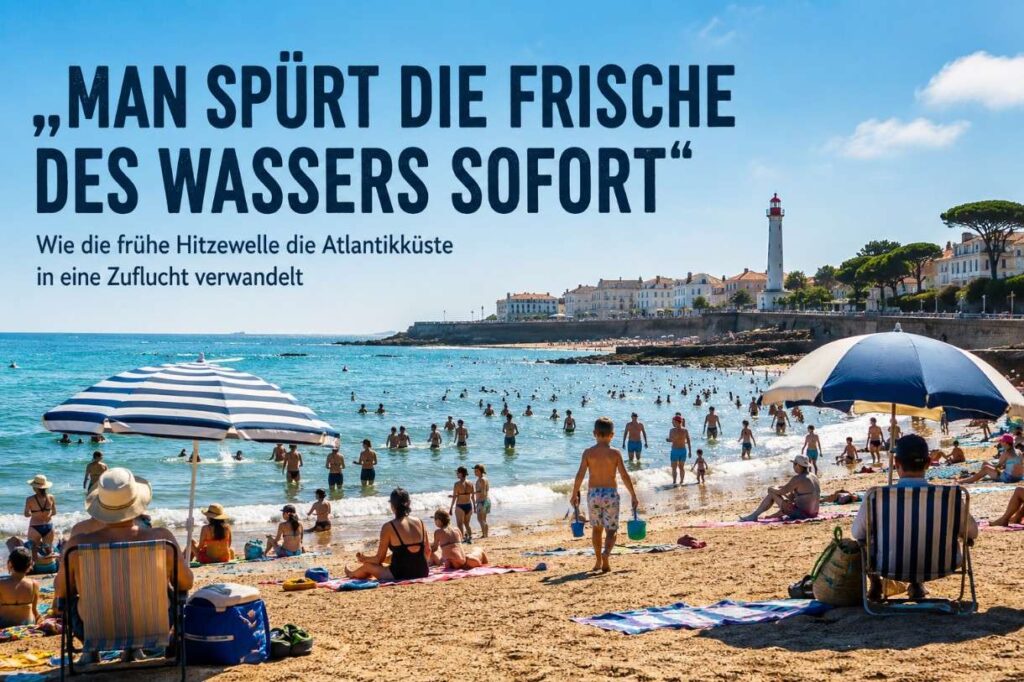
The scene looks more like mid-July than the last days of May: beaches with full parking lots, people carrying coolers under their arms, children wearing sun hats on the sand – and above all that vibrant heat that already weighs heavily on the streets first thing in the morning. While large parts of France are suffering an unusually early heatwave, thousands of people are heading to the Atlantic coast of Charente-Maritime. Between Royan, La Rochelle and Île d’Oléron a kind of spontaneous summer activity is emerging.
Those who come to the sea are looking for one thing above all: cool air.
“As soon as you get into the water, you feel that coolness immediately,” is heard repeatedly along the coast these days. That very moment turns the Atlantic into the region’s most valuable luxury good. Air temperatures in many places clearly exceed 30 degrees, while the sea still retains that reserve of coolness that makes the body breathe instantly. A few steps in — and the circulatory system thanks you immediately. It is no wonder that families, elderly people and inland city dwellers are literally fleeing to the coast.
For many residents this all feels oddly familiar. Just a few years ago, a weather situation like this at the end of May would have been reported as a meteorological exception. Today many people react almost routinely to these first heat peaks. Shutters remain closed during the day, working hours are moved to the early morning, and shaded places become the most coveted asset of the day. The French term “îlots de fraîcheur”, or islets of coolness, is already part of everyday life.
And the Atlantic is increasingly becoming a climatic rescue island just like that.
But where many people seek refuge at the same time, tensions also arise. In several seaside resorts, infrastructure is already reaching its limits. Parking is insufficient, restaurants are improvising additional terraces, and beach cafés sell ice cream and cold drinks at every moment. Some coastal municipalities are now experiencing an influx of visitors that would normally begin weeks later.
Added to this is a problem that increasingly worries rescue services: many spontaneous bathers underestimate the risks of the Atlantic. Because although the air may feel almost Mediterranean, the sea remains dangerously cold. Currents change rapidly, some beaches are only partially supervised outside the high season, and not all visitors know the local danger zones. Especially people who flee the heat unexpectedly often act impulsively – a jump into the water, without sunscreen, with little water to drink. Sounds trivial. But it can be dangerous.
At the same time, the region benefits economically from this early summer season. Hotels report an increase in bookings, campsites fill up surprisingly early, and ice cream parlors and restaurants record sales normally only seen in the height of summer. Many business owners are already talking about a “small second July in May.”
Still, there remains an awkward feeling.
Because the scenes on the beaches also tell something larger about the future of France. The Atlantic is no longer just a holiday backdrop for a few weeks off in summer. Increasingly the coast is becoming a climate refuge – a place where people seek protection from climate extremes that were once exceptions and today have almost become the norm.
Summer has begun.
Only much earlier than expected.
Andreas M. B.