
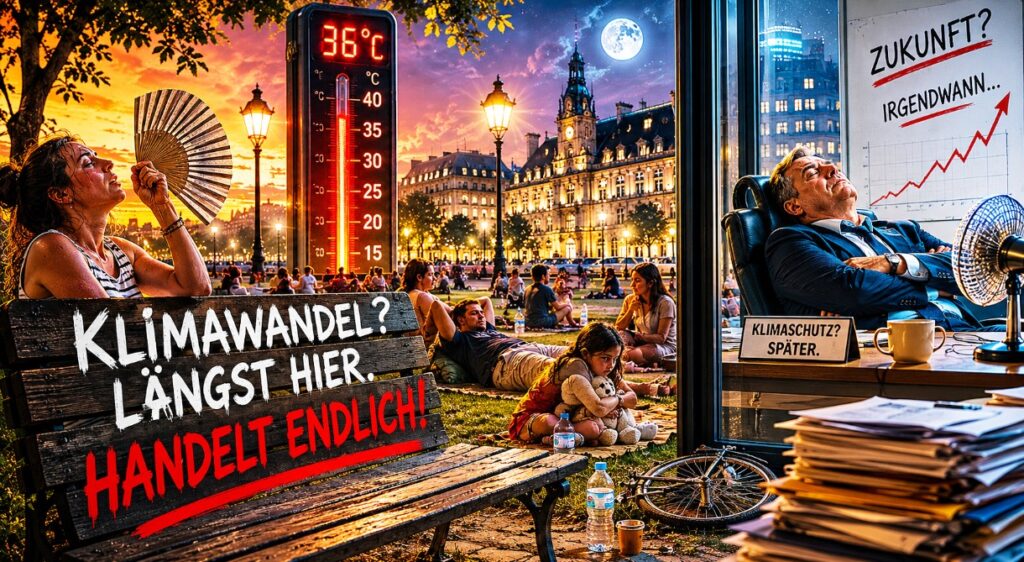
Ah, suddenly it has become urgent.
Politicians have suddenly realized that high temperatures are dangerous, city nights no longer cool down, elderly people collapse, children suffer, and homes turn into concrete ovens. Welcome to 2026—glad you finally started paying attention.
When the people of Rennes sit on park benches at night because bedrooms become unbearably hot, somewhere a committee is still discussing the “long-term climate strategy.” Long-term. This word now sounds like a mockery.
Climate change is no longer lurking outside the door. It has already taken a seat in our living rooms, consuming the electricity of fans, making it hard for us to sleep.
Yet many responsible parties still behave as if this is just some extended weather phase. Some drinking fountains here, some mist cooling there—this has become a local fig leaf. Of course, these measures are effective in the short term, no doubt. But now it seems they are more like band-aids on an open wound.
The fact is: for decades, we have been talking, postponing, downplaying. People kept saying we cannot overly challenge the economy, cannot panic the citizens, cannot pressure industry. Strangely, today the entire city cannot withstand the high temperatures once considered rare exceptions.
So what now? Now, parks are open at night.
This is reasonable from a human perspective. But it is also a frustrating symbol. Because if people in Brittany must seek refuge in parks at night by the end of May, then obviously there is a very serious problem.
The political double standards are especially absurd. The same voices that have viewed climate protection as hysteria or “too expensive” for years are today packaging emergency measures taken due to high temperatures as major innovations. Wonderful, really. The next step might be discovering that trees provide shade.
Such irony is hard to express because the situation has long been very serious.
Future summers will be even harsher. Cities will continue to get hotter, water resources will become scarcer, and extreme weather will be more frequent. All of this has repeatedly appeared in scientific reports for years. No one can say they are surprised by this. What may be truly surprising is that politics still stubbornly tries to downplay the obvious facts.
People have long felt the changes, not in some models, but in their own beds at night, on withered green spaces, when the sun has already set but it feels suffocating.
How many more tropical nights are needed before verbal concerns turn into real action?
Or is everyone really waiting for the last few air-conditioned meeting rooms to become too hot as well?