
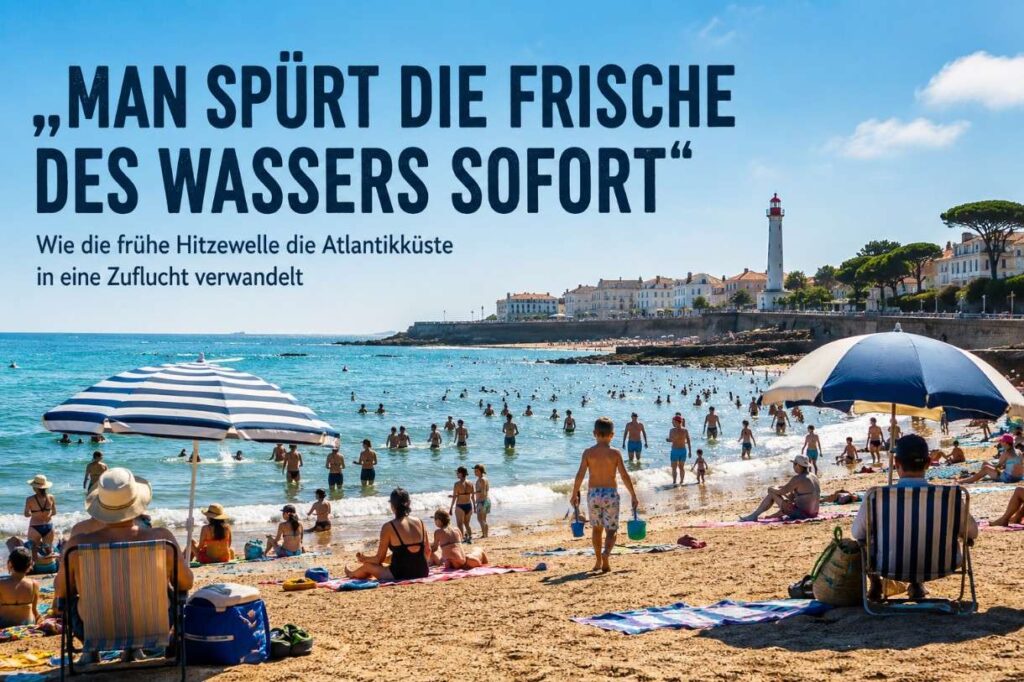
This scene evokes mid-July more than late May: a beach parking lot packed to capacity, people carrying cooler bags on their arms, children wearing sun caps on the sand – and the oppressive heat that has settled thickly on the streets since early morning. As most of France suffers from an unusually early heatwave, thousands of people are heading to the Atlantic coast of Charente-Maritime. Between Royan, La Rochelle, and the Île d’Oléron, a kind of spontaneous summer peak season is currently forming.
Those seeking the sea are looking for one thing above all: cool air.
It is often heard along the coastline that “the moment you touch the water, you feel instantly cool.” That very moment makes the Atlantic the most precious luxury in the region. While air temperatures rise above 30 degrees Celsius in many places, the sea still maintains a cool refuge that instantly gives the body a breather. Just a few steps in, the circulatory system immediately responds. It is no surprise that family travelers, the elderly, and inland city residents flock to the coast.
Many local residents do not find this phenomenon unfamiliar. Just a few years ago, such weather conditions at the end of May would have been an exceptional news story meteorologically. Today, many people almost routinely accept the early heatwave. During the day, window coverings are closed, working hours are moved to the early morning, and shaded places become the most precious spots of the day. The French expression “îlots de fraîcheur,” that is, ‘islands of coolness,’ has already become everyday language.
And the Atlantic is increasingly establishing itself as such a climatic refuge.
But at the same time, as many people flock there at once, friction also arises. In several beach towns, infrastructure is already reaching its limits. Parking spaces are scarce, restaurants are creating temporary terrace seats, and beach cafes are tirelessly selling ice cream and cold drinks. Some coastal cities are now experiencing the surge of visitors that usually begins a few weeks later.
Here is another growing concern for the rescuers: many impromptu beachgoers underestimate the dangers of the Atlantic. The air feels almost Mediterranean-style, but the sea is still dangerously cold. Currents change rapidly, some beaches are only limitedly supervised during the off-season, and not all visitors are aware of the local danger zones. Especially those who have suddenly come to escape the heat often act impulsively – jumping into the water, without sunscreen, and without bringing enough water. It may seem trivial but can be dangerous.
Meanwhile, thanks to the early summer season, the local economy is benefiting greatly. Hotel bookings are up, campsites are full earlier than expected, and ice cream shops and restaurants are reporting sales usually seen only in midsummer. Many business owners are already calling it “May’s little second July.”
Nonetheless, an uneasy feeling remains.
What the beach scene reveals implies a larger story about France’s future. The Atlantic is no longer just a backdrop for summer vacations. It is increasingly turning into a refuge from climate extremes like heatwaves — once rare, but now becoming routine climate shelters.
Summer has begun.
Much earlier than expected.
Andreas M. B.