
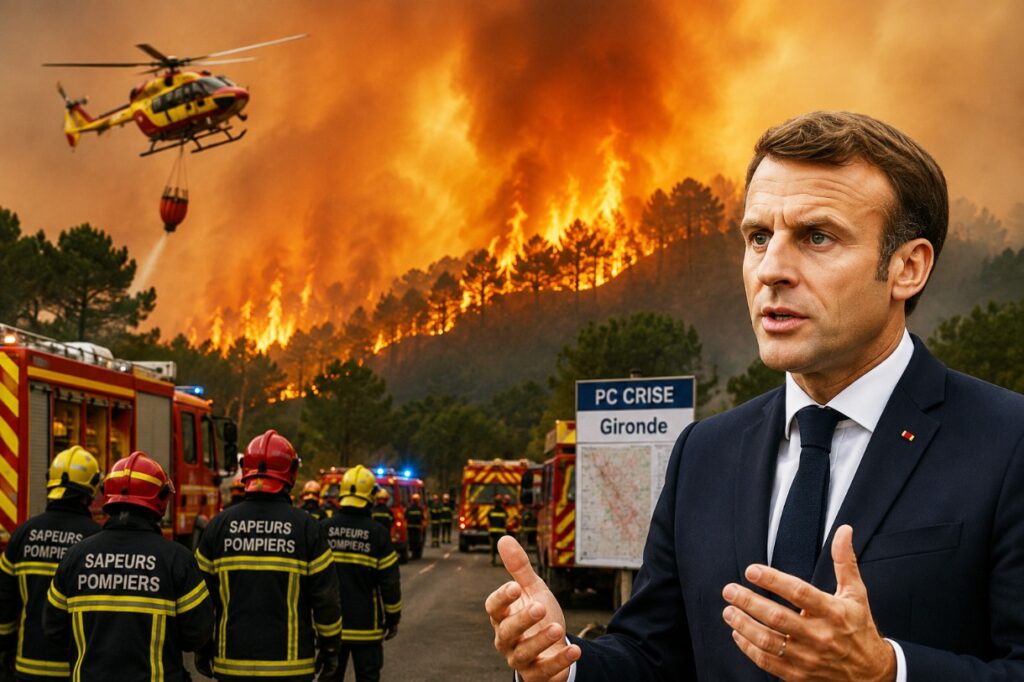
France faces a prolonged test in the fight against the devastating wildfires in the country’s southwest, according to President Emmanuel Macron. During a visit to the fire brigade’s crisis center in Bordeaux, the head of state appealed to the public and emergency personnel not to relent in the face of the dramatic situation. “We must be clear about this: the coming weeks will be tough, and we must persevere,” Macron said on Monday evening.
Together with Interior Minister Laurent Nuñez, the president assessed the situation in the particularly hard-hit Gironde region and assured emergency crews of the state’s full support. His message was clear: despite initial progress, there is no reason to sound the all-clear. While the spread of the massive fire has been slowed in some areas, numerous smoldering hotspots and rekindling fires continue to pose a significant danger.
The scale of the destruction is unprecedented. Around 42,000 hectares of forest and scrubland have been destroyed in Gironde alone. More than 220,000 people have had to leave their homes, campsites or holiday accommodation around the Bassin d’Arcachon. About 240 residential buildings have been destroyed, while 88 firefighters have been injured since firefighting operations began.
No political debate during the operation
Amid growing criticism of France’s preparedness for a disaster of this scale, Macron rejected calls for an immediate political review. An assessment of state measures could only take place once the fires were under control.
“You do not conduct an assessment in the middle of a battle,” the president said. The priority now was to win the fight against the fires together and protect the public.
Criticism is focused in particular on the limited number of operational firefighting aircraft, shortcomings in forest management and the organization of evacuations. In several municipalities, residents reported that they had at times felt inadequately informed or supported. Macron, however, avoided addressing these allegations in detail and focused on the ongoing rescue and firefighting operations.
Some 2,750 firefighters are currently battling the flames in Gironde. They are supported by around 1,500 soldiers, 1,440 security personnel and international emergency crews from several European countries. A total of 18 aircraft are available for firefighting and reconnaissance flights.
New heatwave worsens the situation
Weather developments are causing particular concern among operational commanders. Temperatures of up to 40 degrees Celsius are expected again in southwestern France over the coming days. At the same time, humidity is falling sharply. Even with lighter winds, the parched forests could therefore catch fire again at any time.
Firefighting experts believe that fully extinguishing all fire hotspots could take weeks or even months. Wide firebreaks are still being created in the forests to contain the spread of the flames. As a result, it is not yet possible for all evacuees to return.
Climate change is transforming France’s forests
Macron announced that the reconstruction of the destroyed forest areas would not follow previous standards. France must create “a different forest” that is better adapted to the consequences of climate change.
With this, the president is taking up a debate that has been underway in France for years. Large parts of Gironde’s pine forests are considered particularly vulnerable to large-scale fires because of their monoculture, persistent drought and increasingly frequent heatwaves. Experts are therefore calling for more resilient mixed forests and changes in management to reduce the fire risk over the long term.
However, Macron left open which tree species would be prioritized in the future or what such a transformation would look like in concrete terms.
A summer of historic proportions
The disaster is no longer limited to Gironde. Firefighters and security forces are also continuing to battle numerous forest and vegetation fires in the departments of Landes and Var, as well as on Corsica.
Since the beginning of the year, fires have already destroyed more than 116,000 hectares of land in France – a historic record. The combination of exceptional drought, recurring heatwaves and strong winds has raised the wildfire season to previously unknown levels and is posing enormous challenges for French disaster management.
Macron’s appeal for perseverance therefore describes far more than a short-term crisis. France faces a long summer in which every rise in temperature and every period of dry wind could once again threaten the painstakingly secured fire lines. At the same time, political pressure is growing to fundamentally overhaul wildfire prevention, civil protection and the adaptation of forests to climate change.
P. Tiko