
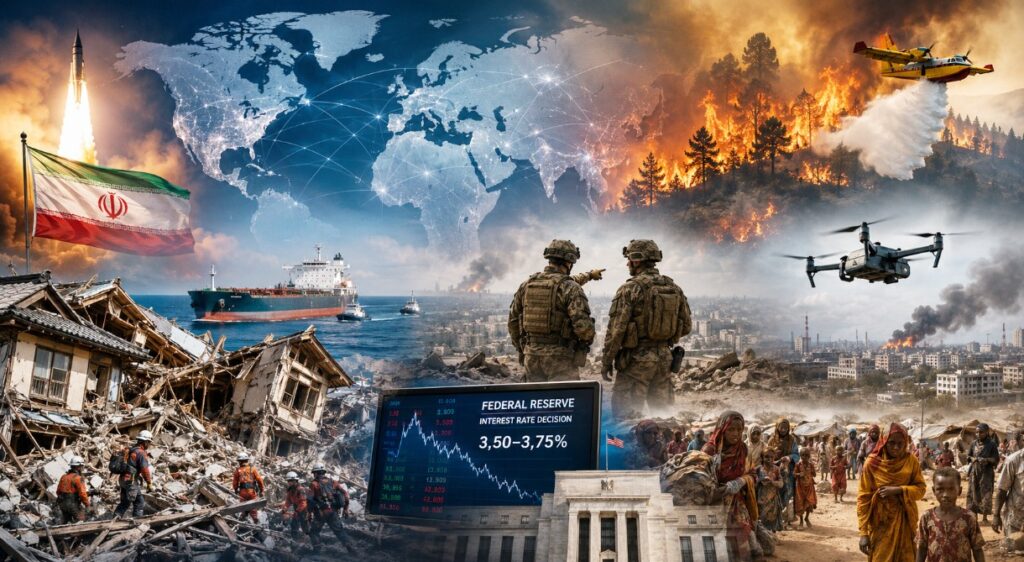
The international news landscape on this Wednesday, July 29, 2026, is marked by an unusual density of simultaneous crises. At the center is the renewed escalation between the United States and Iran, which has dashed hopes of a diplomatic easing within just a few days. At the same time, rescue workers are searching for survivors after a powerful earthquake in southwestern Japan, while Europe is suffering under a new heatwave and devastating wildfires. Added to this are the ongoing wars in Ukraine and Sudan, as well as the eagerly anticipated interest-rate decision by the U.S. central bank, whose effects extend far beyond the United States.
New Escalation Between the United States and Iran
The already tense situation in the Middle East has escalated once again. According to U.S. accounts, a surprise Iranian missile attack was repelled. At the same time, Iran’s Revolutionary Guards reported attacks on three oil tankers in the strategically important Strait of Hormuz.
Only over the weekend, the fighting had temporarily subsided after nearly two weeks of intensive U.S. airstrikes. U.S. President Donald Trump had then spoken of a possible basis for new negotiations. Those hopes have now largely vanished. The latest events are fueling concern about a further military escalation, the consequences of which could extend far beyond the region. The Strait of Hormuz, through which a substantial share of global oil trade is transported, is under particular scrutiny. International energy markets have accordingly already responded with noticeable price fluctuations.
Conflict Spreads to Iraq
The war increasingly threatens to engulf Iran’s neighboring countries as well. U.S. and Saudi fighter jets jointly attacked positions held by pro-Iranian militias in Iraq. According to Iraq’s Popular Mobilization Forces, eight of their members were killed.
Washington and Riyadh accuse the militias of being responsible for drone attacks on U.S. soldiers and Saudi energy facilities. The groups concerned reject these allegations. The development highlights the fragile security situation in Iraq, whose government has struggled for years to bring armed militias under state control. Observers warn that the country could once again become the scene of a regional proxy conflict.
Race to Rescue Survivors After Powerful Earthquake in Japan
In southwestern Japan, rescue operations are focused on Kumamoto Prefecture on the island of Kyushu, which has been particularly hard hit. The magnitude 7.1 earthquake caused severe damage to homes, industrial facilities and public infrastructure. At least 13 people were killed, and numerous others remain missing.
Tens of thousands of households were temporarily without electricity and gas. More than 9,000 people had to leave their homes and sought shelter in emergency accommodation. Recovery efforts are being complicated by high temperatures, which are placing an additional strain on both emergency personnel and the provision of aid to those affected. Disruptions to high-speed rail services and at several airports continue to affect passenger and freight transport.
Europe’s Wildfires Become a Prolonged Crisis
While southern Europe suffers from extreme drought, firefighters in several countries are battling extensive forest and vegetation fires. France and Spain are particularly affected, where tens of thousands of hectares of forest have already been destroyed. Italy, Portugal and other Mediterranean countries are also reporting numerous fire outbreaks.
In view of the increasing intensity, the European Union is calling for a fundamental realignment of its wildfire strategy. The focus is not solely on additional firefighting aircraft, but above all on better prevention. This includes more consistent forest management, wider firebreaks, greater public awareness and long-term investment in climate-adapted forestry. Experts assume that the wildfire season will become significantly longer in the future and could continue well into autumn in some regions.
Heatwave Worsens the Consequences
Alongside the fires, another heatwave is spreading across large parts of Europe. Temperatures of up to 40 degrees Celsius or more are significantly increasing the wildfire risk while also straining health systems, agriculture and water supplies.
Climate researchers increasingly point out that it is not individual extreme events alone that matter, but their growing frequency. The challenge therefore lies not only in disaster protection, but also in the long-term adaptation of infrastructure, urban planning and water management. For many European countries, the ability to respond to recurring periods of heat and drought is increasingly becoming a strategic question for the future.
Ukraine Takes the War Deeper Into Russia
In the war in Ukraine, long-range Ukrainian drone strikes are once again coming into focus. Industrial facilities caught fire in Russia’s Ryazan region. Damage, fatalities and injuries were also reported from Belgorod and other Russian regions.
Kyiv is increasingly pursuing the goal of targeting militarily and economically significant infrastructure. Refineries, fuel depots, logistics centers and industrial facilities are intended to hinder Russia’s conduct of the war while raising the economic costs of the conflict. Russia, for its part, continues its airstrikes on Ukrainian cities and critical infrastructure. A diplomatic rapprochement remains out of sight.
New Findings on Arms Deliveries in Sudan
The civil war in Sudan, ongoing since 2023, is receiving additional attention through new findings by international investigators. A report by UN experts describes alleged supply chains through which weapons, drones and foreign fighters are said to have reached the paramilitary Rapid Support Forces.
According to the report, transport aircraft are said to have brought military equipment to the conflict region through several countries. Foreign mercenaries are also said to have been involved in the operations. The revelations underscore the extent to which the Sudanese civil war is now influenced by external actors. At the same time, the humanitarian situation continues to deteriorate. Millions of people are suffering from displacement, hunger, water shortages and the collapse of medical care.
Financial Markets Turn Their Attention to the U.S. Central Bank
Alongside the geopolitical crises, monetary policy is also at the center of international attention today. The U.S. central bank is concluding its two-day interest-rate meeting. Financial markets largely expect the Federal Reserve to leave its benchmark interest rate unchanged.
Of particular interest, however, are the signals concerning further monetary policy developments. Persistently high inflation and rising energy prices as a result of tensions in the Middle East could limit room for interest-rate cuts. Investors worldwide are therefore closely following the statements of central bank leaders. Decisions by the Federal Reserve regularly affect exchange rates, stock markets, commodity prices and the financing costs of companies and governments on every continent.
The international news landscape on this July 29, 2026, strikingly demonstrates how closely political, economic and climate developments are now interconnected. The conflict between the United States and Iran carries considerable risks for the stability of the Middle East and global energy supplies. At the same time, the war in Ukraine and the civil war in Sudan continue their destructive momentum.
Natural disasters such as the powerful earthquake in Japan and the large-scale wildfires in Europe also demonstrate the growing vulnerability of modern societies to extreme weather events and geological risks. Whether military conflicts, climate impacts or economic uncertainty, hardly any of these crises today remain confined to national borders. Their effects reach deep into international supply chains, financial markets and political decision-making processes, underscoring the global nature of the challenges of the 21st century.