
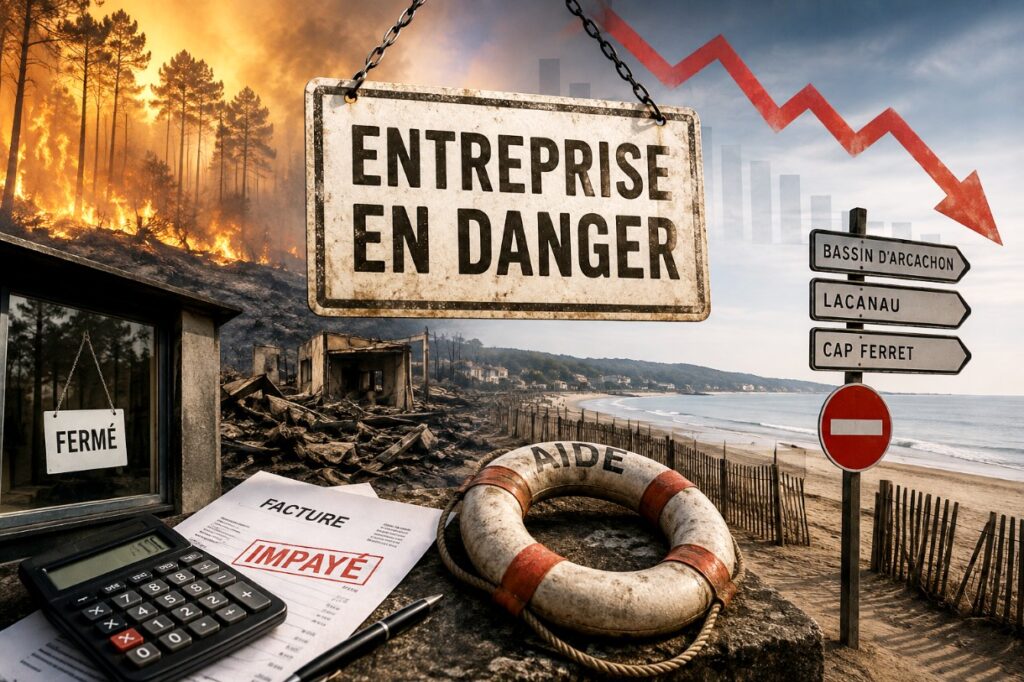
The devastating wildfires in Gironde destroyed far more than forests, homes and tourist facilities. As time passes, it is becoming clear that the natural disaster is also having significant economic consequences. While the flames have now largely been extinguished, the real fight for survival is beginning for thousands of businesses. Small and medium-sized enterprises are particularly affected, as their financial reserves are often insufficient to survive several weeks without significant income.
According to the Bordeaux Gironde Chamber of Commerce and Industry (CCI Bordeaux Gironde), around 40,000 businesses were directly or indirectly affected by the fires. About half of them are now in a critical economic situation. The environmental disaster is thus increasingly developing into one of the largest regional economic crises of recent years.
Thousands of Businesses Under Economic Pressure
The affected businesses include not only those located in evacuated or destroyed areas. Also affected are companies whose employees were unable to reach their workplaces because of road closures or evacuations, whose supply chains were disrupted, or whose customers stayed away as a result of the disaster.
According to estimates by the Chamber of Commerce, nearly 200,000 jobs were at times affected by business interruptions or significant restrictions. The timing of the disaster is particularly serious: the fires occurred in the middle of the peak summer tourism season, the period when numerous businesses generate the largest share of their annual revenue.
Tourism Loses Its Main Source of Revenue
Hotels, campsites, holiday rental providers, restaurants, and leisure and water sports operators around the Bassin d’Arcachon, Lacanau and the Cap Ferret peninsula were hit particularly hard. Evacuations, smoke, road closures and official warnings led to a wave of cancellations within just a few days.
For many businesses in the tourism industry, July and August determine the profitability of the entire financial year. If these weeks are lost, the losses can hardly be made up later. Even where buildings and tourism infrastructure have remained intact, visitors are staying away. Images of the fires have had a lasting impact on many holidaymakers’ sense of security and are affecting areas far beyond the regions directly concerned.
The effects extend deep into the regional economy. Bakeries, grocery stores, laundries, trades businesses, taxi companies and numerous service providers normally benefit from the high number of visitors. When campsites remain closed and holiday rentals are empty, a substantial share of demand disappears along the entire regional value chain.
Strain on Logistics and Forestry
The economic impact is not limited to the tourism sector. Temporary closures of major transport routes significantly hampered the movement of goods in the greater Bordeaux area. Logistics companies and businesses in industrial zones such as Cestas or Marcheprime had to partially reduce or temporarily suspend their operations.
In the long term, however, the damage to forestry and the timber industry could be particularly severe. Gironde is one of France’s most important forest regions. The burned pine forests represented the loss not only of valuable ecosystems, but also of commercially used raw material reserves.
It will take several decades before newly reforested stands can once again provide usable construction or industrial timber. At the same time, substantial costs will arise from clearing burned stands, reforestation, and measures to protect soils from erosion and further damage. The economic consequences will therefore extend far beyond the fire disaster itself.
State Aid Intended to Prevent Insolvencies
To cushion the economic consequences, the Bordeaux Gironde Chamber of Commerce and Industry has set up a crisis unit together with other chambers. Affected business owners can receive support via the central telephone number 3006 with insurance matters, damage reports, state aid programmes and the resumption of their business activities.
Businesses that had to reduce production because of official orders or a lack of work can apply for short-time work support. In addition, payment deferrals for taxes and social security contributions, as well as various support programmes for the self-employed, are available. Under certain conditions, the social security disaster fund for the self-employed can provide aid of up to 2,000 euros.
These measures initially provide many businesses with some financial breathing room. However, they cannot compensate for all economic losses. Numerous companies lost a significant share of their annual revenue within just a few days. In addition, many insurance policies provide only limited coverage, if any, for business interruptions without direct property damage. Businesses whose buildings remained intact but whose customers stopped coming entirely are therefore facing considerable financial problems.
Gironde is therefore facing a double challenge. On the one hand, the destroyed forest areas must be restored and made more resilient to future fires. On the other hand, an economic downward spiral involving business closures and job losses must be prevented. Whether this s쳮ds will depend largely on how quickly financial aid is paid out and whether small and medium-sized businesses in particular can survive the coming months. They form the economic backbone of the region, yet often have only limited financial reserves.