
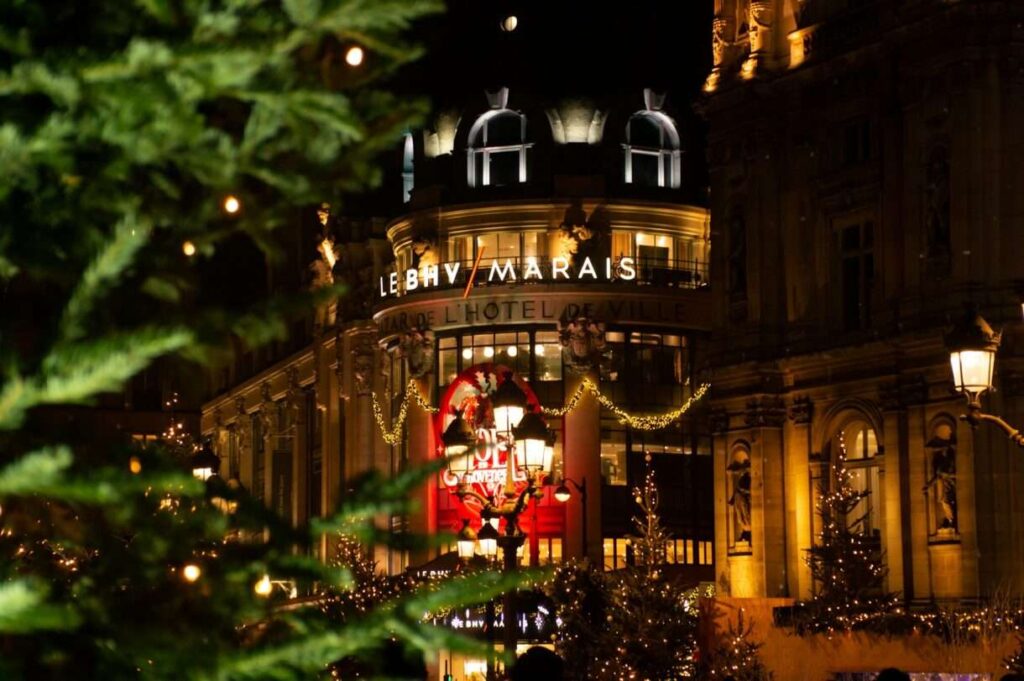
Sometimes, a single evening is enough to feel as though a switch has been flipped across the country. A deep breath, a warm glow, a small touch of nostalgia. That is exactly what happens every year at the beginning of December throughout France, when towns and villages switch on their Christmas lights, quietly signalling the start of the holiday season.
The first sparks appear early, often as soon as mid-November. But at the beginning of December, when temperatures drop and the nights become especially long, the country transforms into a quietly vibrant scene of colours and amazed faces. Paris, Lyon, Dinard, even Monaco: every region has its own way of embracing the darkness and turning it into a celebration.
And every year, we say to ourselves: well, this time it will probably be like usual.
But then we find ourselves there again, somewhere between sparkling domes, softly crackling loudspeakers and clouds of warm breath—and realise that we were wrong.
Paris. The eternal stage of light
Of course, one has to start with Paris. Not out of obligation, but because the capital truly seems different during these weeks. The rhythm changes. Even the traffic seems to hesitate for a moment, as if it wanted to make way for the millions of little lights nestling along façades, trees and boulevards.
The Champs-Élysées have been lit up since mid-November and will remain so until January 4. Let’s be honest: how many times have we already heard, seen, or read things about this famous avenue? And yet, it takes hold of you when you stand there and the lights reflect in the rain-wet cobblestones. It is that feeling that the street suddenly holds its breath. A few seconds of silence in the heart of the big city’s bustle. Crazy, isn’t it?
This year, the organizers have added new displays that combine classic light arches with projected motifs and small musical surprises. It feels like a dialogue between the old and the new, a kind of friendly pat on the shoulder: “So, ready for the season?”
Just around the corner, on Avenue Montaigne or in the Faubourg Saint-Honoré, the chic houses strive to appear not only elegant, but also a little playful. Paris loves this interplay between haute couture and childlike joy. Sometimes a shop window blinks, sometimes a shining star turns, sometimes a brass band plays “Carol of the Bells” somewhere, while a small crowd stops, smiles, and briefly sets its worries aside.
Two streets away, a choir is rehearsing. A tourist asks for directions to Place Vendôme in broken French. A family with roasted chestnuts half-heartedly discusses the best viewpoint. An elderly gentleman raises his glass of mulled wine and says softly: “It’s beginning.”
And yes, it begins.
Île-de-France. The discreet sister with dazzling ideas
People are often quick to underestimate what happens outside central Paris. Yet the region around the capital truly blossoms in December. Val-d’Oise organizes drone shows reminiscent of modern lantern festivals. Small municipalities put on fireworks displays whose echoes bounce off the hills.
Sometimes, twenty minutes on the RER are enough to plunge into a completely different world. Less glamour, more community. Less spectacle, more warmth.
Why does a small market square with a dozen strings of lights often feel more moving than a grand boulevard under the glow of thousands of LED lights? Good question. Perhaps because you can feel that the decorations were hung here by hand. Because people know one another. Because the neighbor’s smile seems brighter in the darkness than any installation.
Dinard. The coastal town that shines like a character from a novel
Then Brittany. Dinard. A town that already looks like the setting of an old French film in summer—but in winter? It puts on a dress of light that suits it surprisingly well.
Ten kilometers of string lights. Four hundred Christmas baubles. And people gathering between the beaches and luxurious villas, as if they were extras in a grand scene.
At this year’s inauguration, the mayor spoke about the social bonds that these illuminations strengthen. It sounds like public relations, but when you are there and see children chasing the first snowflakes and elderly couples walking arm in arm, you believe it. You can even feel it.
“It brings people together,” says a woman in her sixties, holding a cup of hot chocolate. “We talk to each other again.”
How often do you hear that? And how often does someone truly mean it?
Lyon. The luminous heart of the East
Further east, Lyon. The Festival of Lights: not a Christmas celebration in the classic sense, but a cultural magnet that draws hundreds of thousands of visitors every year. The city becomes a laboratory for light artists. Facades tell stories, bridges seem to move, and entire squares become poetic installations.
Sometimes, a project lasts only three minutes. And yet people continue on their way in silence, as if they had just read a letter they do not yet know how to interpret.
The tradition dates back to December 8, 1852, to an old religious vow and years of change. But today, the Festival of Lights is much more than a memory. It is a modern ritual, a shared gesture of wonder.
Perhaps that is precisely where its strength lies.
Monaco. When splendor meets ritual
Monaco, of course. The city-state turns every gesture into an event. But the Christmas lights in Monte-Carlo truly have something touching and family-oriented about them.
The princely family — Charlene, Albert and the twins — is inaugurating a light show this year featuring a huge Christmas tree, sparkling baubles and projections on the famous casino. The children are delighted, cameras are clicking away, tourists are pulling out their smartphones.
Everything could seem perfectly polished, almost a little too staged. Could.
But then you watch the twins laugh, the prince look at his wife, people in the audience toast over their thick winter jackets — and suddenly, everything softens.
You understand why these rituals endure. Because they create connection. After all, what would the holidays be without that moment when everyone says “Oh” together?
Why all this light, exactly?
A naïve question? Perhaps. But let’s ask it anyway
— because sometimes, simple questions are the smartest ones.
What are these millions of little lights for? What is all this effort for?
The economic answer is clear: this season generates consumption, tourism and revenue. Retailers, restaurateurs, hotels — they all benefit. Cities invest, consider energy efficiency, rely on LED technology, and plan more sustainably than before.
But the emotional answer runs deeper.
Light is a promise. A promise that says: “Stay a little longer. We’ll make it together.”
The dark season, the cold, the fatigue — all of it seems less harsh when a warm glow floats above our heads.
And perhaps the true heart of the French month of December lies in this blend of nostalgia and renewal.
A country aglow with lights
France shines more intensely in 2025 than ever before. And it seems that this is exactly what the country needs: spaces where people come together again. Places one enters and immediately understands.
The same scene repeats itself everywhere: someone stops and looks up. Then someone else looks up as well. And suddenly, they are standing side by side, two people who do not know each other yet share the same moment.
A small, fleeting miracle, but a real one.
Travel plans? Then let’s go
Those who want to set off now are spoiled for choice. Do you prefer the refined splendor of Place Vendôme? Or the salty charm of Dinard on the coast? Or perhaps the artistic thrill of Lyon?
And do you really have to choose? The best experience may well lie in the unexpected: an unplanned detour, a small treat from the Christmas market, a conversation with a stranger on a street corner, while a curtain of lights dances above you.
Isn’t that exactly what winter evenings are for?
The last evening sky
It is not just about lights. It is never just about lights.
It is about the stories people share when the sun sets early. It is about the warmth that cities can create, even when the air smells of frost.
And it is about that strange mixture of melancholy and hope that only December knows.
France shines. Not because it wants to show off, but because it remembers that light brings people together.
And that feels good.
An article by M. Legrand