
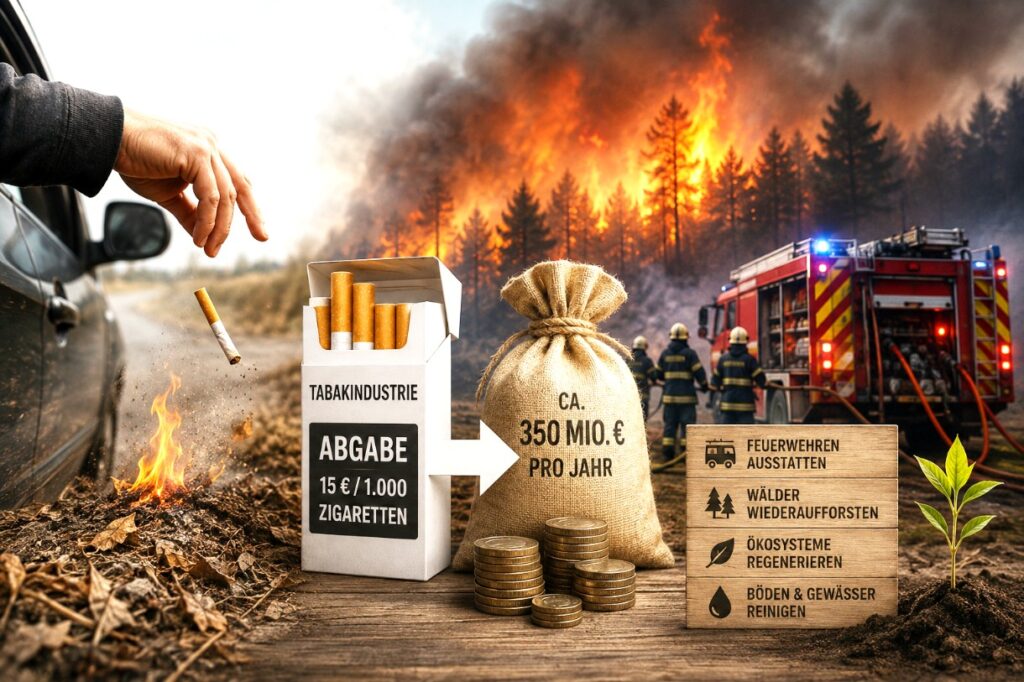
A cigarette butt carelessly thrown from a car window can be enough to trigger a devastating fire in dried-out vegetation. In light of the severe wildfire season in France, conservative lawmaker Yannick Neuder is calling for a new levy on the tobacco industry. The proceeds would be used to better equip fire services, restore burned forests and clean up soil and waterways polluted by cigarette filters.
The former health minister and current Republican lawmaker from the Isère département intends to introduce a bill in the National Assembly. It provides for a levy of 15 euros per 1,000 cigarettes sold, to be collected directly from manufacturers. This works out to 30 cents per pack of 20 cigarettes.
Neuder stresses that this is not a punitive measure against smokers or tobacco retailers. The industry would not necessarily have to pass the entire burden on to retail prices. Whether the companies would actually forgo part of their profit margin, however, seems doubtful. Experience shows that additional levies are at least partly passed on to consumers.
Around 350 million euros for prevention and reconstruction
Based on cigarette sales officially recorded in France for 2025, the lawmaker estimates that around 350 million euros could be raised each year. The revenue would be collected by the French customs administration and transferred to a fund set up at the state-owned Caisse des Dépôts.
This fund could enable fire and rescue services to finance new emergency vehicles, modern firefighting equipment and protective clothing. The national forestry agency ONF, the association of private forest owners, municipalities, municipal associations and recognized environmental organizations would also be eligible for support. In addition to firefighting, the initiative would support reforestation projects, the regeneration of damaged ecosystems, and the cleanup of waterways and soils.
Representatives of the tobacco industry would explicitly not be allowed to sit on the fund’s board of directors.
Neuder bases his initiative on the polluter-pays principle. Manufacturers produce billions of cigarettes, whose filters subsequently end up on streets, in rivers, on beaches or in forests. Municipalities have so far borne most of the collection costs, while départements assume a substantial share of fire service funding.
A brief moment with consequences lasting decades
According to the French Environment Ministry, between 20,000 and 25,000 tonnes of cigarette butts are carelessly discarded every year. Around 17 percent of smokers say they have thrown a smouldering or extinguished butt from a vehicle at least once. Especially during dry periods and in strong winds, even a small remaining ember can be enough to set grassland or undergrowth alight.
Nine out of ten wildfires in France are caused by human activity. Around 15 percent result from carelessness by private individuals, with discarded cigarette butts considered one possible cause. However, according to the findings of investigations so far, this summer’s most spectacular major fires – including those in Gironde, Var and the Forest of Fontainebleau – were not caused by smoking motorists.
The bill is therefore intended less as a direct response to individual causes of fires than as an attempt to distribute the follow-up costs of tobacco consumption more firmly according to the polluter-pays principle. It remains unclear whether Neuder will find a parliamentary majority for his proposal. The lawmaker is counting on cross-party support. If the bill does not secure a place on the National Assembly’s agenda, the levy could also be introduced through an amendment during deliberations on the 2027 state budget. It could enter into force no earlier than January 1, 2028.
Author: P. Tiko