
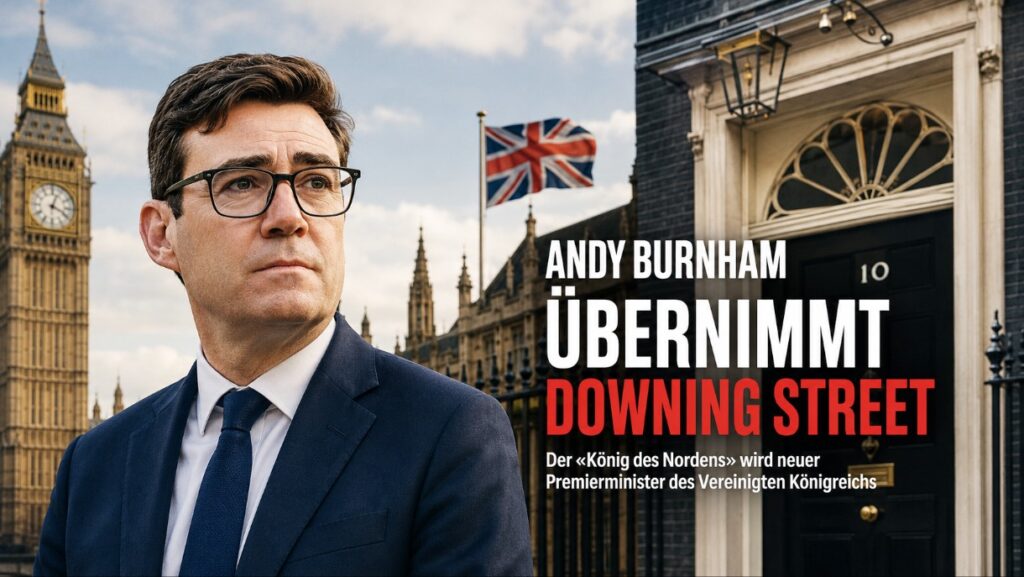
With Andy Burnham, a new phase begins in British politics. Following the resignation of Keir Starmer as Prime Minister and leader of the Labour Party, a politician takes over government affairs who has long been considered one of the country’s most popular social democrats. While Starmer made Labour’s election victory possible, Burnham must now regain the confidence of the population and set the economically weakened United Kingdom on a new course.
The change of power is taking place in a difficult situation. Economic growth remains weak, the National Health Service (NHS) continues to struggle with overstretched structures, the cost of living weighs on millions of households, and trust in the political elite is at a low point. At the same time, pressure from opposition parties is increasing, as they benefit from the dissatisfaction of many voters.
From Liverpool MP to the top of government
Andy Burnham was born in Liverpool in 1970 and has been one of the leading figures in the Labour Party for more than two decades. After his election to the House of Commons in 2001, he quickly rose through the ranks under the governments of Tony Blair and Gordon Brown.
During that period, he held several key portfolios. As Secretary of State for Health, he was responsible for the National Health Service; he also led the Department for Culture and served as Chief Secretary to the Treasury. After the Labour Party’s electoral defeat in 2010, Burnham stood twice for the party leadership, but initially had to concede defeat to his internal party rivals.
Although he did not reach the top of the party at the time, he remained a prominent voice within it and increasingly developed into a representative of those regions that felt economically and politically disadvantaged compared with London.
The mayor who gained national prominence
Burnham experienced his real political breakthrough as Mayor of Greater Manchester. Since his election in 2017, he has raised his profile far beyond the boundaries of the metropolitan region.
He gained nationwide recognition especially during the coronavirus pandemic. When the Conservative government under Boris Johnson imposed stricter restrictions on northern England, Burnham publicly criticised the lack of financial support for affected businesses and workers. His determined resistance earned him the image of a politician who is uncompromisingly committed to the interests of his region.
Beyond that, he carried out various projects that are regarded as exemplary initiatives. Bringing bus services back under public control, extensive investment in public transport, programmes to combat homelessness and his consistent advocacy for stronger decentralisation of government powers made Manchester a model for municipal reform policy.
It is precisely this practical governing experience that distinguishes Burnham from many politicians in Westminster. While numerous party colleagues spent their entire careers in parliament, he gained years of direct experience in governing one of Britain’s largest metropolitan regions.
Social Democrat with a pragmatic profile
Within the Labour Party, Burnham belongs to the social democratic wing. Unlike representatives of the party’s left wing, he focuses less on ideological debates than on concrete improvements to public services.
His key political priorities include strengthening the National Health Service, greater investment in public infrastructure and reducing the economic disparities between the prosperous south and the structurally weaker regions of northern England.
A central focus is also the so-called devolution—the transfer of additional political and financial powers to cities and regions. Burnham has argued for years that Great Britain is too centralised and that many decisions should be made closer to citizens.
He also now takes a nuanced position on Brexit. Although he does not seek the United Kingdom’s return to the European Union, he does advocate closer economic and political relations with Brussels. The goal is pragmatic cooperation that reduces trade barriers and facilitates investment.
Why Labour chose Burnham
The change in leadership did not come out of the blue. After a difficult period in government, Keir Starmer lost more and more support, both among the public and within his own party.
Burnham, by contrast, had for years been regarded as one of the country’s most popular Labour politicians. In numerous polls, he performed significantly better than the former prime minister on key political issues. He enjoyed considerable trust especially in the areas of healthcare, public transport, cost of living and public services.
Added to this is his credibility as a local administrator. Many Labour MPs hope that Burnham can restore contact with voters who have become alienated from traditional politics in recent years.
His appointment is therefore not only a personnel change, but also an expression of a change of strategy within the party. Instead of technocratic governance, there is now to be a stronger focus on visible reforms and regional development.
An ambitious reform plan
In his first speech as prime minister, Burnham announced a ten-year long-term plan for Great Britain. The focus is on major investment in infrastructure, the modernisation of healthcare and reforms of the government apparatus.
In addition, his government wants to boost economic growth and provide stronger support, above all, to regions outside London. In doing so, Burnham is following through on his long-standing demand to break the economic dominance of the capital in favour of a more balanced development model.
Whether this approach succeeds will, however, depend to a significant extent on the available financial room for manoeuvre. British public finances are under considerable pressure, while at the same time there are high expectations for improvements to public services.
A difficult start in turbulent times
The challenges could hardly be greater. The British economy is growing only slowly, the NHS continues to struggle with long waiting lists, many local authorities are under financial pressure, and trust in political institutions remains damaged.
Moreover, Reform UK continues to gain support and is putting pressure on both Labour and the Conservatives. Great Britain’s political landscape is more fragmented than it was a few years ago, making stable majorities harder to secure.
Burnham will therefore be judged not only on his announcements, but on his ability to bring about concrete improvements in the daily lives of the population. His experience as mayor has earned him a reputation as a solution-oriented pragmatist. It remains to be seen whether this leadership style will also hold up at the national level.
The new prime minister takes over a country that, after years of political turbulence, economic uncertainty and social tensions, is searching for stability. Whether Andy Burnham truly embodies the hoped-for new beginning will depend not on his popularity, but on whether he succeeds in implementing reforms, regaining economic confidence and sustainably reducing the deep regional disparities within the United Kingdom.
Author: P. Tiko