
Back

Nachrichten.fr · 05/29/2026

Tropical School: Classrooms Heat Up to 50 Degrees

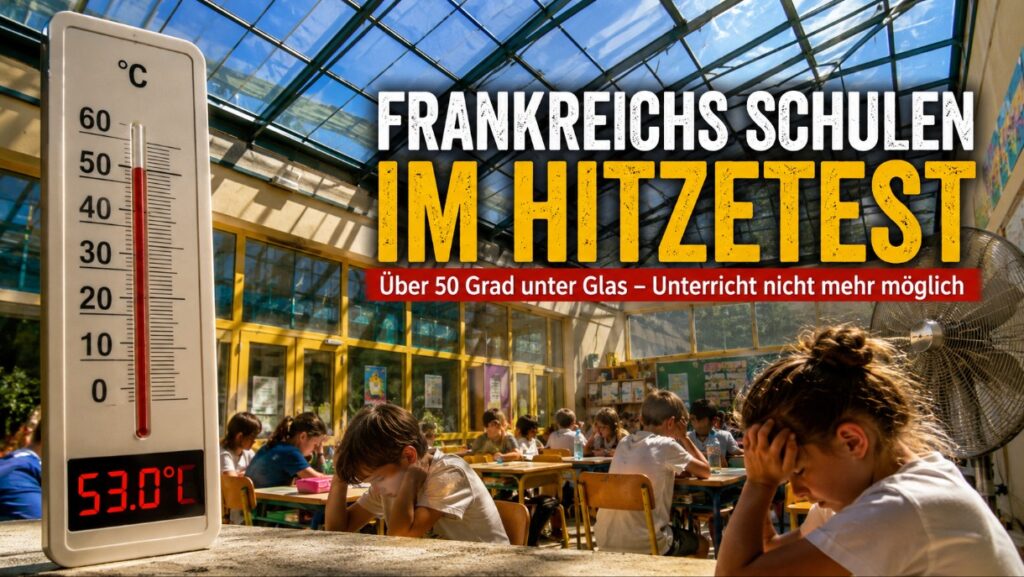
“I call it a tropical greenhouse.” With this sentence, an official described the situation in an elementary school in Soustons, southwestern France. What initially sounded like an exaggeration turned out to be alarmingly accurate. At the Isle-Verte school in Landes, temperatures of more than 50 degrees Celsius were measured under a large glass roof. As a result, the facility closed its doors on Thursday and Friday.

Several children complained of exhaustion, some felt unwell, and others had to vomit. Teaching under such conditions? Hardly imaginable. The school dates back to the 1980s, still partly has simple glazing, and is attended by around 350 students. Ironically, the architectural elements that once stood for light and openness have now turned into a genuine heat trap.

However, the incident in Soustons is much more than a local news story from southwestern France. It symbolizes a development that is affecting the entire country. France is currently experiencing an exceptionally early and unusually intense heat wave. Meteorologists call it a historic weather event for the month of May. Already at the end of May, temperatures were measured that are more reminiscent of midsummer than spring. In Angoulême-La Couronne, the thermometer climbed to 37.8 degrees— a new record for this month.

This brings a question into focus that has long been discussed mainly theoretically: Are France’s public buildings even prepared for the climate of the future?

Many schools were built at a time when extreme heat periods were rare. Large window areas were considered modern, elaborate shading systems often appeared unnecessary. Today, the downside of this construction style is becoming apparent. As soon as the sun shines on glass surfaces for several days unhindered, classrooms and courtyards turn into heat reservoirs.

In the short term, municipalities resort to pragmatic solutions. Windows remain open at night, fans run at full speed, misting systems provide at least some cooling. But such measures often resemble a bandage on an increasingly large wound.

The real challenge lies in structural adaptation. More shade through trees and sun sails, better insulation, natural ventilation, green schoolyards, and fewer sealed surfaces are considered essential components. All this costs money—and not a small amount. Especially smaller communities face the difficult task of adapting their infrastructure to changed climatic conditions while other investments are also pending.

The school in Soustons therefore acts as a warning signal. Children belong to particularly vulnerable groups in extreme heat. When classrooms reach temperatures more reminiscent of a greenhouse than a place of learning, it is no longer about comfort but about health and safety.

What is happening today in Landes could become normal in many places tomorrow. France’s schools are involuntarily becoming an early warning system for climate adaptation. The question is no longer whether public buildings must respond to more frequent heat waves. The crucial question is how quickly this can be achieved.

Andreas M. B.