
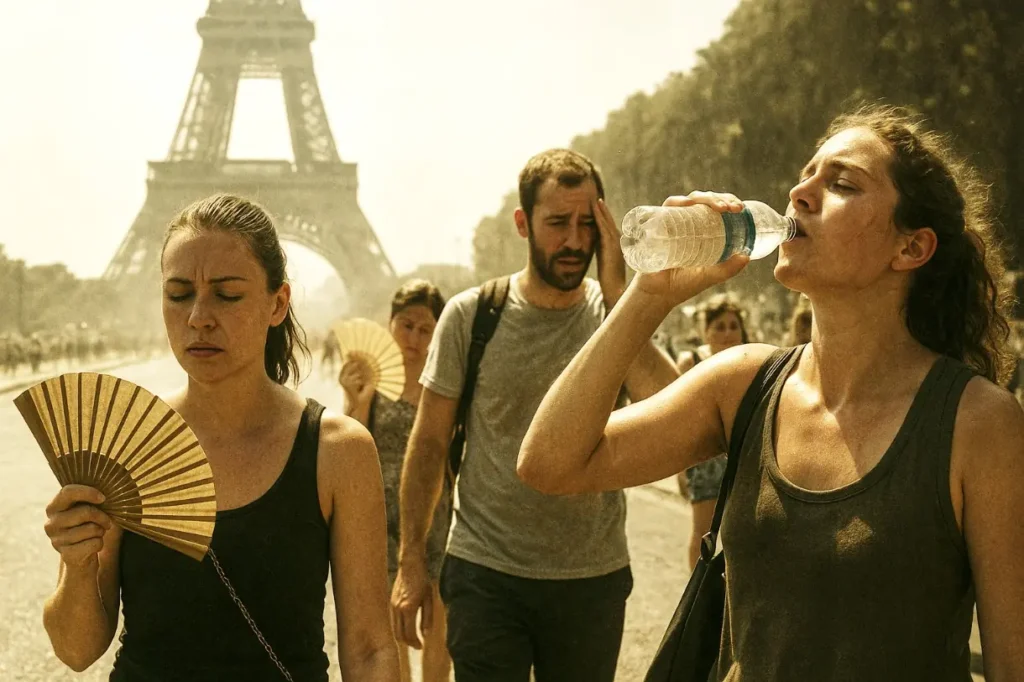
Paris is experiencing days that feel more like the peak of summer than May. Already in the morning, the air above the boulevards is blazing, café guests desperately seek the last shady spots, and even by the Seine it seems there is not a single breeze. «Il fait une chaleur affolante» – an extraordinary heat. This phrase can be heard almost everywhere today in the French capital.
The average temperature of 33.4 degrees indicates that this heat wave at the end of May is exceptional. Just a few years ago, such temperatures were considered a rare anomaly. But now early heat outbreaks occur more and more often and change the boundaries of what is considered normal. For many Parisians, spring has long ceased to feel like spring.
The heat caught a city that is only partially prepared for such conditions. Paris consists of densely built streets, large stone facades, and extensive paved squares. During the day, buildings and roads accumulate large amounts of heat, which is released very slowly at night. Although parks and green areas slightly ease the situation, many residential districts turn into real thermal “accumulators.”
It is especially difficult for people living under the roofs of historic buildings. Temperatures there often significantly exceed official readings. There are far fewer air conditioners in France than in many other countries, so many residents spend hot nights with open windows and fans. But even this often does not bring the desired relief.
The current weather situation also demonstrates how much the discussion about climate change has evolved. Previously, abnormally hot days were seen as a meteorological curiosity. Today, they trigger political debates about urban planning, healthcare, and the adaptation of urban spaces. Paris is already taking measures – creating new green areas, planting additional trees, and opening up public squares. The goal is to reduce the “heat island” effect and increase the city’s resilience to extreme temperatures.
However, these changes are happening more slowly than the climate is changing. Every new temperature record increases pressure on politicians and administration. It is no longer a question of whether cities should adapt to more frequent heat, but the speed of this process has become the main challenge.
So, an extremely hot May day is more than just a weather report. The temperature of 33.4 degrees in Paris symbolizes a future that has already arrived in many places.
Author: C. Hatty