
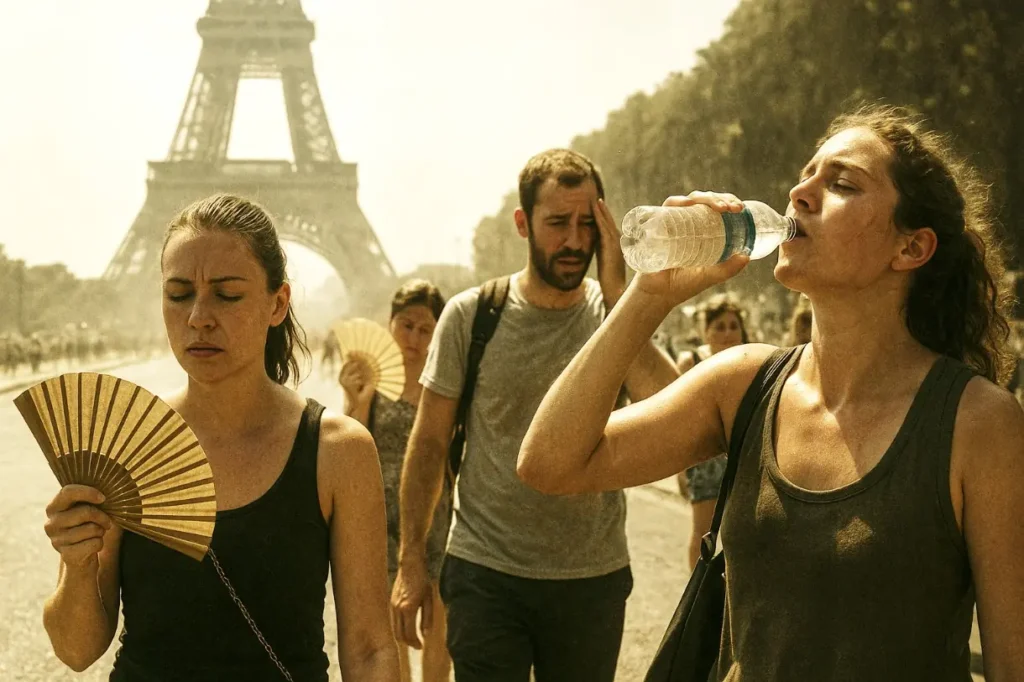
The days experienced in Paris feel more like midsummer rather than May. On the streets, you can see the air heating up as early as the morning, coffee drinkers desperately searching for the last shady spots, and even along the Seine River, there seems to be a lack of any cool breeze. “Il fait une chaleur affolante” — it is insanely hot. This phrase can now be heard in almost every corner of the French capital.
This heatwave has reached 33.4 degrees, a number that seems exceptional at the end of May. A few years ago, such temperatures were still considered a rare exception. Now, early high-temperature events are increasingly frequent, redefining people’s perception of normal temperatures. For many Parisians, the season no longer feels like spring.
This heatwave hits a city unprepared for such climatic conditions. Paris is made up of dense blocks, large stone facades, and asphalt-covered streets. During the day, buildings and streets store a lot of heat, releasing it slowly in the evening and at night. Although parks and green spaces offer some relief, many residential areas have become true heat reservoirs.
The situation is especially difficult for those living under the roofs of historic buildings. Temperatures there often far exceed the official monitored values. Air conditioning in France is far less common than in many other countries, and many residents can only rely on open windows and fans to get through hot nights. However, even so, the much-desired cooling is often not achieved.
The current weather conditions also reflect a profound shift in the discussion about climate change. Days that were once considered meteorological anomalies due to extreme heat are now triggering political debates about urban planning, health protection, and adapting urban spaces. Paris has begun addressing the heat island effect by adding more green spaces, planting more trees, and removing hardened surfaces in public areas, aiming to reduce urban heat islands and enhance the city’s resilience to extreme temperatures.
However, progress is much slower than the pace of climate change. Each new record high temperature increases pressure on policymakers and administrators. The question is no longer whether cities need to adapt to more frequent heat waves, but how and how quickly this adaptation should be achieved.
Therefore, this unusually hot day in May is not just a weather news item. Paris’s 33.4 degrees symbolizes a future that many places have already begun to experience.
Author: C. Hatty