
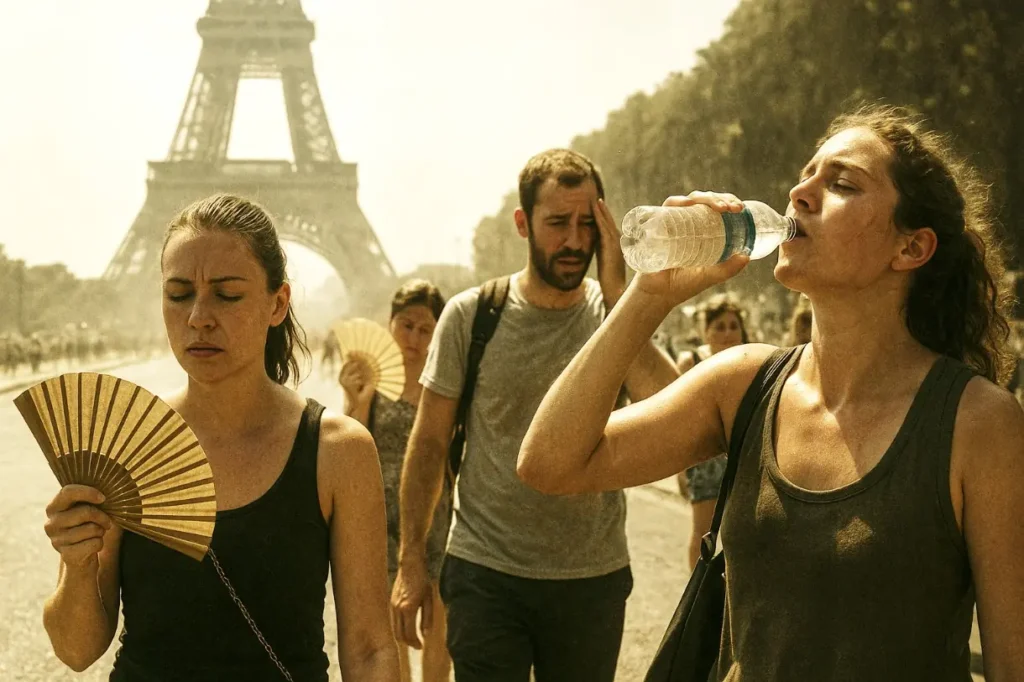
Paris is experiencing days more typical of high summer than of May. Already in the morning, the air above the boulevards flickers, café visitors desperately look for the last shady spots, and even along the Seine, every breeze seems to be missing. „Il fait une chaleur affolante“ – it is insanely hot. This expression is currently heard almost everywhere in the French capital.
With 33.4 degrees, the current heatwave reaches values that seem exceptional for late May. Just a few years ago, such temperatures were considered rare exceptions. Meanwhile, early heat periods are increasing and shifting the boundaries of what is perceived as normal. For many Parisians, the season no longer feels like spring.
The heat affects a city that is only partly prepared for such conditions. Paris consists of densely built streets, large stone façades, and extensive asphalt surfaces. During the day, buildings and streets absorb enormous amounts of heat, which they release only slowly in the evening and night hours. While parks and green areas provide some relief, many residential neighborhoods turn into true heat storage places.
The situation is especially stressful for people who live under the roofs of the historic houses. Temperatures there often rise far above the official measured values. Air conditioning is significantly less common in France than in many other countries, so many residents survive the hot nights only with open windows and fans. Nevertheless, the desired cooling often remains absent.
The current weather situation simultaneously shows how much the discussion about climate change has changed. In the past, exceptionally warm days were considered meteorological curiosities. Nowadays they lead to political debates about urban planning, health protection, and the adaptation of urban spaces. Paris is already responding with new green spaces, additional trees, and removing pavement from public squares. The goal is to reduce the so-called heat island effects and make the city more resilient to extreme temperatures.
But developments are progressing more slowly than changes in the climate. Every new temperature record increases the pressure on politics and administration. The question is no longer whether cities should adapt to more frequent heat waves. The real challenge is how quickly this can be achieved.
Thus, an unusually hot day in May becomes more than just a weather report. The 33.4 degrees in Paris symbolize a future that has already begun in many places.
By C. Hatty