
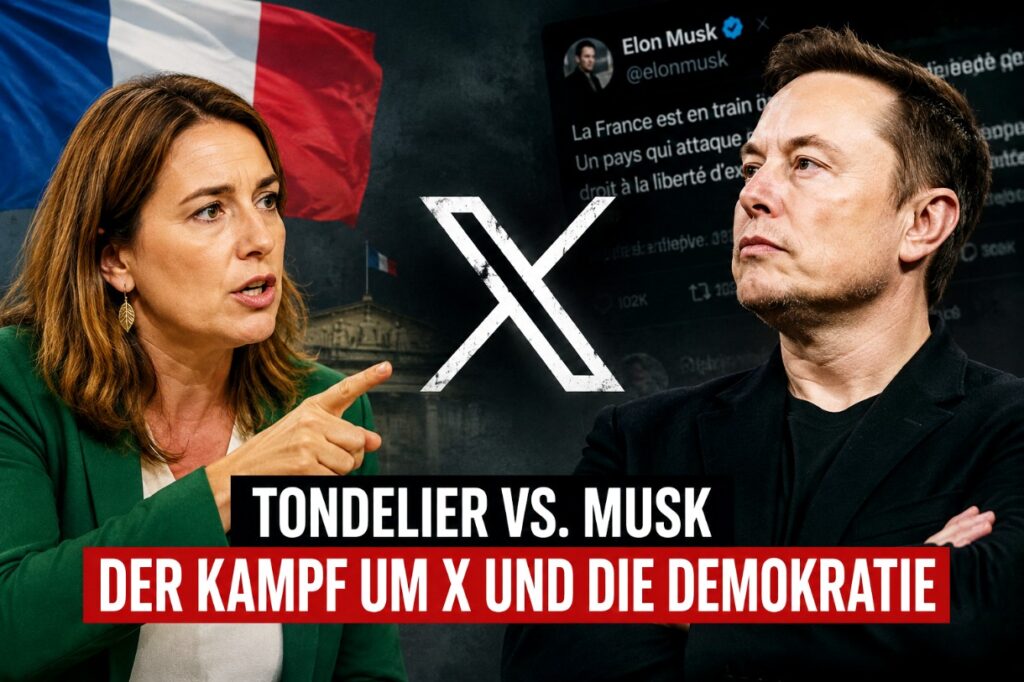
The conflict between French Green Party leader Marine Tondelier and Elon Musk has reached a new level of escalation. After another sharply worded post by the US billionaire on platform X, Tondelier responded with a direct call for the owner of the social network to finally take responsibility for its development. The public exchange is emblematic of the growing tensions between parts of French politics and the entrepreneur, whose influence on public debate in Europe is increasingly viewed critically.
Criticism of algorithms and political influence
Marine Tondelier accuses Elon Musk of no longer running X as a neutral communication platform, but of using it as a tool for political influence. At the center of her criticism is the way recommendation algorithms operate, which in her view favor problematic content and disinformation. She also holds the platform operator responsible for taking more decisive action against hate speech and manipulative content.
Her response came directly after an angry post by Musk on X. Rather than merely addressing the content of his post, she directed her criticism at the entrepreneur’s fundamental responsibility as the platform’s owner and decision-maker. In doing so, she shifted the debate from a personal dispute to a fundamental question of democratic oversight of digital communication spaces.
A consistent position for years
The latest confrontation comes as no surprise. Marine Tondelier has long been among X’s most outspoken critics in French politics. At the beginning of 2025, she had already called on parties of the left-wing opposition to leave the platform collectively. In her assessment, the network under Elon Musk had increasingly developed into a political tool whose operation could distort democratic debate.
Shortly afterward, however, she publicly stated that she herself would remain active on X. Her reasoning was pragmatic: in her view, withdrawing would leave the field to political opponents and radical actors. Instead, she wanted to conduct public discourse where a significant part of political communication takes place. She describes this strategy with the principle of not surrendering the digital space without a fight.
Musk under legal pressure in France
The exchange comes at a time when Elon Musk is also under considerable legal pressure. Investigations into X are underway in France on suspicion of possible violations related to the operation of the platform. The inquiries are examining, among other things, how the network operates and how it handles problematic content.
Musk himself caused additional tension after publicly attacking French investigators and judicial representatives in harsh terms. He had previously failed to comply with a summons from the French judiciary, further intensifying the conflict between the entrepreneur and French authorities.
Support for Marine Le Pen intensifies the conflict
The political dimension of the dispute gained further momentum through Musk’s public support for Marine Le Pen. In the summer of 2026, the entrepreneur described the leader of the Rassemblement National as France’s “last glimmer of hope.” This statement sparked cross-party discussions about possible interference by foreign actors in the French presidential election campaign.
Politicians from the left in particular responded with sharp criticism. Marine Tondelier is among the voices accusing Musk of deliberately using his enormous reach to influence political developments in European democracies. The conflict has therefore long ceased to be limited to questions of platform regulation and now touches on fundamental issues of democratic sovereignty.
Europe struggles to regulate major platforms
The dispute between Tondelier and Musk reflects a broader European development. Since the Digital Services Act (DSA) came into force, the European Union has significantly tightened its oversight of major online platforms. Platform operators must provide more transparency about their algorithms, assess risks to democratic processes, and take more effective action against illegal content.
X is among the companies under particularly close scrutiny from European regulatory authorities. Critics have for years complained about inadequate moderation, the increase in automated disinformation campaigns, and growing political polarization on the platform. Musk, by contrast, regularly defends his approach by citing the protection of freedom of expression and, by his own account, rejects excessive state intervention in digital communication spaces.
These opposing views are increasingly leading to open conflicts between European governments and the entrepreneur.
The dispute between Marine Tondelier and Elon Musk is therefore far more than a personal exchange on a social platform. It highlights the fundamental conflict between privately controlled digital communication spaces and democratic states’ political claim to ensure transparency, the rule of law, and fair public debate. In view of the upcoming political decisions in France, the question of the role of major platforms and their influence on elections and opinion-making is likely to become increasingly important.
Andreas M. Brucker