
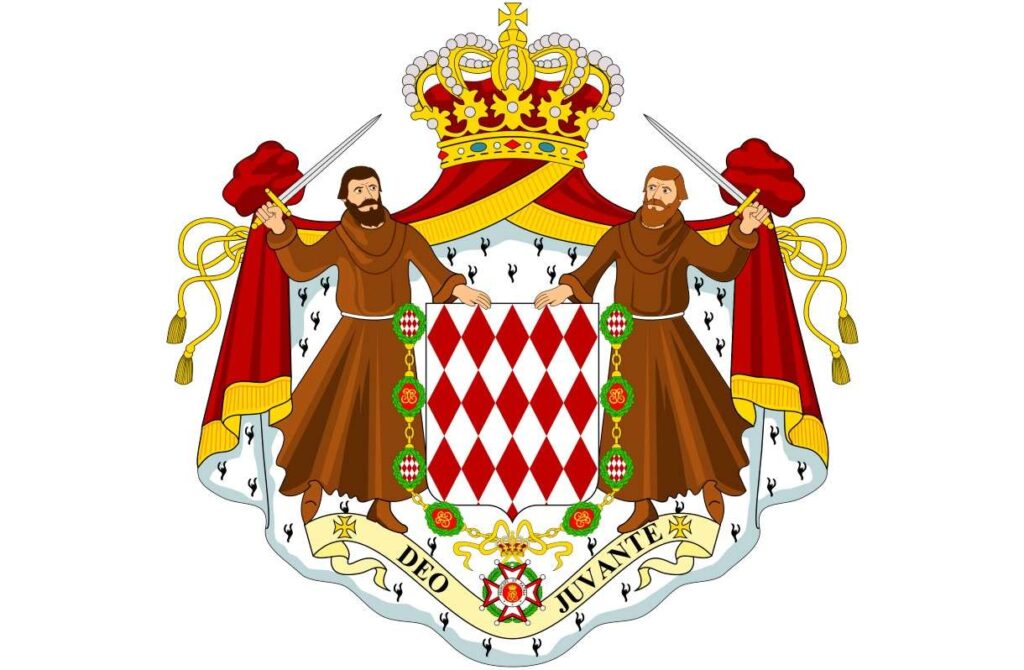
When President Emmanuel Macron travelled to Monaco on 7 June 2025 for a state visit, he followed in rare footsteps. Only two of his predecessors in office have visited the Principality in a comparable protocol setting. Diplomatic relations between Paris and Monaco have traditionally been close – yet official state visits have remained exceptions. This discrepancy points to a special relationship shaped by both proximity and restraint.
Macron’s visit therefore marks not only a political gesture, but also a deliberately sent signal in the context of current geopolitical, economic and environmental challenges. The fact that such a meeting in Monaco is rare makes it all the more significant.
Charles de Gaulle – the first step
In 1960, French general and president Charles de Gaulle was the first president of the Fifth Republic to pay an official visit to the Principality. Although it was not formally a state visit, the occasion was marked with all protocol honours. At the time, de Gaulle met Prince Rainier III – a highly symbolic encounter at a time when France was seeking to redefine its foreign policy role. The diplomatic gesture underscored the interest in stable relations with the closely connected small state on the Côte d’Azur.
Mitterrand’s gesture in 1984
Nearly a quarter of a century passed before a French president once again set foot on Monegasque soil – this time on an official mission. In January 1984, François Mitterrand made the first and, until then, only formal state visit by a French president to Monaco. Alongside the recognition of traditional relations, the focus was also on concrete political issues: including the expansion of Monaco’s maritime sovereign rights and the role of the Principality in international organizations. Mitterrand’s visit strengthened the ties between Paris and the Principality at the highest level and was also seen as a personal acknowledgment of Prince Rainier.
Macron 2025: Between Symbolism and Strategy
Now, more than forty years later, Emmanuel Macron. The timing of his visit has been carefully chosen: immediately before an international UN conference on oceans in Nice, the French president is taking the opportunity to once again place the Principality at the center of European and global agendas. The range of topics is broad: climate protection, marine research, sustainability, and the “blue economy.” The visit has a clearly strategic focus, embedded in the French agenda of an ecologically and technologically oriented foreign policy.
At the same time, the visit provides room for symbolic accents: the honoring of decades of partnership-based cooperation, the commitment to Monaco’s role as a reliable neighbor and partner in European affairs, and the personal dimension of the meeting between the head of state and the princely family. The visit encompasses both historical depth and a contemporary perspective.
Why so rare?
The fact that decades lie between these three state visits is not an expression of diplomatic neglect, but the result of a deliberately discreet approach to shaping relations. Despite its geographical proximity, Monaco is a sovereign state with its own prince, foreign policy, and interests. France, in turn, has always taken care not to overshadow this independence through overly frequent or intrusive signals. The institutional framework—regulated, for example, by the treaties of 1918 and 2002 and the EU partnership agreement with Monaco—allows for close coordination even without spectacular gestures.
State visits are subject to a special protocol and are always symbolic acts. The fact that France has chosen this form of recognition only rarely gives the few occasions all the more weight. It is the discreet dignity that characterizes Franco-Monegasque relations—a diplomatic balance of closeness and respect.
New Role Distributions in Europe
Macron’s trip to Monaco also takes place against the backdrop of a changing geopolitical landscape. The war in Ukraine, growing uncertainties in the Mediterranean region, economic challenges, and the search for European answers to global problems—all of this calls for new alliances, even on a smaller scale. Monaco, with its expertise in maritime affairs, its role as a financial center, and its political stability, can be seen as a complementary actor.
In this context, the visit does not seem like a courtly ritual, but rather like a deliberate inclusion of the Principality in the priority list of French diplomacy. It is a sign that even symbolically small gestures can have strategic relevance in today’s international order.
With his visit, the French President continues a tradition that is rare enough to attract attention—and significant enough to have an impact. Monaco thus remains not only an elegant neighbor, but also a discreet partner amid a turbulent world order.
By P. Tiko