
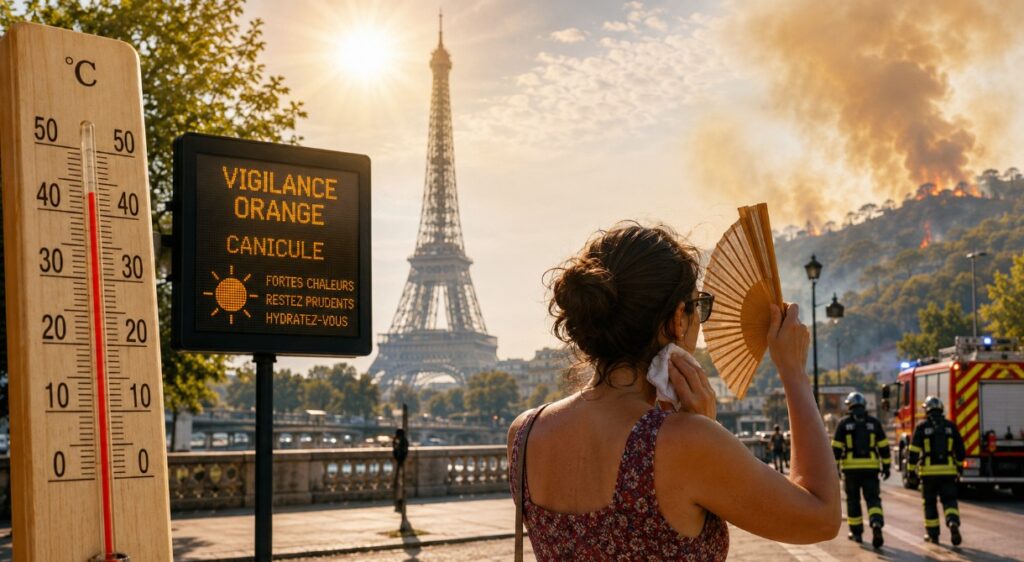
France is experiencing one of those moments when multiple crises simultaneously dominate the public debate. The extraordinary heat wave, which has affected much of the country, not only marks the weather reports. It raises questions about health, infrastructure, climate adaptation, and the political capacity of the state to act. At the same time, environmental problems, wildfire risks, and the first strategic battles ahead of the 2027 presidential elections are at the center of attention.
The heat wave dominates current news
The predominant topic remains the unusually early and intense heat period. In Paris and many other regions, high alerts are in effect. Temperatures of up to 38 or 39 degrees Celsius at the end of May are considered exceptional even by French standards.
The discussion is no longer limited to weather records. At the center is the question of whether France is sufficiently prepared for increasingly frequent extreme climate events. The government has convened an interministerial crisis meeting to coordinate measures for the upcoming summer. Among the priorities are water reserves, wildfire prevention, health protection, and the resilience of critical infrastructure.
The opposition is using the situation to criticize the government’s lack of foresight. Thus, the heat is increasingly becoming a political issue.
Schools as a Symbol of Lack of Adaptation
Currently, schools are receiving special attention. In numerous regions, the media report on overheated classrooms and insufficient cooling options. At the national level, there is discussion about how educational institutions should respond to a changing climate.
A symbol of this debate has become a primary school in the Landes department, where temperatures above 50 degrees have been measured under a glass roof. Parts of the facility had to be temporarily closed.
For many commentators, this is more than an isolated case. The situation shows that numerous public buildings were still designed for the climatic conditions of the last century. Schools, hospitals, and administrative buildings are increasingly the focus of a broader debate about the adaptability of the French state.
Air Pollution Worsens Health Risks
Alongside the heat, a higher concentration of ozone, especially in the Île-de-France region, is causing concern. Authorities have implemented various measures, including traffic restrictions and reduced speed limits.
The combination of high temperatures and poor air quality represents a special burden for the elderly, children, and people with respiratory illnesses. Health experts warn of a situation in which climate and health risks reinforce each other.
The media increasingly point out that heat periods cannot be seen only as meteorological phenomena. These are complex crisis situations with impacts on health, mobility, and public safety.
Early Start to the Wildfire Season
Another major issue is the concern about forest and vegetation fires. In particular, authorities in the south of the country are monitoring developments with growing attention. Drought, high temperatures, and regional winds significantly increase the risk, even before the official start of summer.
Experts point out that the wildfire season has noticeably lengthened in recent years. Events that previously mainly took place in July or August are now already occurring in May. This poses new challenges for firefighters and civil protection.
The debate highlights how the effects of climate change are increasingly integrated into the daily lives of state institutions.
First Positioning Battles Before the 2027 Presidential Elections
In addition to climate and social challenges, the focus is increasingly shifting to the country’s political future. Discussions about the 2027 presidential elections are gaining momentum.
Special attention is given to former Prime Minister Gabriel Attal’s announcement to run to succeed President Emmanuel Macron. His positioning is seen as an important step in the competition for leadership of the political center.
At the same time, various editorials address fundamental questions for the future: How should France modernize its economy? How to ensure energy supply? What are the responses to social tensions and the challenges of climate change?
The current heat wave acts like a magnifying glass: many structural problems debated for years become especially evident due to the extreme weather conditions.
At the end of May 2026, France finds itself in a situation where climatic events, environmental issues, and political debates are increasingly intertwined. The extraordinary heat is no longer just a meteorological phenomenon, but a test for infrastructure, the healthcare system, and state crisis prevention. Consequently, it shapes the public discussion far beyond weather reports and already defines the agenda for the coming summer.